

When you think of it, life is an assembly of creative mistakes.
| Roger Rosenblatt, I Ain't Dead Yet
…
Embrace Mistakes or Abandon Hope
When I read Rosenblatt’s recent column, I was reminded of the insights offered by James Bareham in The essential art of making mistakes:
One of the best lessons I learned early on in my creative career was how important it was to not worry about making mistakes; better to embrace them. Not just from the perspective of trial and error to improve my skill set, but sometimes the errors I made were better than any of the original ideas in my head. Making mistakes is being creative.
He clarifies later in the piece:
Making mistakes is my definition of learning, an intrinsic part of the creative process.
What we are wired to do is to learn, and underlying creativity is learning by making mistakes: trying experiments which only once in a while work out. Being creative requires accepting that we can’t know in advance what will work and what won’t. And one part of creativity is to sift out the good mistakes, and use them, like a starter for sourdough.
Bareham intended his piece as a polemic against AI as being inherently uncreative:
GenAI isn’t a genius author channeling their neon imagination through psychedelics; it’s a statistician with a spreadsheet. GenAI is designed to fit the brief to the letter, and any mistakes aren’t “happy accidents” (to borrow the classic Bob Ross phrase) so much as they are muddled, discomforting negative side effects that have become something of a watermark for these generative models. I shouldn’t be surprised that everything that comes out is so metaphorically beige.
The problem with AI is that it makes too many bad mistakes and not good ones.
And when you are working at being creative, a ‘statistician with a spreadsheet’ might not be the best collaborator or muse.
What we are wired to do is to learn, and underlying creativity is learning by making mistakes: trying experiments which only once in a while work out.
Remember that thinking creatively leads to hope, as Solitaire Townsend pointed out:
This research was shared in 2023 and has played on my mind ever since. Based on a global survey of nearly 2,300 people, the behavioural economists at BEworks discovered that creative thinking isn’t just about making art or telling stories, it’s a way of seeing and shaping the world that naturally leads to hope and action.
In fact, creative people in the study were more likely to believe in humanity’s ability to tackle the climate crisis, to feel personally motivated, and to put effort into sustainable behaviors.
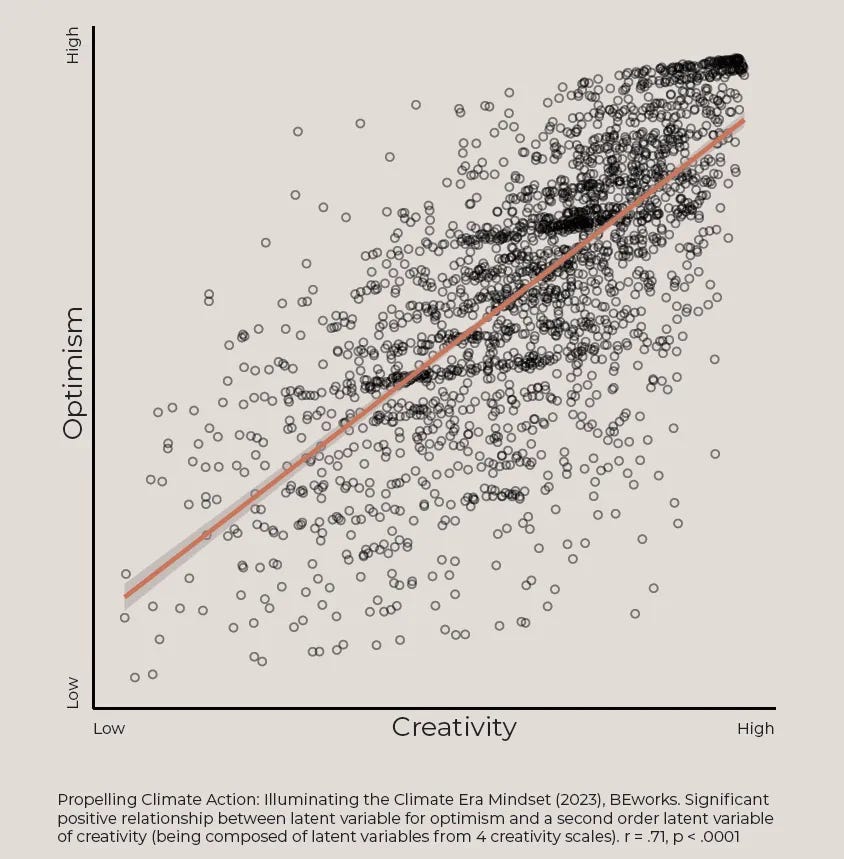
So, don’t outsource your creativity to AI chatbots: you may also inadvertently outsource your hope.
I’d really like readers to sign up for a paid annual subscription, so for the present time, I have dropped the annual subscription to $30. Note that I’ve also raised the monthly subscription to $10 from $6. Give annual a try. The biggest value is years of posts behind the paywall, and of course, seeing new posts in their entirety.
Or you can just buy me a coffee.
Week in Review
This last week I published a few interesting bits:
First, Convince Yourself

Tech is, to put it bluntly, full of people lying to themselves. As countless cult leaders, multilevel marketing recruits, and CrossFit coaches know, one powerful way to convince people that following you will change their life is to first convince yourself. | Christopher Mims

..
I had promised to post something about the renewed interest — and backlash — about ‘Girl Bosses’: it’s in the works.
…
Real income growth down.
Mike Zaccardi shared this dismal news from Goldman Sachs:
Real personal income per worker excluding transfers declined 0.6% over the last year, a pace rarely seen outside of recession.
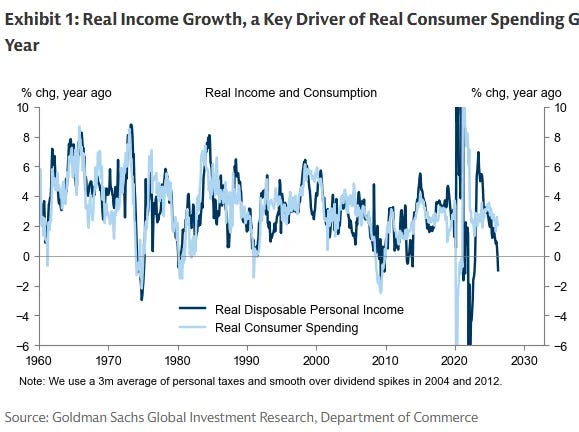
Uh-oh.
…
Capital beating Labor.
Via Kevin J. Delaney [emphasis mine]:
In the first quarter of 2026, labor’s share of gross domestic income fell to 51%, the lowest level on record, according to a government report. Since 2019, wages have grown by 3% when adjusting for inflation, while corporate profits have increased by 50%.
Note that the Goldman Sachs numbers real income growth dropped by 0.6% last year.
…
Hiring is hard to do.
Richard Thaler, the Nobel laureate in economics, shared this insight on hiring [emphasis mine]:
Hiring decisions are difficult in general, and getting it right becomes harder as you move up the organizational hierarchy. The most reliable predictions about job performance come from what are essentially tests. If you are hiring a chef, ask her to cook something. Predicting whether she can also keep everyone in a large restaurant working together is harder. What test can you give to measure that ability?
In the absence of a suitable proxy for observing someone doing the actual job, many employers resort to some sort of interview. This is problematic, because unstructured interviews provide surprisingly little useful information about future job performance.
One illustration of how hard it is to pick and evaluate successful leaders comes from the dismal record of hiring head coaches in major sports. This past year, nine of the 32 National Football League teams fired their head coaches, and a 10th resigned. All these coaches had gone through rigorous selection processes and had track records. Yet the turnover rate was more than 30 percent in a single year.
