

Every fall is an excuse to rise.
| Gia Kourlas
…
Resilience v. Doom Trolling
I think this is the first time I have featured a quote from a dance critic, a field perhaps uniquely suited to discuss the fall-and-rise dynamic inherent in mastery and confronting challenges: being resilient in the face of disruption and uncertainty.
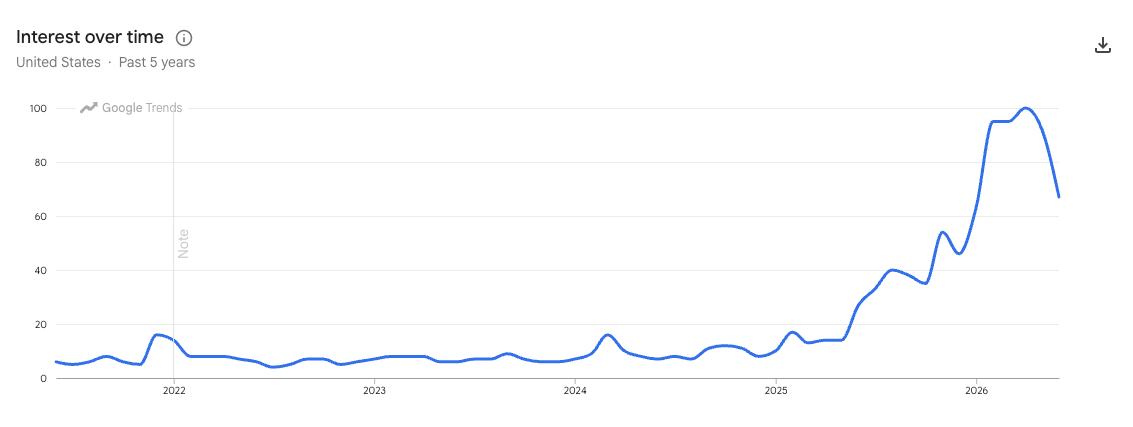
Interest in resilience in the business context has been steadily growing in recent years, peaking earlier this year:
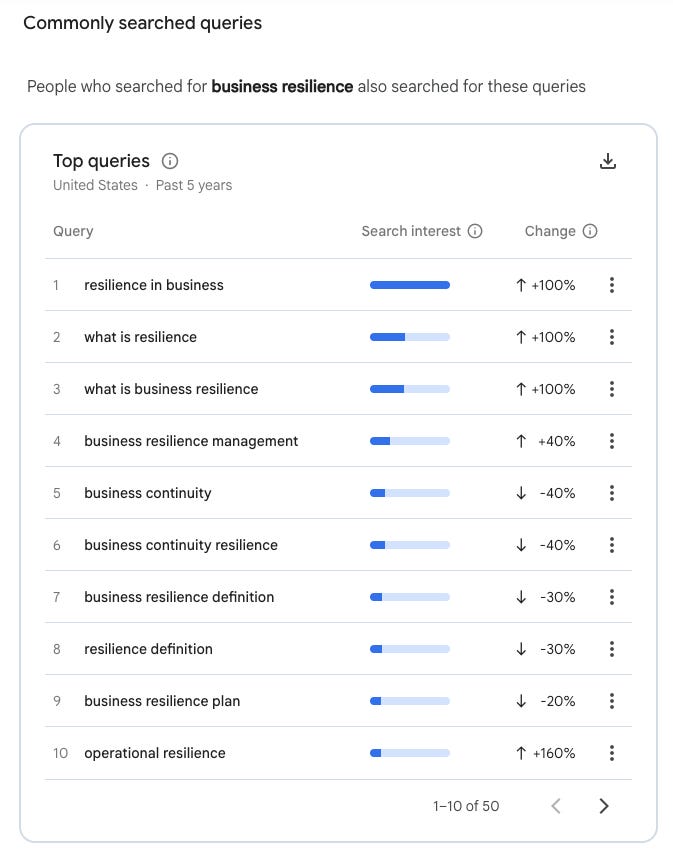
Looking at the queries involved, we see very high growth on all sorts of facets of resilience. Note the spike in operational resilience:
As I wrote in 2023,
Put into everyday terms, resilient systems are designed with as many points of failure in mind as possible and organized to withstand adverse circumstances. And, since a system isn’t self-aware, each is a reflection of the thinking of their designers who must consider the adversities the system confronts. Those who build resilient systems are pessimists. But being a pessimist isn’t enough: you have to build pessimistic systems, as well.
And organizational resilience adds the human factor. Not just as system designers, but as agents in the system:
Organizational resilience is even more complex, since organizations involve the intersection of the human (like social networks, partnerships, governments, markets and customers) and artificial (computer systems, software systems, facilities, and information).
One clue to organizational resilience is the root word for resilience. It’s based on the word salire, which means to jump (while resalire means to jump back).
Unlike systems, the human parts of organizations can be self-aware. And in recent decades we’ve learned that organizations that seek to become more resilient work to incorporate certain capabilities: they create emergent organizations, where decision-making is distributed, groups and individuals have high degrees of autonomy to create and execute plans, they invest in high degrees of learning and well-being, and where leadership — like decision-making — is distributed across the organization.
As in system resilience, resilient organizations continue to carry out their mission in the face of adversity, but along with jumping back they can also jump ahead: they can adapt and improve when confronted with challenges. In this way, those who work to shape resilient organizations are optimistic: they plan for the worst, but they believe they can overcome it, through the capabilities they have developed organizationally.
I suspect that the spike in interest in organizational/business resilience is driven by increased uncertainty: climate change and its increased risks, political turmoil, economic disruption, and — perhaps most central — the emergence of AI.
In years gone by, I would argue that personal resilience requires us to embrace uncertainty:
Those who design resilient systems are pessimists, and those who shape resilient organizations are optimists, but we as individuals must rely on hope, ‘the embrace of the unknown and unknowable’1. Resilience is, in the final analysis, to reach beyond certainty to our capacity for hope, and the acceptance of uncertainty as a counter to adversity.
I remain aligned with hopecore, but I confess I see mounting uncertainty and risk with growing concern.
Consider the recent essay by Cal Newport, Dear A.I. Companies: The Doom Trolling Needs to Stop, about the efforts of AI companies to scare the shit out of everybody, unlike earlier prophets of tech:
Technology revolutions in the digital age are typically accompanied by optimism and excitement — recall Steve Jobs basking in thunderous applause as he introduced the iPhone in 2007. The major A.I. companies seem to be following a darker and weirder strategy: They like to solemnly describe the harms that their models will cause, while acting helpless to do anything about it.
He singles out statements by Anthropic and OpenAI, and gives a name to this mirror-world, downer, prophetic forecasting:
Let’s call this strategy “doom trolling.” It’s one of the defining and most arresting properties of our current A.I. moment, and I’ve come to believe that it’s morally indefensible.
There are really only two options for the intentions of A.I. companies when they engage in doom trolling. The first is that they actually believe that the systems they’re building have a nontrivial chance of producing massively disruptive events — from destroying the economy in the best case to wiping out our species in the worst. If this were true, every reasonable ethical system would argue that there is only one acceptable response: to immediately stop working on any product that might accelerate such a future, and lobby with all of your resources to help force other A.I. companies to do the same. From a moral perspective, any other reaction would be monstrous.
The second option is that these A.I. companies aren’t really concerned about these risks, and that they’re injecting these doses of unresolvable doom for other reasons. They might want to amplify the perceived power of their technology at a time when they’re setting up their initial public offerings. Or they hope their performative reports and somber interviews will help them compete for top engineering talent coming from a Silicon Valley culture that’s steeped in this type of doomerism.
He goes on at length, handicapping why these AI firms might want to carpet-bomb the popular zeitgeist like this. He then ties the last ligature in his argument:
As a computer scientist and a digital ethicist, I’m both optimistic about the possibilities of A.I. and confounded by the terrifying and grim way that current technology leaders insist on talking about it. This could have been a period of hopeful innovation, but instead our emotions are being manipulated by Silicon Valley’s self-serving and morally untenable addiction to doom trolling. This communication strategy has to stop. The harm it’s causing to the public’s mental health has arguably outweighed the benefits that A.I. has so far delivered.
And possibly leading business leaders to search for ways to increase resilience in a world undergoing an earthquake, disturbing the foundations of the economy, business, and society. I am uncertain how we can build resilience when the ground is shaking so much.
I’d really like readers to sign up for a paid annual subscription, so for the present time, I have dropped the annual subscription to $30. Note that I’ve also raised the monthly subscription to $10 from $6. Give annual a try. The biggest value is years of posts behind the paywall, and of course, seeing new posts in their entirety. I rely on your support.
Elsewhen
Constructive Uncertainty
A few years ago, I wrote about constructive uncertainty, a skill which is relevant to the discussion above, but from a different angle:
One of the paradoxes that reveals a great deal about making sense of the world is the tension between uncertainty and action. On one hand, we are often told that being effective relies on decisive reasoning, and quickly choosing a course to pursue even with incomplete information. However, opting to eliminate the discomfort of an uncertain or ambiguous situation by making a quick decision can often backfire, and in predictable ways.
When I recall events in my life where my decisions went sideways, they were often hurried, and driven more by my desire to end a period of stress and insecurity than actually determining what could go wrong… before finding out the hard way.
And the world is more complex than ever, more ambiguous, less predictable. As Margaret Wheatley points out in Willing to Be Disturbed,
we live in a complex world, we often don’t know what’s going on, and we won’t be able to understand its complexity unless we spend more time in not knowing.
Wheatley’s formulation, that we need to spend more time in not knowing, is a first step in deconstructing uncertainty. One aspect of contemporary emotional maturity is to accept the state of not knowing. Not having a quick answer for complex questions. Being willing to admit being confused by new situations, or rapid changes in the context we are living and working in. Remaining open to spending more time listening to alternative viewpoints before shutting down gathering inputs. These are all aspects of constructive uncertainty, a term I learned from Howard Ross: ‘learning to slow down decision-making’.
You might want to read the whole thing. I made constructive uncertainty open to all.
