

Belief in the future is the unspoken baseline of the social contract.
…
Blaustein’s assertion comes as a response to what he considers the ‘institutional nihilism’ of Trump’s administration: an unconcern for posterity, or perhaps any span of time beyond the current news cycle. But people want more surety, more certainty, than feckless and unconstrained members of Trump’s cabal — and the man himself — are offering up.
This jettisoning of an articulated vision of the future is emblematic of Trump and matched by the rejection of the factual past and MAGA’s nostalgia for a time that never existed.
Part of that syndrome is Luuk van Middelaar’s politique événementielle — a ‘politics of events’ — where the timeframe of politics is drastically compressed. I first learned of this idea from Anton Jäger, who also quotes Ivan Krastev’s Trump’s revolutionary sense of time is changing politics 1[emphasis mine]:
The essence of the Trumpian revolution is... the implosion of time itself. Trump shows no interest in anything that has happened before him and is unconcerned with what will transpire after him. He acts as if history must come to a screeching halt when he exits the stage. This helps explain why he believes that all wars should be stopped in weeks, if not days. Trump’s experience of time is central to his political behaviour. The president doesn’t think in terms of long-term strategy but rather in terms of deadlines. He’s like a director who does not shoot films but only trailers for movies that will never be made.... Trump’s revolutionary sense of time, in the absence of any revolutionary project, is a source of both strength and vulnerability. He weaponizes the public’s growing sense of urgency. The existential anxiety that ‘there is no time’ forestalls the question: ‘Time for what?’
And Trump is not alone in this time implosion. There are echoes of this same disbelief in the future, and a self-aware rejection of agency, in the corporate sphere these days. Consider the unbridled investments in data centers and AI buildout as the world faces mounting challenges, like climate change, growing economic inequality, and geopolitical polarization.
This lack of concern for a way forward we can all push for, and dream of, is exactly the nihilism Blaustein highlighted. I am reminded of the line from Akira, by Katsuhiro Otomo:
There ought to be a future we can choose. It’s up to us to find it.
We can’t expect establishment politicians of any stripe or party, or the corporate overlords, to provide us a future to work toward or believe in. They have fallen prey to nihilism, anti-humanism, and what would be despair if they ever took time to reflect.
Short Takes
Hamilton Nolan on Wealth Taxes
Californians will see a wealth tax proposed on the ballot in November, and one of our most astute observers, Hamilton Nolan, strongly supports it and related efforts. Here’s why [emphasis mine]:
The most important political task in America is clawing back the vast fortunes (and the vast power they create) of the ultra-rich. This task is more fundamental than all of the other important things—climate change, immigration, health care, you name it—because if we do not do it, then the path to democratic achievement of all of the other things will be permanently foreclosed. The second Trump administration is a preview of the model of governance that comes next: An indulgent, hollow-minded elected leader who gives billionaires and their companies carte blanche in exchange for their corrupt support. This is fascism. While most of us pay attention to the various abuses of the regime, the oligarchs themselves don’t care very much. What they want is for their own interests to sit on top of those of the public and the government, and for democracy to dissipate under the pressure of corporate control. If we do not do something about the fact that a handful of centibillionaires are indistinguishable from the White House now, this is our future.
The level of billionaire wealth should be seen straightforwardly as a problem to be attacked. It is dangerous. It upsets, to a fatal degree, the balance of power that is necessary for any democratic society to exist. At a time when the 15 richest Americans are worth a combined $3.6 trillion—twice the gross domestic product of Australia, equivalent to the GDP of the entire Arab world—we are already in emergency territory. These people may be very nice but they have too much money. We need to take a lot of it away from them, soon, or no more democracy. It’s pretty simple.
In the long term, it is possible to strengthen the power of organized labor to allow working people to capture a bigger share of national income and thereby tilt the playing field back towards sanity. That will take decades, if indeed we ever accomplish it. We can’t afford to wait that long. (More to the point, billionaires will continue to use their own power to ensure that we never get far down that path anyhow.) In the near term, taxes and regulations are a faster and more direct way to rein in extreme fortunes. “Take away money from billionaires” is a necessary and appropriate policy goal and there is no need to couch it in fuzzy platitudes about fairness and free enterprise. It is just plain fatally destabilizing to American democracy for so few people to have so much money. Though I do not support the mass imprisonment of billionaires due to my belief in universal human rights, there is no doubt that imprisoning our nation’s billionaires and confiscating and redistributing their wealth would be a net positive for humanity by utilitarian standards.
A future that we choose will require debillionairing our economy and governance.
…
Mark D. Levine on AI in NYC
Mark D. Levine, the Comptroller of New York City, is keeping an eye on AI for the city:
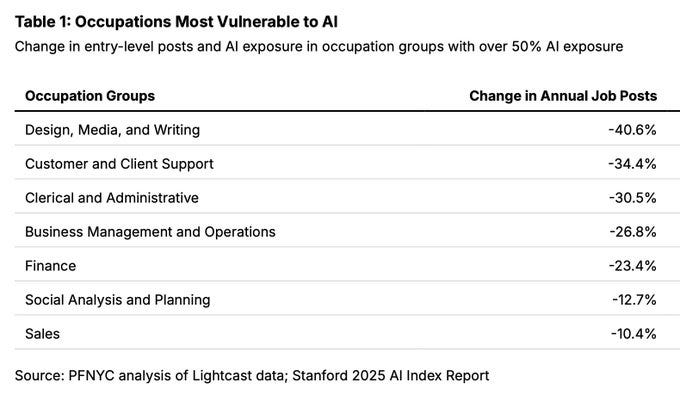
Early warning signs are mounting that AI is already impacting the job market in NYC.
New data just out show entry-level job postings in the city are way down in the careers most exposed to AI. Below chart shows change in NYC since 2022:
This is coming fast and we are doing almost nothing about it.
We have got to slow the AI wave, and as Hamilton Nolan (in the previous section) notes unions are too weak and small to mount an effective holding action. We’ll need bottom-up mass organizing to halt the displacement of millions as corporations enclose work. We need a #NoKings sort of movement to curtail work enclosure, just like the grassroots pushback on data centers.
Recently
I don’t usually dedicate a section of the newsletter to updates on workfutures.io, but some recent milestones are worth noting.
Over the past few months, I've shifted my focus at workfutures.io to the politics and economics of work. One result? Subscriptions, including paid subscriptions, are up:
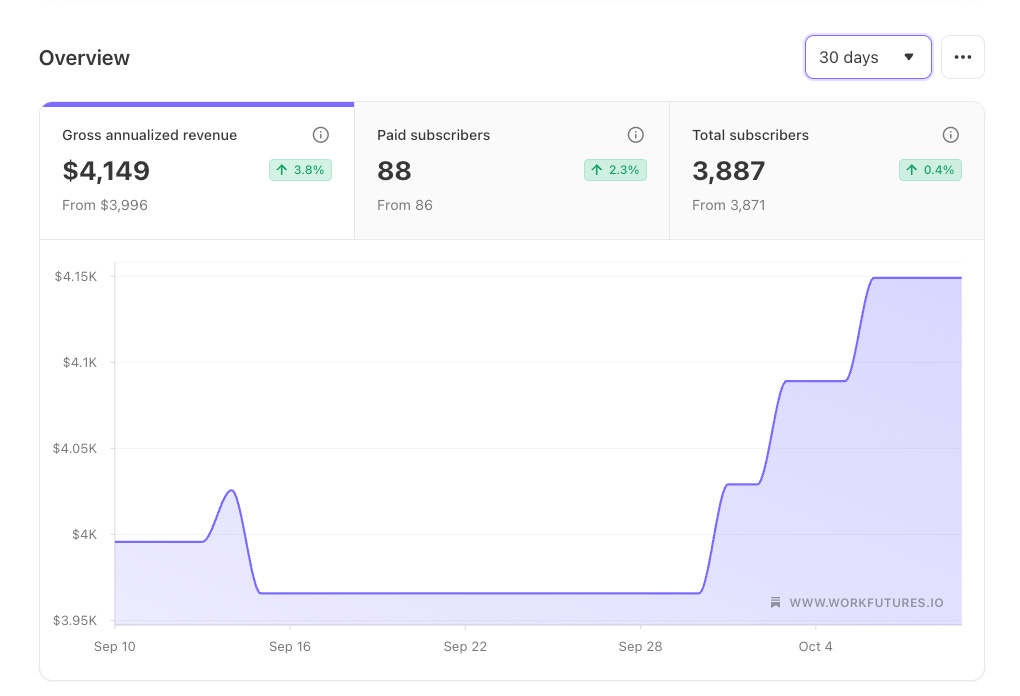
So, I guess it’s working; maybe I am finding a community more interested in the place of work at the center of a range of critical issues, rather than inward-focused reporting on how companies are seeking to eke out the next slice of productivity, or how to maintain wellbeing in workplaces that could care less.
Apropos of that, a recent post (from September 2026) —
The Job of Thinking People

In such a world of conflict, a world of victims and executioners, it is the job of thinking people, not to be on the side of the executioners.
— has climbed into the top four posts on workfutures. Take a look if you haven’t already.
Please support my work with a paid subscription, which I have made as marginal as possible. If you can’t afford yet another subscription, please help me by restacking this post to spread the word.
