
The way to crush the bourgeoisie is to grind them between the millstones of taxation and inflation.
| Vladimir Lenin
…
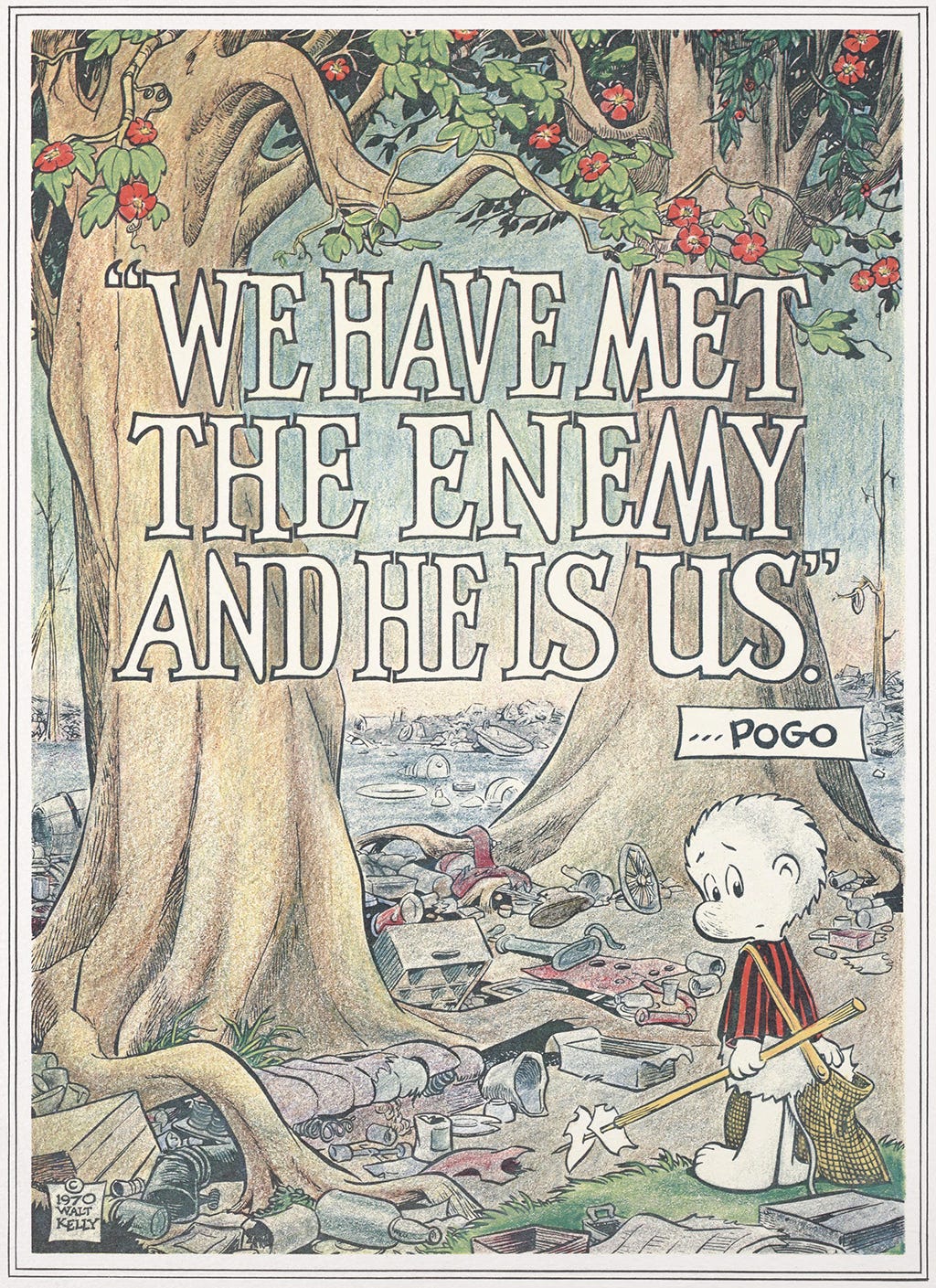
Lenin’s words ring true in our current economic straits. Trump’s tariffs are a tax on everyone in the US, and inflation continues to rise as his wars grind on. But it isn’t the communists that are doing it to us. Walt Kelly, the creator of Pogo, wrote:
We have met the enemy, and he is us.
Capitalism.edu
Chris Marquis has written1 a full-throated (and overly long) takedown of the modern business school. Marquis has a long history as a business school professor with over 20 years at Harvard, Cornell, and Cambridge.
I’ve come to realize that business schools don’t just reflect our economic system — they actively manufacture its priorities and normalize its harms, training the future leaders who will design and defend the structures driving our overlapping global crises. Tinkering at the margins with a class on corporate responsibility or ethics is not going to help. We don’t need to “fix” business schools. We need to abolish them.
Marquis lays out a fatal error of business schools: they are founded on anecdotal knowledge. Unlike hard science — like medicine, engineering, mathematics, or physics — business schools sidestep the scientific method of testing hypotheses and verifying theories through experimentation and logic. They also differ from law, which relies largely on deeply argued case law and the precedents set by jurisprudence.
As he frames it [emphasis mine]:
Business schools have always struggled to justify their place in the university. A medical school’s core justification is health, and a law school’s is justice — undisputed public goods. Business schools are organized explicitly around a private good: the pursuit of profit. The American sociologist Thorstein Veblen identified this tension a century ago, criticizing university schools focused on commerce because they “need imply nothing in the way of serviceability to the common good.”
I have summed up this system as ‘Capitalism.edu’.
Those who founded business schools adopted the case study model from medicine and law departments, but it has been skewed into propaganda, since the companies featured in the case studies have massive influence on their preparation and presentation. These case studies also focus on companies deemed winners, not losers.
Before Enron’s fraud was exposed, its business model was presented in admiring terms by at least five H.B.S. case studies. More damning still, the strategies that later led to its collapse — its asset-light model, its trading platform — were portrayed as innovations. Questions about deregulated energy markets, revolving-door oversight and opaque accounting went unasked.
[…]
Real organizations don’t move in clearly delineated phases toward a decision point, but business school teaching materials often do — compressing timelines, dropping messy subplots and smoothing over contradictions to produce clean narrative arcs and satisfying problems to debate.
[…]
The result is a curriculum built around false narratives. Some of the most celebrated ideas in management have not been the ones that survived peer review or replication, but the ones that could be turned into TED Talks, consulting frameworks or airport best sellers. Faculty members are rewarded not for knowledge but for performance — selling a big idea with a memorable label that promises “success” or “disruption.”
I recommend Jill Lepore ferocious disemboweling of Clay Christensen in The Disruption Machine2, the father of the ‘disruption’ meme. He is a perfect example of the prominent business guru — in the mold of Michael Porter — whose models don’t hold up to real scrutiny. She wrote:
The idea of innovation is the idea of progress stripped of the aspirations of the Enlightenment, scrubbed clean of the horrors of the twentieth century, and relieved of its critics. Disruptive innovation goes further, holding out the hope of salvation against the very damnation it describes: disrupt, and you will be saved.
But Marquis is not just arguing that business schools offer bogus theories of winning at business, or how best to climb the greasy pole into the professional-managerial class. It’s not just that they advance the incantations of charlatans. They are grounded in the pathology of ‘stakeholder capitalism’, which makes their work schizophrenic:
Business schools have a divided mission: They seek to legitimize an economic system focused on private gain while also developing guardrails to tame it. They found a remarkable way to manage this tension: the “win-win” story in which the conflict between private gain and public good simply evaporates.
[…]
These aspirations are built on the delusional but widely accepted idea of “stakeholder capitalism”: that companies can produce climate stability, fair wages, healthy communities and functioning democracies while also delivering profits. Executives promise that technology will solve our environmental problems; voluntary measurement systems are offered as appropriate alternatives to public accountability; ethics is rebranded as competitive advantage rather than moral obligation.
In the midst of the AI explosion, we see the same panacea of self-regulation being advanced by OpenAI, Anthropic, etc., and the federal government, while we slide down the slippery slope into yet another crisis.
At the outset, Marquis stated that business schools can’t be fixed: they need to be torn down. But, unsurprisingly, he does envision an alternative near the end of his essay. He clarifies his thesis first:
Business schools are not malfunctioning institutions; they are highly efficient machines doing exactly what they were designed to do.
He then highlights the efforts of Stuart Hart at the University of Vermont who started a program centered on sustainable business:
In this program, sustainability is not a lone elective but runs through the whole curriculum, and students spend the summer embedded in a mission-driven company.
Which seems like only a mild tweaking of business schools, after his impassioned buildup.
And then a hand wave for another lightly sketched idea:
What would that clean-sheet logic mean across an entire university? One starting point is the organization theorist Martin Parker’s call to create “schools for organizing” rather than schools for business, centered on how humans coordinate for shared ends.
Sounds like Elinor Ostrom’s economics work on what I have come to call commonsism: how people can come together to protect and sustain shared resources, and often as a counter to market-based (capitalist) approaches.
Marquis closes with an appeal to not forget the students:
Many of my students arrive on campus wanting to work on the crises that our economic system has created. What they lack is an institution that is worthy of their better impulses.
Dethroning the MBA might be the way to avoid losing those who aspire to higher goals, instead of being swept up in the paper chase of aspiring capitalists.
Relationslipping
Gretchen Gavett introduces3 us to a new term: relationslipping:
When people begin turning to AI more often than their coworkers for help, their trust in each other and ability to coordinate diminishes.
[…]
In worst case scenarios, they argue, “a worker would rather receive a worse answer from AI than a better one from a teammate.”
This term is an outgrowth of research from BetterUp Labs and Stanford University, who offer ways to counter this slippage:
Some steps leaders can take to “continue on [the] path of technological exploration, while maintaining the strong connective tissue required for teamwork”:
Increase asynchronous communication.
Build psychological safety.
Rethink teamwork with new team norms and aligned incentives.
Use AI to prepare for conversations instead of replacing them.
Or, of course, to simply say no to AI.
Please support my work with a paid subscription, which I have made as marginal as possible.
If you can’t afford yet-one-more-subscription, please help me by restacking this post to spread the word.
