

Trumpenfreude. There is a simple joy in seeing someone who has broken their promises not getting away with it.
| Helen Lewis, A Night of Pure Trumpenfreude1
…
I recently wrote about the huge collective ‘no’ the country delivered to Trump and the GOP. But Helen Lewis has come up with a wonderful term — Trumpenfreude — to describe the emotion of the mighty brought low, slipping on the banana peel, falling on his ass.
Engagement Falls
New research from Gallup reveals a telling truth: ‘The world’s employee engagement has dropped to 20% from its peak in 2022 of 23%’.
This is the first time global engagement has fallen two years in a row since Gallup began measuring it.
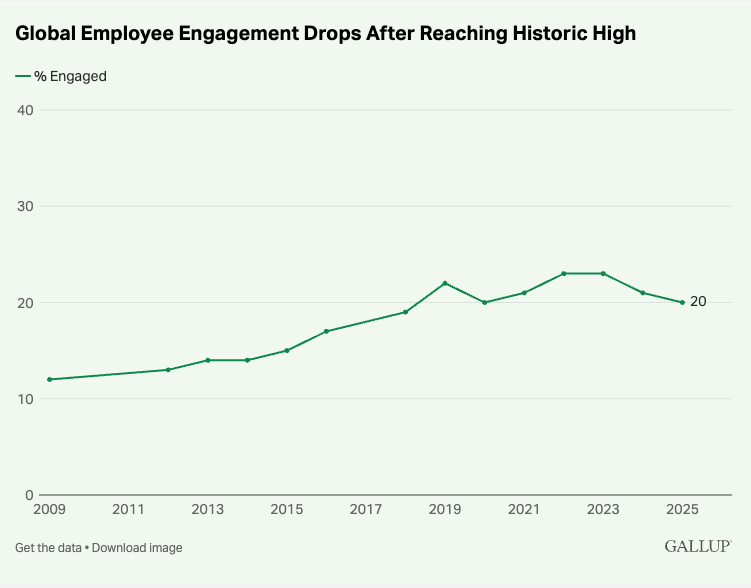
These are global numbers, so it’s not strictly limited to what’s going on in US business, like many more narrowly focused surveys. However, a few additional factors may be having a global impact.
Consider this eye-watering number: ‘Since 2022, Gallup finds manager engagement has dropped by nine points.’ Yikes.
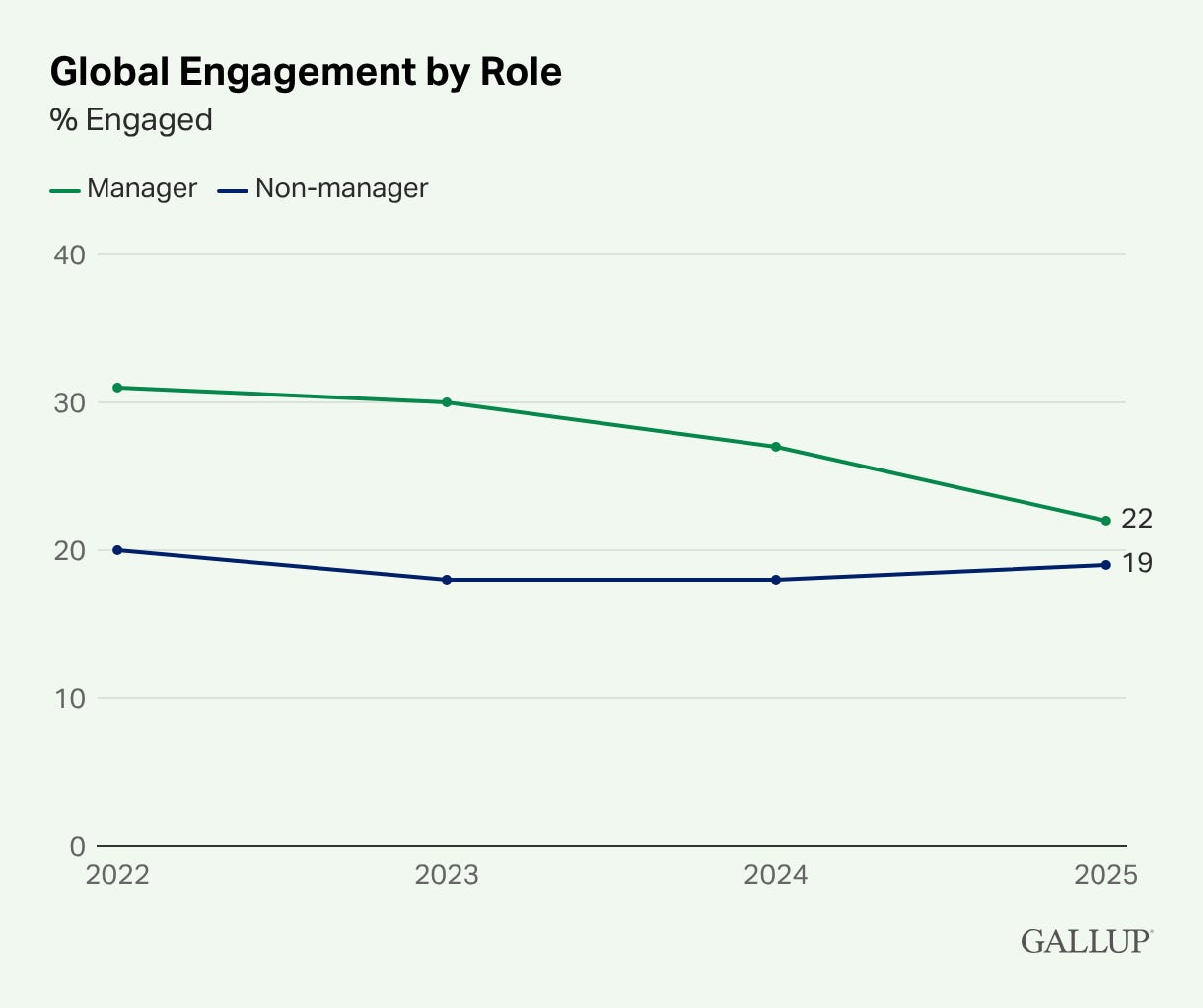
According to the 2026 State of the Global Workplace report, the largest year-over-year drop in manager engagement occurred between 2024 and 2025, when it declined by five points from 27% to 22%. In short, managers used to enjoy an “engagement premium” at work, but they are increasingly only as engaged as those they lead.
Are managers becoming ‘infected’ by the lower engagement of those who report to them, or is there some other factor?
It’s hard to stay ready for change when the change you have to prepare for is the end of your job.
In another report, Span of Control: What’s the Optimal Team Size for Managers?, Gallup notes a correlation between span of control and manager engagement: as managers gain more direct reports, their engagement falls [emphasis mine].
Average Span of Control in the U.S. Is Growing
According to the Bureau of Labor Statistics, there is roughly one manager for every 11.5 employees. Gallup data show a similar pattern: The average number of people reporting to managers has increased from 10.9 in 2024 to 12.1 in 2025. This is a nearly 50% increase in team size since Gallup first measured in 2013.
The increase in average team size across the U.S. working population in the past year is largely influenced by a two-percentage-point increase in teams of 25 or more employees. That shift likely reflects what many organizations are doing in practice: downsizing or consolidating middle management roles while expanding the number of people who report to each remaining manager.
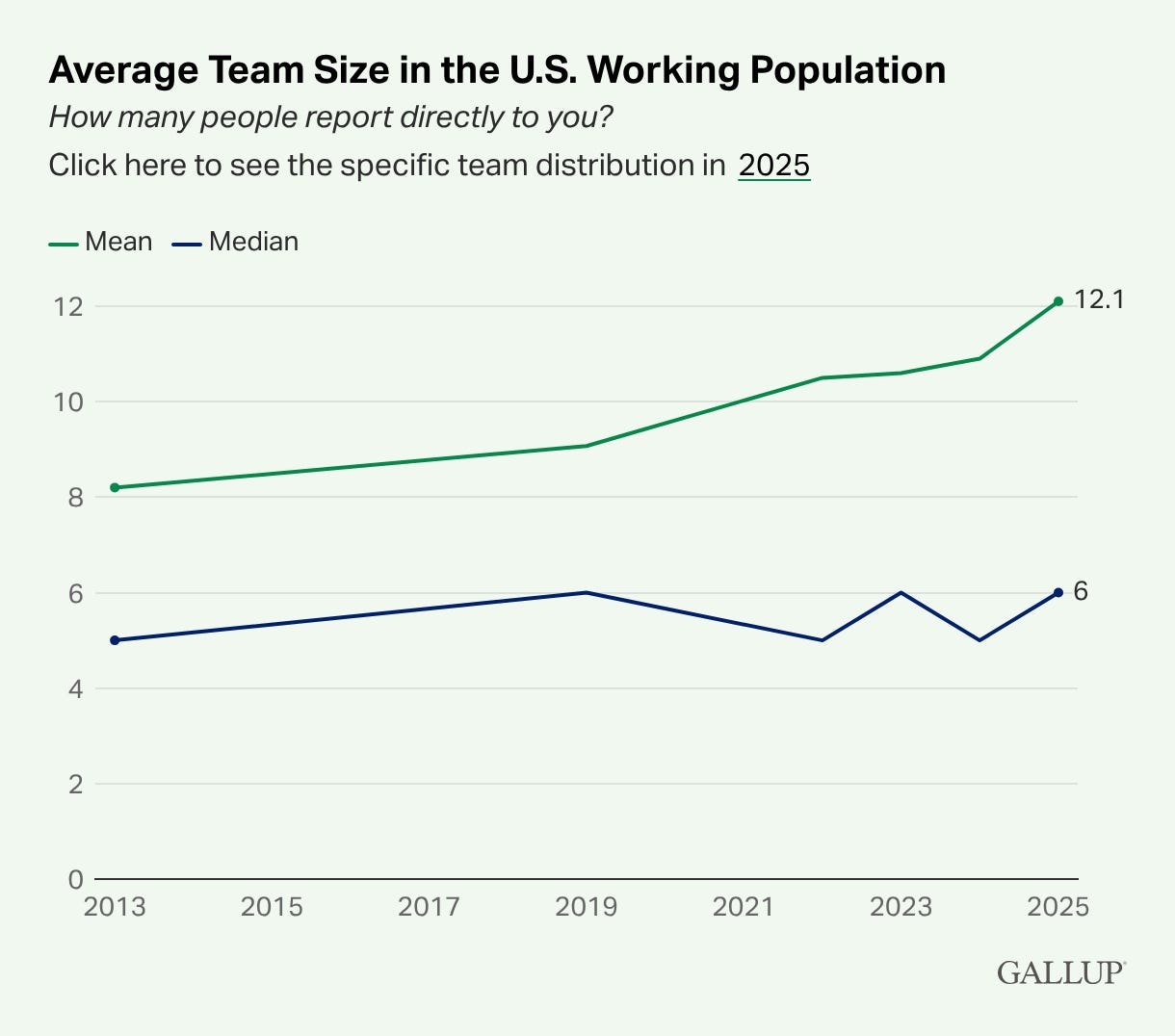
This translates to more responsibility, pressure, and work for some beleaguered middle managers (while most teams remain around six in size), and, perhaps (although the research doesn’t show it), no increase in pay. I would certainly feel less engaged.
One additional factor: AI.
In the 2026 Gallup engagement report, you’ll find this kernel of insight:
One way of thinking about employee engagement is as a measure of readiness for change. AI is a major disruption; organizations with engaged employees tend to navigate disruptions more successfully. In the age of AI, productivity gains will depend in part on how effectively individual workers use these tools. Disengagement will erode those gains, and active disengagement could create serious security risks.
Although a great deal of evidence suggests that the promise of AI-driven productivity across companies is still on the horizon, AI is creating a great deal of fear, which could decrease workers’ readiness for change [emphasis mine]:
U.S. data show concerns about AI-related job losses are rising.
In Q1 of 2026, Gallup research found that 18% of U.S. employees said it was “very” or “somewhat” likely their job would be eliminated in the next five years due to technological innovations, such as automation or artificial intelligence. In organizations where AI has been implemented, that figure rises to 23%. In some industries, such as finance (32%), insurance (32%) and technology (31%), it is much higher. A separate Gallup survey in Germany found that 19% of German employees in organizations that use AI said it was very or somewhat likely that their job would be eliminated in five years due to automation or AI.
Presumably, as the adoption of AI increases, these numbers will climb, and at some point, people might be displaced by automation/AI.
Seeing that storm coming over the hill is not likely to instill a strong sense of engagement. It’s hard to stay ready for change when the change you have to prepare for is the end of your job.
Absent some unknown X factor — like regulations slowing the spread of AI — we can expect these numbers to continue to fall, I bet.
When companies make fewer promises in the first place, people are less likely to believe they have a place in the directions being set, especially when they are increasingly seen as costs, not assets.
Please support my work with a paid subscription, which I have made as marginal as possible.
If you can’t afford yet-one-more-subscription, please help me by restacking this post to spread the word.
