

…
The human condition can almost be summed up in the observation that, whereas all experiences are of the past, all decisions are about the future. It is the great task of human knowledge to bridge this gap and to find those patterns in the past which can be projected into the future as realistic images.
| Kenneth Boulding
Decision-making is critical to business performance, so much more time should spent on systematically and rigorously examining the factors that can impede it. And many of those factors are in our wiring, both as individuals and as organizations.
If Decision-Making Is So Important, Why Do We Take Shortcuts?
Decision-making is critical to business performance. To go even further, it is an existential requirement. Yet so often things go wrong. Why?
Some problems in strategic decision-making seem obvious when you step back far enough. Consider the ‘loss aversion’ problem. Operating unit managers are focused on short-term timeframes and therefore tend to take on only small risks, instead of larger ones that may contribute more to long-term corporate growth. They are more concerned about the possibility of a status decline if things go wrong: the potential loss for the manager may be perceived as worse than any potential upside for the company and the manager.
Research indicates that, contrary to what one might assume, good analysis in the hands of managers who have good judgment won’t naturally yield good decisions.
Senior managers, however, must take a portfolio view and therefore must anticipate a portion of projects to fail in the search for a few that will yield big returns. The incentives — and fear of downside risk — between corporate goals and the individual manager’s goals are mismatched.
The important takeaway is this: the economic downside of loss aversion is only one instance of a much larger case of cognitive biases that distort human behavior whenever decision-making is called for. And like so many other aspects of life, avoiding examination of these influences on our behavior leads to big problems.
The basic assumption is wrong.
The basic assumption in business is that strategic decision-making requires three basic elements:
fact-gathering and analysis,
the insights and judgment of a defined group of people (stakeholders or advisors), and
some process -- ranging between very formal to very informal -- for that group to make a decision, reflecting that analysis and judgment.
However, as Dan Lovallo and Olivier Sibony reveal,
Our research indicates that, contrary to what one might assume, good analysis in the hands of managers who have good judgment won’t naturally yield good decisions.
And why is that? The authors go on to draw our attention to the third part: the process. After extensive analysis of 1,048 major decisions over a five-year period, including investments in new products, M&A decisions, and large capital expenditures they determined that
process mattered more than analysis—by a factor of six.
Process, by extension, is also more valuable than the judgment of those involved in the decision-making, too, since flaws in both analysis and judgment are countered by processes designed to do exactly that.
Process, process, process.
Lovallo and Sibony took a hard look at decision-making effectives, and broke things down:
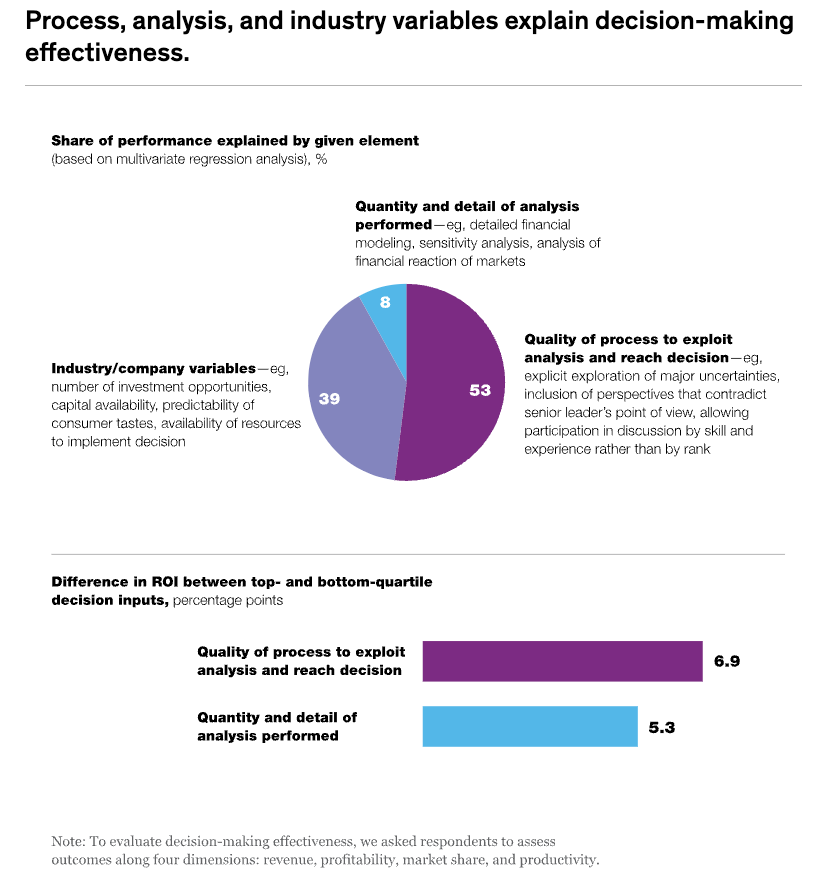
And a major value of good decision-making processes are to overcome — or at least moderate — cognitive biases that lead to poor decisions. As Lovallo and Sibony put it:
The prevalence of biases in corporate decisions is partly a function of habit, training, executive selection, and corporate culture. But most fundamentally, biases are pervasive because they are a product of human nature—hardwired and highly resistant to feedback, however brutal. For example, drivers laid up in hospitals for traffic accidents they themselves caused overestimate their driving abilities just as much as the rest of us do.
Improving strategic decision making therefore requires not only trying to limit our own (and others’) biases but also orchestrating a decision-making process that will confront different biases and limit their impact. To use a judicial analogy, we cannot trust the judges or the jurors to be infallible; they are, after all, human. But as citizens, we can expect verdicts to be rendered by juries and trials to follow the rules of due process. It is through teamwork, and the process that organizes it, that we seek a high-quality outcome.
Structuring decision-making processes helps, but we need to be vigilant about biases.
Perhaps the core message to be gained from Lovallo and Sibony’s research is this: while awareness of our cognitive blinders is helpful, the best approach to debiasing is to create processes that structure decision-making to intentionally counter biases to the greatest extent possible.
Here are five of the most common groups of biases relevant to business decision-making.
Pattern-recognition biases — We are pattern recognition machines: it is a defining characteristic of our species. But there are some side effects of our pattern-matching prowess that skew our reasoning. For example, confirmation bias leads us to discount new information when it doesn’t support an initial hypothesis. As Sydney Finkelstein, Jo Whitehead, and Andrew Campbell detailed in Think Again: Why Good Leaders Make Bad Decisions and How to Keep It from Happening to You, pattern-matching can lead to huge mistakes [emphasis mine]:
Most of the time, pattern recognition works remarkably well. But there are important exceptions. If we are faced with unfamiliar inputs— especially if the unfamiliar inputs appear familiar-we can think we recognize something when we do not. We refer to this as the problem of misleading experiences. Our brains may contain memories of past experiences that connect with inputs we are receiving. Unfortunately, the past experiences are not a good match with the current situation and hence mislead us.
Another exception is when our thinking has been primed before we receive the inputs, by, for example, previous judgments or decisions we have made that connect with the current situation. If these judgments are inappropriate for the current situation, they disrupt our pattern recognition processes, causing us to misjudge the information we are receiving. We refer to these as misleading prejudgments.
In other words, our pattern recognition process is fallible. We have all experienced the embarrassment of accosting a complete stranger we thought we recognized. We have also experienced some degree of terror because we have misjudged the sharpness of a bend in the road or the speed of an oncoming car. What is less obvious is that our pattern recognition processes can also let us down when we are trying to judge the severity of a financial crisis, the value of an acquisition target, or the threat from an incoming hurricane.
Counter: One technique is to undermine the presuppositions that lead to the pattern match in the first place. Why are the team members so certain about a particular course of action? Explicitly draw our what is the underlying analogy between this circumstance and others from the past. One means is to dramatically enlarge the set of comparison scenarios, and supply known facts for each example.
Action biases — There is a well-known bias toward action among managers which can lead to accepting overly optimistic analysis and yielding to cultural pressures to make decisions quickly without accurately assessing uncertainties.
We can’t eliminate these cognitive blinders: they are as deep in our DNA as language and love.
Counter: Promote the recognition of uncertainty rather than trying to squeeze it out of the conversation. Tools like scenario planning, decision trees, and Gary Klein’s ‘premortems’ explore the many dimensions of uncertainty before pressing ahead with a decision.
