The way in which the world is imagined determines at any particular moment what men will do.
| Walter Lippman, Public Opinion
I’ve been Substacked.
A few anecdotes about recent Substack experiences — and imaginings — a topic I don’t write about much.
AI gumming up the machine.
Yesterday, I spent a considerable time reading what seemed like a solid post on the increasing risks in the insurance markets. At the core, these risks are being driven by the growing climate crisis, which is leading many insurers to send out non-renewal letters to homeowners and businesses. Those letters reflect the growing gap between what insurers assess as the likelihood of catastrophic disasters — wildfires, hurricanes, flooding, and the like — and how much the insured are willing (or able) to pay.
This problem has ratcheted down to the reinsurance markets, which underwrite and allay the risks insurance companies take on: they too are being forced to raise the rates they charge to insurers. And down another layer is retrocession, reinsurance for reinsurers, and below that is the private banking world, where capital seeks opportunity. All of these entities are finding the risks inherent in insuring homes and businesses to be increasingly unprofitable. The result: bundling the risk into financial instruments and selling them to investors, and taking themselves out of the equation. As the article says, retrocession ‘now takes slices of hurricane and earthquake and wildfire risk through catastrophe bonds and other insurance-linked securities, so that a Danish pension fund can end up holding a piece of the Florida wind season in exchange for a yield.’
Reads like The Big Short, doesn’t it?
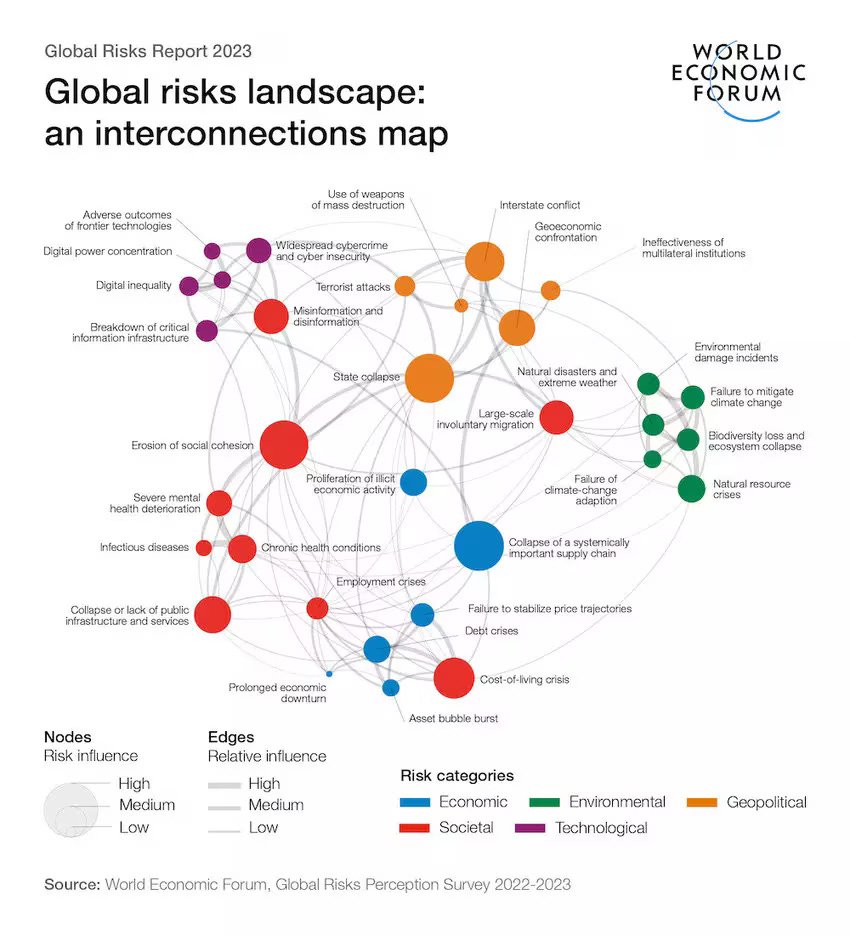
I believe this is a critical thread in the polycrisis, a term Adam Tooze uses to tie together the many parallel crises that beset the world today.
Note that the chart above doesn't explicitly call out the particular mess around insurance/reinsurance/retrocession/private capital, although it represents hundreds of billions of capital swirling around. Maybe it’s buried in the ‘Debt crises’ bubble, or an undrawn link between that node and ‘Environmental damage incidents’.
That’s all just a build-up to the Substack angle.
As I was reading this incredibly detailed and incredibly long post, I started to have an odd feeling about the writing: namely, that it might be AI-generated. And, sure enough, the first comment on the post is:
100% AI text (check Pangram)
I’m pissed. I want my time back. What parts of this piece are hallucinated? Which ‘facts’ can I rely on, if any? I shouldn’t really rely on any of it, or cite it.
I feel like one of those office workers who’s received some AI slop from a coworker, and it just makes more work for me.
So, Substack has provided a means to check if something is AI-generated (an integration of Pangram) and what percent is human. But they don’t allow me to set a general block against, for example, anything that is 50% AI-generated or higher. That’s what I want.
But maybe they don’t want to pay the tokens for all that compute.
(Note that the new Twitter.now — an attempt to resurrect the old pre-Musk Twitter — has a built-in service called Vera that checks every tweet for AI-ness.)
Substack Creator Match as a first step toward magazines.
I spent some time in the winter and spring whiteboarding a way to create a magazine on Substack, and how to invite other writers to participate. I ran aground on the issues around sharing: sharing revenue, subscribers, content, ownership, and so on.
Without infrastructure to support it — which would have to be Substack building it — I couldn’t pencil it out. Without a standard mechanism, it would be a promise of scale that would require a lot of accounting, contracts, and hackery with posts, subscriptions, and mailing lists.
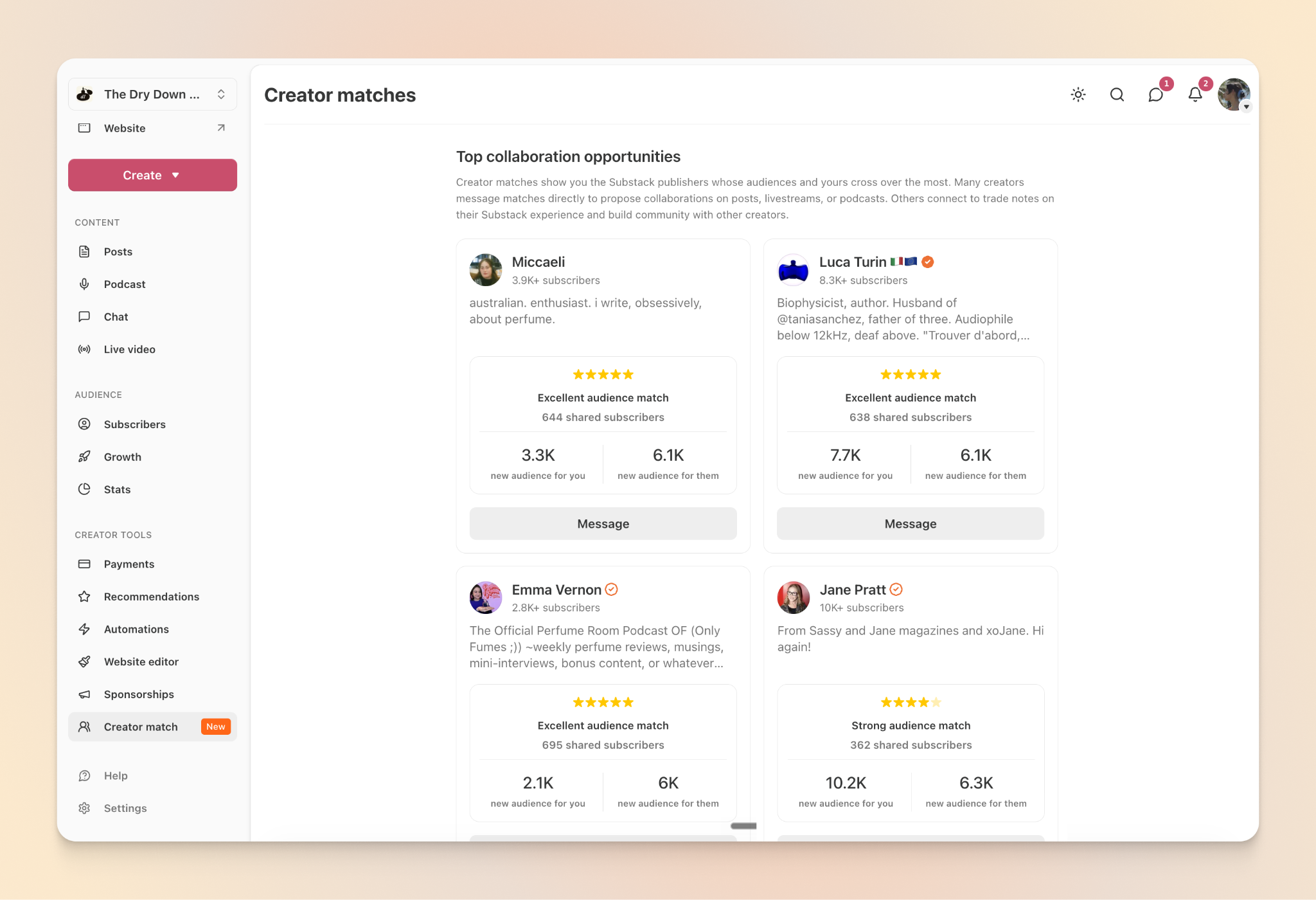
Substack seems to have offered a first step in this direction with the newly announced Creator Match.
The feature provides a dashboard populated with potential collaborators and relies on overlap in current subscribers. That’s a smart angle, and one that we — the creators — wouldn’t be able to easily discover on our own.
The more important missing piece is some mechanism for revenue sharing, likely based on a variety of factors that the co-creators could tweak to make sense for them.
Note that Substack’s recommendations are very loose:
Creator matches show you the Substack publishers whose audiences and yours cross over the most. Many creators message matches directly to propose collaborations on posts, livestreams, or podcasts. Others connect to trade notes on their Substack experience and build community with other creators.
It may be that Substack is attempting to fix the leak at the bottom of the boat: subscription fatigue. How many $8/month subscriptions can the average reader afford?
Here’s Scott Carney’s take on the progression of shrinking revenue for creators [emphasis mine]:
Early adopters on the platform did the best. Writers like Heather Cox Richardson and Matthew Yglesias arrived early and earned millions. But as more writers showed up the subscription revenue pie didn’t grow commensurately. Even with Substack’s discoverability mechanism (something that is missing on places like Ghost and Beehiv) it was getting more difficult to establish a real career here.
So Substack tried to solve the problem by adopting a strategy that every other tech company had already worn thin. They pivoted to adding a twitter-like function called “Notes” (which created a distinction between ““subscribers” and “followers”). Soon they incorporated video and live-streaming and encouraged posters to clip shorts into their feeds with an AI-generated clipping program.
In other words: Substack’s growth strategy was to offer almost the exact same things as every other social media network. They pushed the idea that the subscription revenues would keep the best creators on this platform and the new engagement opportunities would grow truly massive audiences. The stated plan was to make Substack the go-to-place for everything internet in a winner-take-all contest.
At first the strategy even sort of worked. A lot of new users DID join the platform and engaged with all this new free content—increasing the overall number of eyeballs that were here. These new “engaged users” helped skyrocket the VC-backed valuation , but, notably, didn’t do much to help the flood of new creators who came here to actually earn more money.
In fact, they started earning a lot less.
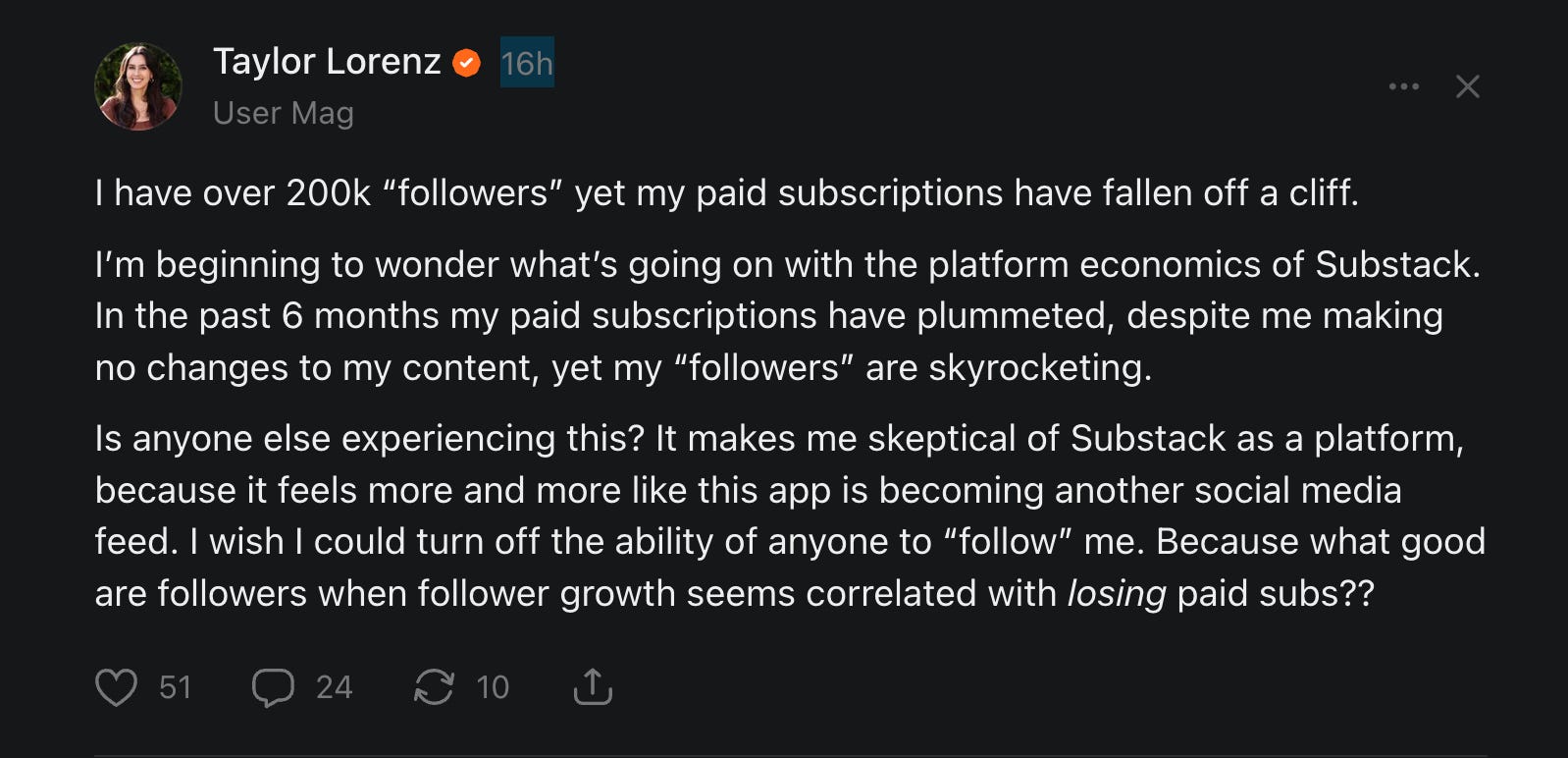
Take for instance this note from Taylor Lorenz from just yesterday.
Carney goes on with his analysis, and wonders why Substack doesn’t build the infrastructure to support magazines or newspapers, which might be a way around the mess: people might subscribe to a publication with 25 contributors for $8/month, and it might attract more than 25 times as many subscribers, so the numbers would line up.
Carney spelled it out similarly:
It’s interesting to me that the higher-ups at Substack didn’t see this coming a long time ago and head it off before we reached a crisis point. One obvious thing they could have tried would be to allow creators to team up and pool their creative resources into something akin to the role previously held by newspapers.
They could have instituted some sort of curated subscription bundle that allowed me to team up with 20 or so other similar writers and share a pool of money. Perhaps readers would be open to paying $15/month to access a bunch of writers at once so that writers could share helpings of an overall larger pie. I’m not sure this would work, I assume that there would be squabbles between writers about what percentage of the bundles that they actually deserve, but I would certainly give it a go.
From the consumers’ point of view, the ideal system would allow them to pay a monthly subscription fee and read anything they want, as with Spotify. Yet even if Substack were far more generous than the music streaming service, this would be disastrous for the ‘creators’, as I suppose we’re supposed to call ourselves. Substack has attracted a lot of very good writers because it offers a great deal of money to those who succeed, and the top earners would refuse to take part in such a system. Some customers would like to pay per article, but that would also translate into a significant pay cut, unless they were perhaps allowed only one such purchase per writer; after that, you need to subscribe. A pay-per-article system would also change the incentives which currently make Substack interesting, encouraging far more clickbait.
Perhaps the alternative is bundling, whereby consumers buy paid subscriptions to 3 or 5 or 10 substacks at much reduced rates, with the income shared between the writers. Maybe it could be distributed based on how much time the consumer spends on each, although that sounds complicated, or just shared evenly.
[…]
Writers would have to opt into the bundling system, and the very high earners might not feel the need to join, but that probably wouldn’t matter; there might be issues about contrasting prices between substacks, but this doesn’t sound like an insurmountable problem.
The insurmountable problem is we need Substack to implement all the plumbing needed for such federations — newspapers or magazines — to come together and to handle all the complex publishing, sharing, and funds sharing in such a way that the creators can spend their time writing, and not managing the ‘back office’ of such publications. It won’t work if all involved have to take on an additional part-time (or full-time) job.
The reality is that Substack is principally making money from their slice of subscriptions, and followers aren’t paying those fees.
Build on the trust creators have earned on Substack. Drive cultural impact for brands. Real revenue for creators.
Substack is launching a new initiative to expand revenue opportunities for writers, publishers, and creators in ways that are additive to a subscription foundation.
We’re working with a select group of flagship partners to create bespoke partnerships with the most influential voices on Substack. We’re also building tools to connect bestsellers to brands investing in the Substack creator ecosystem.
This program will make connecting with talent easier and better than ever before—our pilot partners are proof of the potential.
They have already lined up ‘best sellers’ for a pilot sponsorship program. But the gradient of gaining subscribers has shifted downward, so it has become harder to become — or remain — a best seller.
Dying the death of a thousand unsubscribes.
I hope they implement magazines so that like-minded creators can band together and attract sponsorships before the economics of Substack collapse. It won’t be successful if only the top few percent of writers here can survive. And if most leave because it doesn’t really pay, Substack will dwindle into a social network platform with a difficult-to-achieve sponsorship tier for a select few writers.
But maybe it was destined to go there anyway. After all, Medium went through various iterations of publication infrastructure — up to announcing a planned advertising scheme — and then backed out. Maybe that was just Ev Williams's ambivalence, but maybe something else made it hard to pull it all together.
However, I come away thinking that there has to be a way to bundle, say, a dozen writers into a magazine-like collective, and that the economics will pencil out better than a dozen individuals dying the death of a thousand unsubscribes.