
Buildings aren’t made out of glass, concrete and stone: they’re made out of time, layers of time. | Frank Duffy
…
Stewart Brand was influenced by architect Frank Duffy’s ideas about architecture, leading to his book, How Buildings Learn, in which he created this diagram:
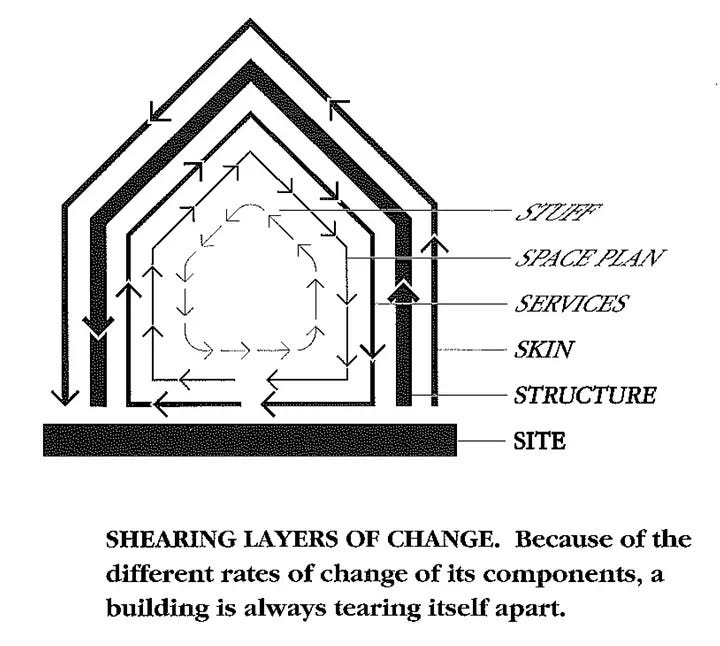
The thicker the arrows, the slower the change. This sets the stage for my essay, below.
In an earlier installment of How To Use Time, I focused on the time distortion that the pandemic has caused, unsettling our perception of the pace of time. Even when we are not caught up in a pandemic, we are shifting from different scales of time, perhaps several times a day. However, we have become so enmeshed in this reality, that we may not even be aware of it, like fish who do not ‘see’ the water they are swimming in.
Work is a large presence in our lives, and it surrounds and buoys us, and we are subject to the many layers of time shifting all around us.
The brilliant Stewart Brand, along with musician and polymath Brian Eno, explored a model — Pace Layers — in which various elements of civilization are arrayed from fastest to slowest. (Note that he was inspired by the thinking of Frank Duffy, as seen in the opening quotation.)
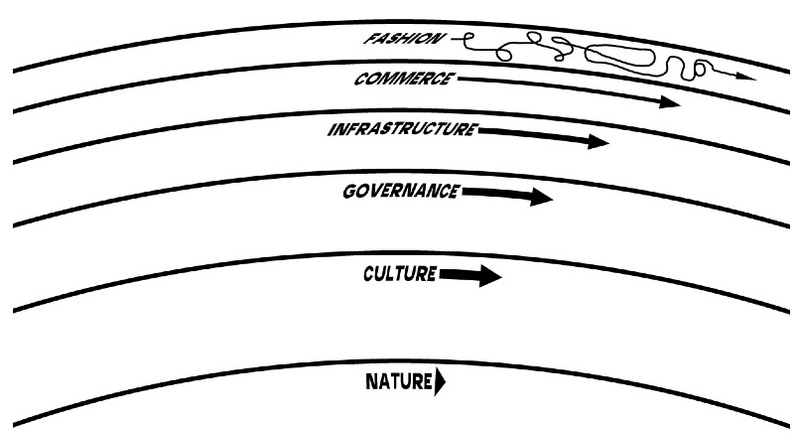
As Brand’s original caption reads,
The order of a healthy civilization. The fast layers innovate; the slow layers stabilize. The whole combines learning with continuity.
He goes on in his description
In a durable society, each level is allowed to operate at its own pace, safely sustained by the slower levels below and kept invigorated by the livelier levels above. "Every form of civilization is a wise equilibrium between firm substructure and soaring liberty," wrote the historian Eugen Rosenstock-Huessy. Each layer must respect the different pace of the others. If commerce, for example, is allowed by governance and culture to push nature at a commercial pace, then all-supporting natural forests, fisheries, and aquifers will be lost. If governance is changed suddenly instead of gradually, you get the catastrophic French and Russian revolutions. In the Soviet Union, governance tried to ignore the constraints of culture and nature while forcing a five-year-plan infrastructure pace on commerce and art. Thus cutting itself off from both support and innovation, it was doomed.
So, the various layers have their own pace: fast at the top, slow at the bottom. Along with pace, they have differential levels of power and inertia. Fashion has a lesser impact on commerce than governance has on culture, and so on. But more importantly, since we are talking about social phenomena, these relationships have societal impacts:
