[Man] can adapt himself somehow to anything his imagination can cope with; but he cannot deal with Chaos.
| Suzanne Langer
2025-08-14
Working, Fast And Slow | Greg Satell
More about slow productivity than behavioral economics, despite the homage to Kahneman.
Creating something new and meaningful is slow, often tedious work. And for long stretches, it’s not clear whether you’re making progress at all.
Like the discovery of penicillin, which languished in a journal article for ten years before a group of researchers—not the original discoverer—turned it into a widely available medicine after years of hard, slow lab work.
Apart from Fleming’s initial accident, every step required teams of people performing mundane, repetitive tasks: maintaining lab equipment, preparing cultures, and logging data. Despite the historical impact, that’s what most days looked like.
Even people who do exclusively creative work devote only a few hours a day to it. Hemingway, quite famously, wrote each morning and stopped by noon. In Slow Productivity, Cal Newport notes that this pattern is common. I’ve found the same to be true in my own work. The rest of the day is spent handling more routine tasks.
Reminds me of how Ignacy Jan Paderewski, the Polish pianist, composer, and Prime Minister, put it:
Before I was a genius, I was a drudge.
Satell returns to his central example, penicillin, to hammer his point that the slow drudgery of daily practice is the wellspring of work of value, not just the lightning strike of insight or discovery:
Producing work of lasting value requires learning to mode shift —from reactive execution to reflective creation, and back again. The story of penicillin shows why. Each breakthrough led to a flurry of activity, with tasks that needed to be performed with efficiency and skill in the moment. Yet inevitably, that progress led to unsolved problems, which needed much slower, more reflective modes of work and thought to overcome.
2023-08-14
How Economists Missed the Big Disinflation | Paul Krugman
Inflation optimists -- like Krugman -- and pessimists -- like Larry Summers -- were both wrong. The optimists were wrong that inflation would prove small and transient. The pessimists were wrong that inflation would be high enough to require large increases in unemployment for a long period of time to bring down inflation. The optimists seem to have learned from their mistakes, but the pessimists haven’t. The Fed got lucky, because it tried to engineer a recession to bring down inflation, but the economy just muscled the recession away.
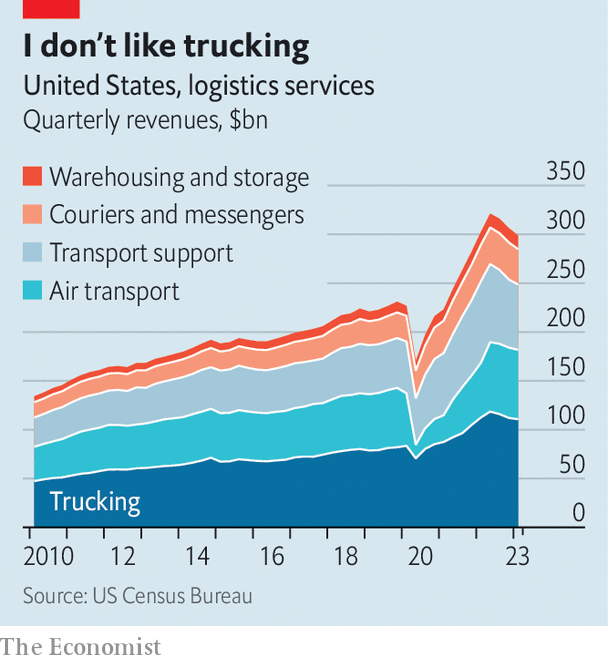
America’s logistics boom has turned to bust | The Economist
The logistics sphere -- trucking, warehousing, freight -- has been whipsawed by economics. Overhiring and overbuilding is now being reversed as the supply-chain bottlenecks of the pandemic have straightened out and people aren’t buying rice cookers or Pelotons anymore. Yello goes out of business, Amazon closes or delays hundreds of warehouses, and 20,000 truck operators have gone bye-bye since mid-2022. However, some companies are holding onto excess workers:
Lay-offs in the industry have thus far fallen short of what one might expect given the stagnation in consumer spending, argues Aaron Terrazas, chief economist of Glassdoor, an employment portal. Having long suffered from labour shortages, many firms have been reluctant to lay off workers, reckons Tim Denoyer of ACT Research.