

In science, novelty emerges only with difficulty.
| Thomas Kuhn
…
Kuhn is the author of The Structure of Scientific Revolutions, to whom we owe the notion of paradigm shift. Via Wikipedia:
Kuhn contrasts paradigm shifts, which characterize a scientific revolution, to the activity of normal science, which he describes as scientific work done within a prevailing framework or paradigm. Paradigm shifts arise when the dominant paradigm under which normal science operates is rendered incompatible with new phenomena, facilitating the adoption of a new theory or paradigm.
Kuhn did not extend his thinking outside the natural sciences, but the premise of paradigm shifts carries over into other realms, like art, music, fashion, and, yes, even business.
The Cycle of Management Models
Back in the pre-pandemic, I first came across a tantalizing analysis by well-regarded academics, Zlatko Bodrožić and Paul S. Adler, that laid out a historical analysis of the rise and replacement of management approaches over the past few hundred years. Entitled What explains the evolution of management models over the past two centuries?1, the quite short piece attempts a great deal, and falls short in some basic ways. But the core concept is worth understanding.
At the core, the authors assert that scientific management, human relations, and strategy-and-structure are ‘well-known management models in the history of business’ and then pose an implied question: ‘we still understand little about why a given model succeeds in competition with other models.’ They answer this question in the same introductory paragraph:
Our analysis of the historical record led us to conclude that management models succeed when they respond effectively to the organizational challenges and opportunities created by successive waves of technological revolution.
In a way, that top-level take is not too surprising. I find it strange that they don’t cite other work on these ideas, like Edgar Schein’s Organizational Culture and Leadership2 from the ‘90s, or David Ronfeldt's groundbreaking Tribes, Institutions, Markets, Networks: A Framework About Social Evolution. Also odd that company size goes unmentioned; perhaps we can assume these trends impact the largest companies first and the rest follow?
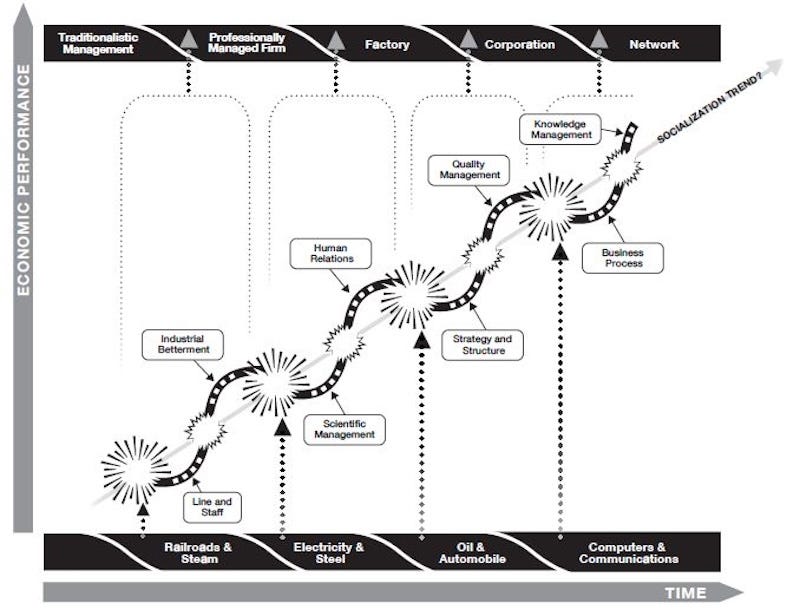
Here’s the ‘tech revolution’ diagram at the heart of their model of models. (Forgive the small fonts; they are in the original.)
Along the bottom are a sequence of technological breakthroughs, arrayed temporally, but not on a precise scale. An arrow points up from each, impacting the organizational form of the time. For example, Railroads & Steam led to a transition from Traditionalistic Management to Professionally Managed Firms. In each cycle, there are two parts: first, the overthrow of the status que ante model of management — in this case, family-run firms — and the creation of a new model, as in the adoption of a Line and Staff model of organization. Second, there is a counter-revolution: an effort to address the new problems introduced by the transition to a new model. In this case, Industrial Betterment.
The authors explain:
This cycle also led to a degradation of working and living conditions for the workers who staffed the railroad operations and who were thus scattered far from their communities and families. This degradation exacerbated industrial conflicts, which in turn led to a secondary cycle that gave rise to the “Industrial Betterment” model. Industrial Betterment did not undo the Line-and-Staff model, but added a counter-balancing social function that was responsible for improving workers’ living and working conditions. Occupationally, we see the emergence of the welfare secretary role (which subsequently evolved into the personnel manager).
Left unsaid is a great deal of context. Just a few exxamples: the rise of suffrage for unpropertied working men (in the UK, the Second Reform Act of 1867; in the US, by 1860 just five states restricted suffrage to male taxpayers and only two required property), unionization efforts, and labor-oriented political parties also paralleled these management shifts, which on a societal level also involved strikes, riots, anarchy, and the dissemination of socialist thought. The chart and descriptions lack those societal inputs/outputs.
Also left unmentioned is the original sin of slavery. One commenter on the essay notes that in the 1861 census ‘the largest single occupational category of managers, identified as such, was on US plantations worked by enslaved human beings. Four million enslaved people were worked for profitable production, integrated into the US and the global capitalist economy, not least through the work of 38000 salaried managers.’ Yes, this was agricultural work, but it set the context for organizational models prior to and during the rise of railroads and steam. No discussion or acknowledgment by the authors.
The next cycle?
The steel and electricity revolution of late 19th and early 20th century yielded the Scientific Management model based on workflow optimization and capitalizing on the acceleration of production afforded by the new technologies. This inaugurated a transition to a new organizational paradigm that we call the Factory, symbolizing a unitary, centralized organization. This model also led to high turnover and low morale of workers due to the close control over how and how fast tasks were performed. The resulting conflicts provoked a secondary cycle that yielded the Human Relations model, based on counselling and supervisory techniques that responded to the alienation induced by rationalized workstation operations. Human Relations did not undo Scientific Management but rebalanced the Factory paradigm.
Note that the concept of worker alienation is originally from Marx3: he asserted that under capitalism, workers are alienated from the products they make, the work they do, other workers, and their personal well-being. Again, a great deal of context is left out. Consider, for example, this4 from Nelson Lichtenstein:
Nor did wage labor mean truly free labor in the new factories. That was a nineteenth-century conceit designed to distinguish the proletarian labor of the industrial heartland from slave labor elsewhere. Whatever the difficulties of agricultural labor or proto-industrial home production, few workers, and certainly not adult males, were eager for employment in the new factories where close supervision and unrelenting work requirements created a prison-like environment. That was one reason that a huge proportion of those so employed were women and children. One landowner spoke of factory villages as a “convenient asylum” for those displaced from their farms when enclosures snuffed out their rural livelihood. Meanwhile, in the cities, vagrancy laws targeted the “idle and disorderly poor,” while Britain’s Master and Servant Act of 1823 made workers criminally liable if they left their employer before the contractual end of their service. In Prussia, workers who left work without permission could be punished with a fine or fortnight’s imprisonment.
Factory work of that day sounds like slavery by another name. I don’t think adopting Human Relations was really enough5.
Returning to Bodrožić and Adler, and more recent history:
The automobile and oil revolution of the mid-20th century yielded the Strategy-and-Structure model based on differentiating internal structure and business-unit strategies so as to support the production, marketing, and sales of differentiated products to different customer segments. This contributed to the establishment of an organizational paradigm that we call the Corporation, representing the multi-divisional mass-production firm with strategic integration but operating autonomy in the divisions.
The new model eventually led to poor quality and service, low worker involvement, lack of cooperation and political games among managers. These problems provoked a secondary cycle aimed at quality, organization culture, and organization learning. The Quality Management model that emerged in this cycle recommended a management system that involved personnel at all levels in continuously improving product and process quality. It did not undo the Strategy-and-Structure model but remedied its dysfunctions and stabilized the Corporation paradigm.
I won’t belabor the greater context of the late 20th Century, and all the social turmoil, because this is too long already, and I would like to focus on the last of their cycles:
Our analysis of the most recent wave is more tentative because that revolution is only now reaching the critical inflection point where computers and telecommunication begin to transform a wider range of industries and functions. As we see it, the first cycle of this revolution yielded the Business Process model, based on the redesign of business processes up and down the value chain, redrawing internal and external boundaries, and externalizing “non-core” activities.
Buried in this are workflow automation, reengineering, the email revolution, cell phones, instant messaging, social media, offshoring, and outsourcing, to name just a few of the novelties that have arisen in the past 30 years.
This model contributed to the establishment of a new organizational paradigm that we call the Network, where units within and across organizations are interlinked by rationalized processes supported by digital technologies. This cycle seems to have led to the neglect of the human element and thereby weakened the innovation-generating capacity of firms. These problems, in turn, have provoked a secondary cycle that has encouraged the emergence of a cluster of concepts that appears to be cohering around Knowledge Management and novel types of communities of practice.
How very 2019. Knowledge management? I buy into the Network notion, though, that work is increasingly atomized and our reliance on communication tools has led to increased alienation and disengagement from work.
This was penned pre-pandemic, so the authors wrote without the perspective of today’s hybrid, always-on, pervasively web conferenced, burned-out business. With today’s hindsight, it would be interesting to see what the rebalancing trend might have been; I doubt Knowledge Management would have been seen as a bandage for the wounds inflicted by aggressive corporatism. Just as one glaring instance: consider how large US corporations continue to fight against unionization drives, or other organizing by employees. Starbucks continues to drag its feet, and the writers’ strike in Hollywood are just two examples that come to mind. I won’t get into the perturbations that AI is introducing into this vortex of swirling forces, but that’s worthy of a separate, longer treatment, in the works.
The larger context for the Networked model is perhaps the general sense of brokenness around the work contract, as I have written about before. It’s an element of the greater societal perception of brokenness in our institutions, as Alana Newhouse writes in Brokenism:
The most vital debate in America today is between those who believe there is something fundamentally broken in America, and that it’s an emergency, and those who do not.
[…]
At its base, brokenism revolves around the idea that institutions and even whole societies can and do decay—sometimes in ways that are obvious, often in ways that are not.
Consider me a brokenist, then.
Please support my work with a paid subscription, which I have made as marginal as possible. If you can’t afford yet-one-more-subscription, please help me by restacking this post to spread the word.
