The problem with business is that it is afraid of dealing with the business of people.
| W. Edward Deming
…
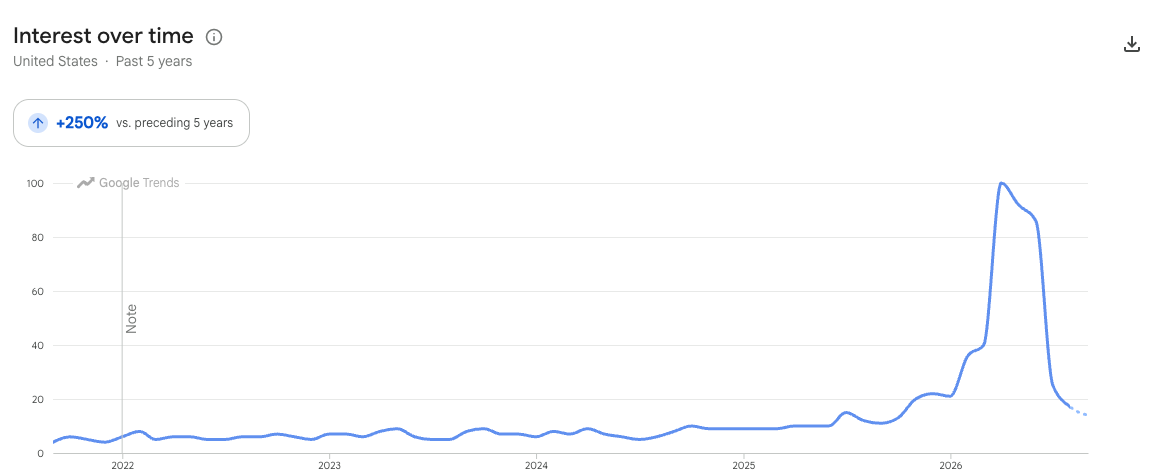
This Deming quote reminds me of the first meeting I attended with Google’s ‘collaboration tools’ group, after signing them as an advisory client.
They had a slide showing on the giant monitor in the meeting room: a quote from a post I had written, making a distinction between tools for people at work and tools for businesses to manage people.
They informed me that they had decided to rename the next release of Google’s collaboration suite as ‘Google for Work’ instead of the originally planned ‘Google Enterprise’.
It was a great start. However, a new SVP (who shall remain nameless) arrived quite soon after, and the suite was recast as a lowly, lowly element of the Google Cloud, and the emphasis on people was dropped. Instead, we saw the return of ‘Enterprise’ everywhere in their marketing and messaging.
Remember: names matter.
Words are slippery; both in meaning and in time.
Some terms are likely to be used forever; others fade quickly.
Overemployment
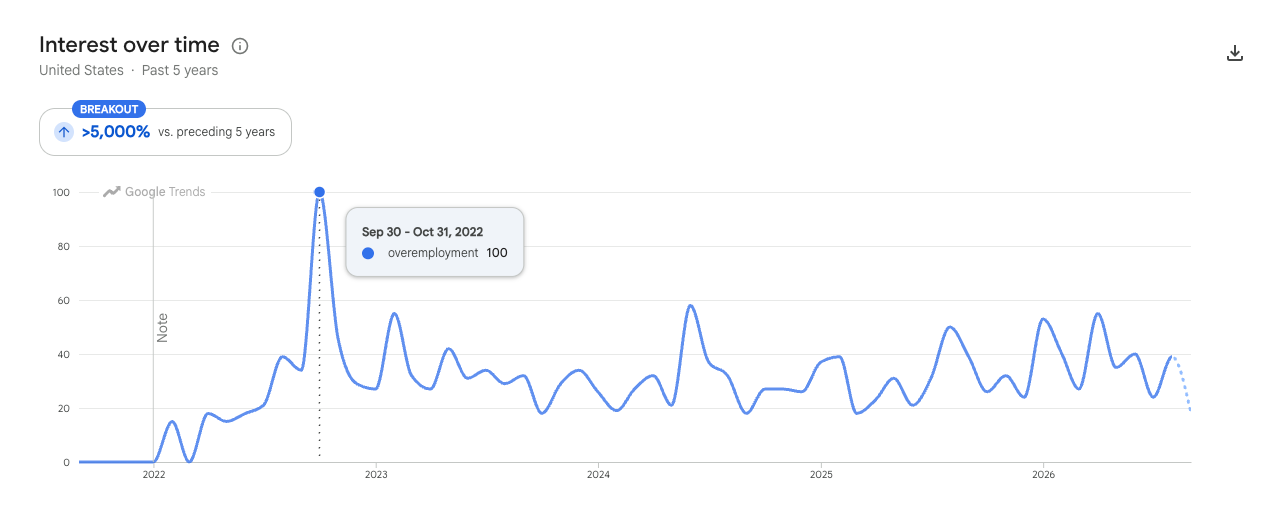
A vestige of the post-pandemic hiring spree, the term ‘overemployment’ was directed to those who were ‘secretly working more than one full-time job’, as reported in 20221 by Fadeke Adegbuyi.
All of her points are informative, and some are very insightful:
For a time, Murphy [one of the overemployed] thought she had stumbled upon a novel way of working—something she alone was experimenting with. But it wasn’t long into her new work arrangement that she realized there were scores of knowledge workers doing the exact same thing and discussing it online. On TikTok, the tag #overemployed has over 4.3 million views. The subreddit r/overemployed has over 89,000 members, and the accompanying Discord community has more than 32,000 users; during active periods of the day, a new member joins every few minutes. Both the subreddit and Discord exist under the banner of the Overemployed website, a resource hub and the home of this emerging work movement. These internet communities and online spaces have become a lifeline for people experimenting with or considering this new mode of work.
The online mentions for the term have risen and fallen over the years — spiking in 2022 when Adegbuyi wrote about it — and are now at a relative low. Not surprising, given the employment picture in tech:
The overemployed have cynical views of the relationship to their employers [emphasis mine]:
The overemployed are rarely seeking self-actualization and meaning-making at work.
Antiwork and OE have an overlap. Antiwork talks about how the system is against the workers and we should tear that system down. OE thinks the system is against the workers and says ‘let’s exploit it.’
Overemployment is more than just a style of work. It’s an ideology of individualism and self-reliance held by many who feel that corporations have turned their backs on workers.
They know work is broken.
Greedflation
In 2022, Lydia DePillis summarized2 a growing perspective of progressives called ‘greedflation’. Namely, it wasn’t only impartial inflation of that post-pandemic era that was driving up prices but deliberate profiteering:
Increasingly dominant corporations are taking the opportunity to jack up prices more than they otherwise could, which is squeezing consumers and supercharging inflation. Or “greedflation,” as the hypothesis has come to be known.
Well-known economists — like Ben Bernanke and Oliver Blancard — attempted to reassert the historical ‘wage-price spiral’ as the source of this inflation, in essence putting the blaming on increases in pay, and that corporations were only of necessity raising prices.
A 2023 article3 by Emily Peck pointed out that the concept of greedflation was gaining ground:
Once dismissed as a fringe theory, the idea that corporate thirst for profits drives up inflation, aka “greedflation,” is now being taken more seriously by economists, policymakers and the business press.
Fewer commentators and policy-makers were fooled by the corporate smokescreen and directly challenging the conventional wisdom:
In a speech in January, then-Fed vice chair Lael Brainard said wages weren’t the main driver of inflation and pointed to a “ price-price spiral,” where companies mark up prices far higher than the increases in their input costs.
In March, the chief economist at UBS Global Wealth Management, Paul Donovan, published a note on “profit margin-led inflation,” describing how in late 2022 and into this year, companies — particularly retailers and consumer goods makers — convinced consumers that they needed to raise prices. (They didn’t really.)
As just one example of someone who had been considered a conspiracy theorist for advancing greedflation as a major factor in rising inflation, consider Isabella Weber:
By May [following Donovan’s note], the Wall Street Journal published a story on how corporate profits were keeping inflation high, citing the work of Isabella Weber, an economist at the University of Massachusetts, Amherst, who was derided for her work on the topic back in late 2021.
In a stunning comeback this month, The Times of London profiled Weber’s rise from a lone voice to star economist who’s drawn attention to the notion that companies and certain sectors can drive inflation — she calls it “sellers’ inflation,” not greedflation.
Nobel Laureate Paul Krugman pulled an about-face after his criticism of her work:
Krugman deleted tweets attacking Weber’s article as “truly stupid” and made a public apology.
Even Jerome Powell pivoted in 2022 away from his more conventional views in 2021.
The term has stayed in use, but fallen from its peak in 2023.
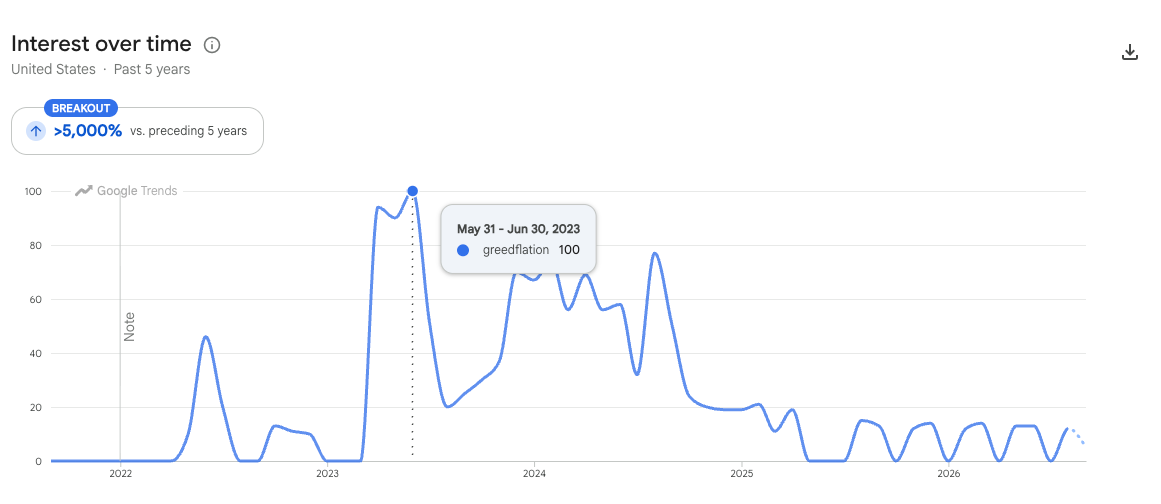
I choose to interpret this as the widespread acceptance that inflation — at least to a significant extent — can be influenced by profiteering. So where people talk about inflation now, it’s shaded by that awareness: we know they are taking advantage of the exogenous rise in the cost of their inputs to gouge us on the price of their outputs.
Class Ceiling
A recent piece4 by Noam Scheiber introduced the term ‘class ceiling’ to me.
Being female or a person of color has long been seen as a disadvantage in hiring and promotion. A new study of college professors shows that class may loom as large.
According to a recent paper, such a background [first-generation scholar] can also hurt a scholar’s career. The paper, in the prestigious journal Econometrica, found that scholars whose parents did not graduate from college are less likely to land tenure-track jobs at major research universities and less likely to get tenure.
The researchers, Anna Stansbury and Kyra Rodriguez, found that the disadvantage of being a first-generation college graduate could be even greater than the disadvantages associated with being female or nonwhite.
So, for example, a female, Black PhD with college-educated parents might be more successful than a male, white first-generation PhD.
This effect boils down to social capital, in several ways:
First-generation graduates appeared to have less social or cultural capital than people from more privileged backgrounds.’ Fewer relationships with those with higher social capital, who might be able to open doors, make introductions, or teach graduates how to play the game.
This extends beyond academia:
“In many other elite professional settings, the qualities on which you’re judged — on which you’re getting ahead, getting opportunities — are somewhat subjective,” said Dr. Stansbury, an economist at M.I.T. Lawyers, bankers, consultants and middle managers typically advance when higher-ups perceive them as crafting strong arguments or giving good presentations. But there’s no way to measure these skills precisely.
Instead, just as for aspiring professors, “networks, social capital, perceptions and bias of how you present yourself — cultural capital — are a big reason for how it plays out,” Dr. Stansbury said. And those criteria put the working class at a real disadvantage.
And the first-generation doctorates enter the workforce beyond academia the ceiling still plays:
First-generation college graduates with Ph.D.s earned less when they entered the private sector and were less likely to hold senior management jobs than Ph.D.s whose parents had a graduate degree.
This is a quite new term, and one that is already rapidly fading, but that doesn’t mean the effect is: