

Illness is neither an indulgence for which people have to pay, nor an offence for which they should be penalised, but a misfortune the cost of which should be shared by the community.
| Nye Bevan
…
The news of student-led protests around the world — some are calling this global protest The Great Fuckoffening — shows that in places as diverse as the Philippines, Albania, France, and Serbia, people are coming together to call for a response to the polycrisis. A long list of issues generally treated as distinct and separate are reactions to widespread neoliberal policies designed to benefit the monied, not the many.
Paolo Gerbardo argued (in The Great Recoil) that there is a central theme behind people’s response to authoritarianism, the environmental death-spiral, bad educational institutions, inadequate healthcare, economic inequality, and more: in a word, insecurity.
The Left needs to develop a politics of protection that addresses the real reasons behind the popular feeling of insecurity.
[…]
Coextensive with the idea of a socialism that protects is the idea of a society of care. This political platform is fundamental in alleviating people’s fear of exposure and fragility, as is the struggle to establish and reinforce various “minimums” (minimum wage, minimum income, minimum working conditions, and environmental standards) to reverse globalization’s race to the bottom.
People are demanding a commitment to, at least, the minimums. Otherwise, fuck off.
And in a time where millions — 160 million — of Americans have their healthcare covered (in part) by employers, the first place to start should be minimum healthcare for all. After that, all the other minimums.
Shifting Healthcare Costs Onto Workers
Reed Abelson breaks down the numbers to get at the trend in American business to make workers pay for more of their healthcare expenses. A few factoids [emphasis mine]:
‘Roughly six in 10 adults reported they were very or somewhat worried about affording care.’
‘The majority of Americans — about 157 million — get insurance through their employer. But as costs for coverage have spiked, with increases in the high single digits, businesses have been shifting much more of the additional expenses onto their workforces.’ This should not be the model for healthcare coverage in 2026.
‘Many people are also paying thousands of dollars in medical expenses when they get sick, because companies have increased the plans’ deductibles to offset increases in premiums.’
‘The yearly price, on average, for employees to cover their family is now $7,471 a year, up 9 percent from 2025. The total cost for a family plan, including the amount the employer contributes to the annual premiums, has reached $28,303.’
‘Overall, the average deductible for U.S. workers is approaching $2,000 before insurance kicks in.’
‘“People tell us in polls that their health care costs are their top cost-of-living concern, tied with gas prices. The fact that workers’ share of premiums went up almost three times faster than inflation in 2026 helps explain why,” said Drew Altman, the president and chief executive of KFF, in an email.’
‘Harder hit are employees of small companies, defined as those with fewer than 200 workers, whose paychecks have been shrinking as premiums increase, according to the KFF survey. On average, they are paying $9,687 a year for coverage.’
‘More than a third of people working at a small employer have annual deductibles of $3,000 or more.’
Josh Allan Dykstra shares the bizarro-world reason for us relying on employers for healthcare [emphasis mine]:
During World War II, the government froze wages. Companies couldn’t compete for workers with bigger paychecks, so they started offering health insurance instead. The government said thumbs up and even added tax benefits for both employers and employees. Then the war ended, the wage freeze lifted, but the tax break stayed. So companies kept doing it. Not because it was the right system, but because it was cheaper than paying equivalent wages, incentives. And let’s be honest, if your healthcare is attached to your job, you’re a lot less likely to quit. Congratulations, here’s your leash, sir. And the kicker is, nobody really designed this at all. A wartime accounting rule became a tax loophole, which became corporate retention, which became the foundation of the American social contract.
For the last 80 years, the U.S. has built its entire social safety net on this rickety foundation. Not as a public system like the rest of the developed world, but as a private system delivered through your employer. You want healthcare here? Get a job. You want retirement security? Get a job. You want to be able to afford your bills when you have a baby? Get a job... maybe. Better hope it’s a good job with a company that likes babies and make sure you don’t tell them YOU like babies before they hire you... it’s a whole thing.
[…]
Now to make our social contract worse, let’s bring in neoliberalism. […] Starting in the late 1970s and accelerating through the 80s and 90s, the dominant economic logic became: markets are efficient, government is not. So we privatize everything, deregulate everything, and just trust that the “invisible hand” will sort it out. […]
One of the quieter effects of this era has been the systematic weakening of the institutions that could have provided some alternatives to this employer-based social contract. Unions, for example, might have helped, but they were being actively undermined by Reagan and others. Private pensions could have helped, but they were quietly replaced with 401ks. Public housing was deliberately stigmatized and then pretty much demolished everywhere, leaving the market to “solve shelter” for working people. And a LOT of propaganda — including the creative use of some powerful bogeyman “-isms” like “socialism” — helped ensure universal healthcare has never gotten traction in the U.S. (You might notice some of this is still happening right now, today.)
The logic was, and in many ways still is, “The market will handle it.” “Your employer will handle it.” “You’ll be fine.” But my friends, we are clearly NOT fine. Look around... I don’t think I know anyone that feels like things are “fine.” To me, it seems clear... the invisible hand is giving us the invisible middle finger.
FDR’s New Deal did not include nationalized healthcare, despite including it in his 1944 Economic Bill of Rights state of the union address, and Harry S Truman failed in his attempt to enact it in 1945:
Truman’s plan was that all Americans would pay a certain amount in fees and taxes each month to cover the new healthcare program’s costs. With a Democratic controlled House, Truman’s proposal turned into a bill that would end up as part of the Social Security expansion, but it was quickly shot down as people began to fear an increase in taxes. Some people even feared the program would be a “Communist” act, giving too much control to the federal government. This fear was spread specifically by the American Medical Association (AMA). The bill was also halted by Republican Senator Robert Taft’s Taft-Smith-Ball Bill, which would allow states to make healthcare private. As Republicans regained control of the House in 1946, Truman’s healthcare bill died. Truman considered this a failure of his presidency.
So, we are living in a crappy system, where democrats have tried and tried to make piecemeal changes, with a few small victories like LBJ getting Medicare passed in 1965 for people 65 and over, and Obama’s Affordable Care Act in 2010.
Conservatives and the entrenched medical and insurance lobbies have been crying ‘communism’ every time the idea returns, and so the fundamental lack of a nationalized healthcare system has continued, 81 years later.
Short Takes
We Spend Billions Designing Workplaces. Two Thirds of Workers Still Need to Fix Them1 | Libby Sander
‘A recent survey of 16,400 employees across 16 countries found that two thirds of workers make adjustments to their workspace to overcome shortcomings in its design. That hardly seems like a design success. If so many employees are having to compensate for their workspace, we need to ask whether we are designing workplaces around the work people actually need to do.’
‘In one study in our lab, my colleagues and I found a causal link between open plan office noise and a 34% increase in objectively measured physiological stress, and a 25% increase in negative mood. A causal relationship shows that A is causing B, controlling for any other factors.’
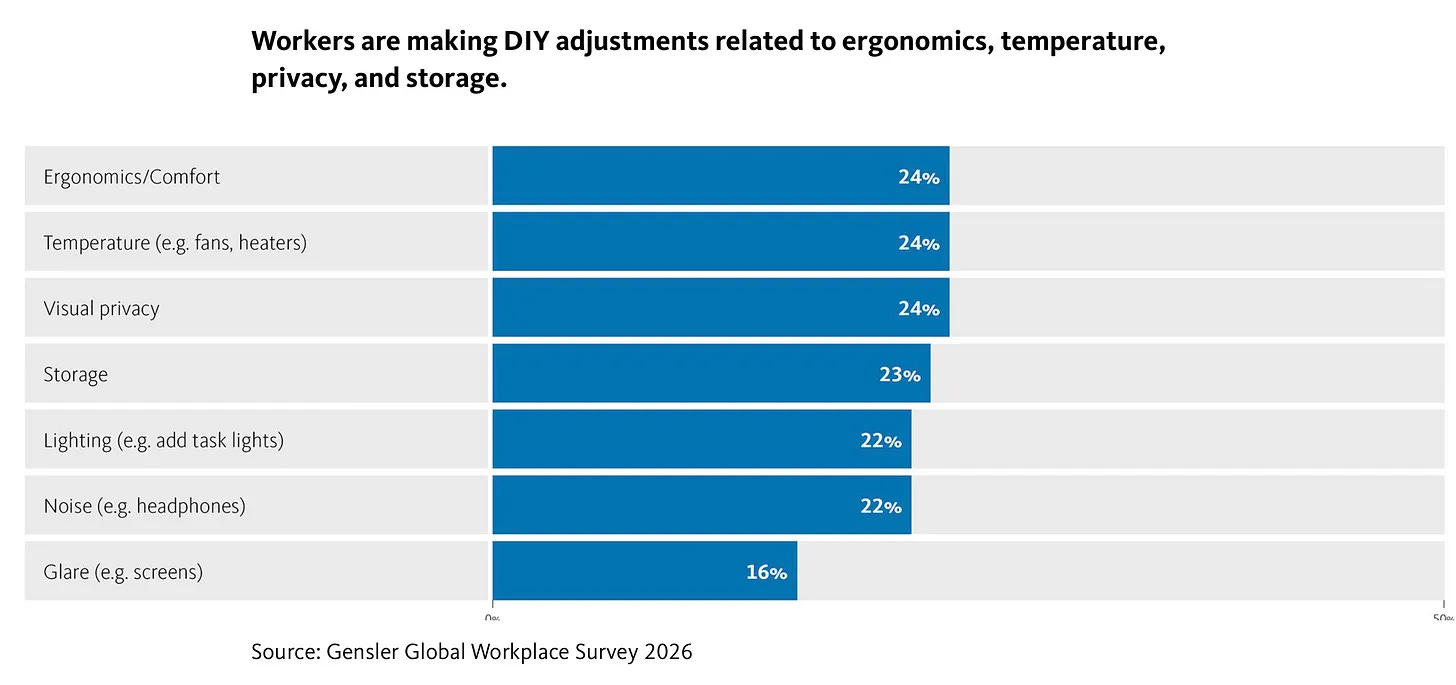
She cites a Gensler survey that found
65% of workers use meeting rooms for individual focus work because quiet space isn’t available elsewhere.
64% take calls in hallways due to a lack of appropriate spaces.
43% have cancelled meetings outright because rooms weren’t available.
Workplaces just don’t work, it seems.
…
Do You Have ‘Purpose Anxiety’? | Christina Caron
‘The phrase “purpose anxiety” isn’t commonly used in psychology, but it is a familiar concept to both researchers and clinicians. The phrase appears to have been coined in 2014 by a psychology graduate student who studied the topic, concluding that most people crave a sense of purpose in life, but “nearly always encounter purpose anxiety during their search process, no matter the searcher’s age.”’
‘Finding purpose can be difficult. A survey of more than 2,400 Gen Zers published in June found that about 45 percent of respondents reported lacking meaning or purpose in their lives.’
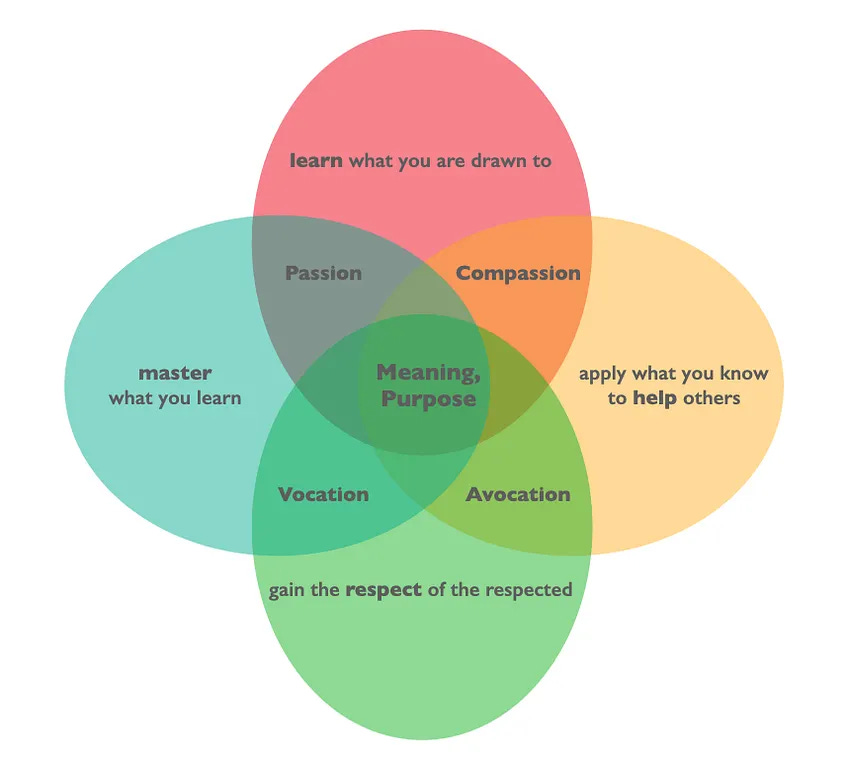
I recommend this post of mine on Ikigai, to help think about purpose and meaning in life and work.
Meaning is a muscle, not a mood. Meaning emerges from the myriad activities associated with the circles and loops of purpose. It’s not a medal or a parchment with a seal of wax, but something that animates the space between us and others the way that a carpenter’s workroom smells of wood shavings, and how a crowded city square hums with ten thousand sounds of people walking, talking, and maneuvering their passage past each other and through, all happening at once, at once independent and dependent on each other.
There is no summation of meaning, it must be considered as both tiny and enormous at the same time.
Please support my work with a paid subscription, which I have made as marginal as possible.
If you can’t afford yet-one-more-subscription, please help me by restacking this post to spread the word.
