
Short Takes #12: A Variety Of Biases
O’Toole, Bennis | Meta VR Layoffs | AI Layoffs. Oops. | US Home Insurance Crisis | Remember Trump’s Promised Manufacturing Boom?

When you’re setting out to understand a culture, it’s best to seek diverse sources of information that demonstrate a variety of biases.
| James O’Toole, Warren Bennis, A Culture of Candor
…
A friend asked me to explain why I write about — or collate — all sorts of information, stats, and events in these Short Takes that are not immediately subsumed under a narrow interpretation of the future of work. Why? Because I share the viewpoint of O’Toole and Bennis, above.
Many writers focus obsessively on leadership and management, questions about internal communication, transformation, and change management in the workplace. But I view work in a larger context, one is enmeshed in a larger world of economics, anthropology, history, psychology, and politics.
And I have always believed you have to find as many dots as possible before figuring out how — and to what end — to connect them.
If you are looking for facile explanations and gurus sharing their received knowledge (especially in the rapid-fire, sing-song broetry style), you need to look elsewhere.
Meta VR Layoffs
Meta is scaling down its ten billion+ investment in virtual reality (think Metaverse and chunky headsets), laying off around thousands of employees, according to Mike Isaac and Eli Tan:
Meta Plans to Cut 10% to 15% of Employees in Reality Labs Business -- Meta plans to cut around 10 percent of the employees in its Reality Labs division who work on products including the metaverse, according to three people with knowledge of the discussions, as the company shifts priorities to build next-generation artificial intelligence.
Virtual reality is a dead end as I have been saying for a long time. Augmented reality was always a better idea:
The Reality Labs division that works on augmented reality, which builds hardware like glasses and wristbands that allow people to interact with computing menus and commands using voice and gesture commands, is expected to be largely spared from the cuts, two of the people said. That division is responsible for Meta’s Ray-Ban sunglasses, which have incorporated a camera and personal A.I. assistant. The glasses have been a surprise hit, selling more than two million units over the past few years, the company has said.
I hope they spin it out because I won’t invest in Facebook, er, Meta.
…
AI Layoffs. Oops.
Did they lay off people too soon? Yes.
Some 55% of leaders who have laid people off because of AI now say they made a mistake, according to a survey by Orgvue. “Some leaders are waking up to the fact that partnership between people and machines requires an intentional upskilling program if they’re to see the productivity gains that AI promises,” Orgvue CEO Oliver Shaw told HR Dive.
It will take time to see the productivity gains AI promises. A lot longer than AI giants have runway.
US Home Insurance Crisis
One aspect of the affordability crisis: home insurance is increasingly unaffordable, as a consequence of climate change risk:
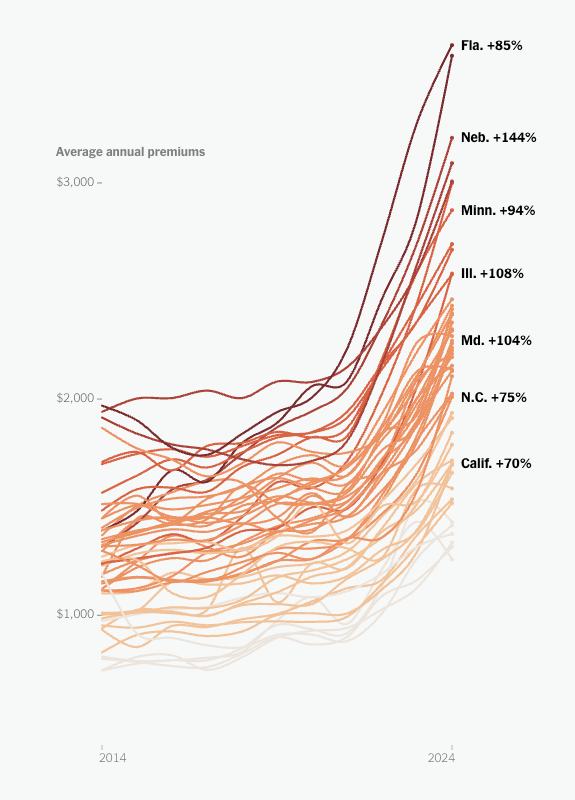
After analyzing 74 million home payments — which included mortgage, taxes and insurance and were made between 2014 and 2024 — the researchers found that a rapid repricing of disaster risk had been responsible for about a fifth of overall home insurance increases since 2017. Another third could be explained by rising construction costs.
And the result?
13 percent of U.S. homeowners are uninsured, according to Census Bureau data.
| Claire Brown and Mira Rojanasakul
And insurance companies are fleeing:
In recent years, insurance companies have found themselves increasingly on the hook for homes hit by wildfires and severe storms. In Louisiana, a parade of back-to-back hurricanes and extreme storms in 2020 and 2021 caused insurers to pay out well over twice as much money as they brought in. Similarly, in Colorado, where the state has experienced over 40 billion-dollar disasters in the past decade, insurers lost money in eight of the past 11 years.
To pay for all this damage, premiums have been skyrocketing nationwide. According to a 2024 study of insurance rates, the average home premium rose 33 percent between 2020 and 2023. In disaster-prone areas like Florida, the Gulf Coast, and California, rates have increased even more, with some insurers pulling out of markets entirely.
| Jesse Nichols (2024)
It’s a house of cards, just waiting to fall in the next strong storm.
Remember Trump’s Promised Manufacturing Boom?
Hiring in manufacturing [...] has been in the doldrums. The sector lost another 8,000 jobs in December, the Bureau of Labor Statistics estimated, and factory employment has dropped more than 70,000 since April to 12.69 million as of last month - the lowest reading since March of 2022.
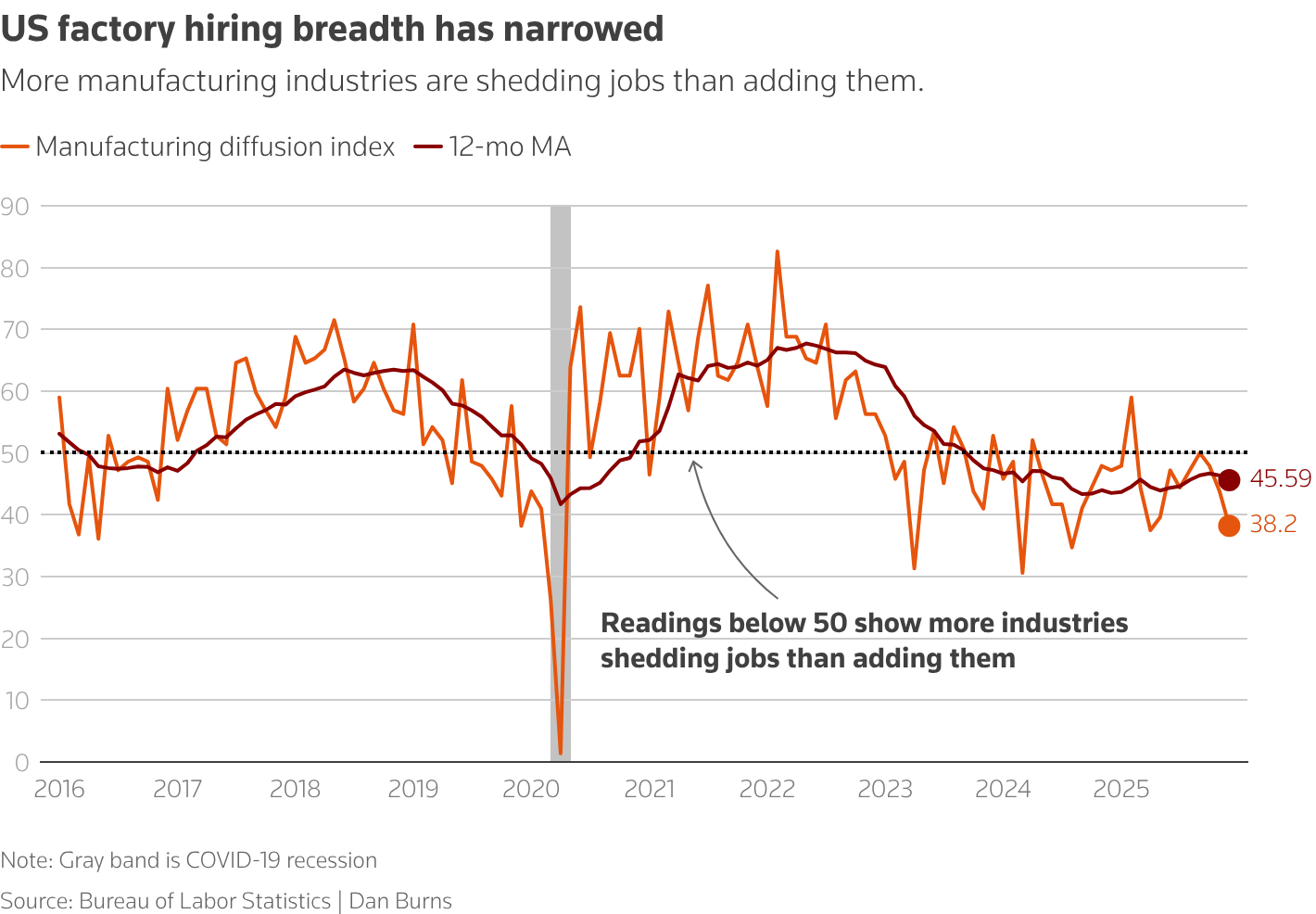
Liberation Day sure was liberating! No wonder Trump is getting spun up in regime change and irredentist imperialism: the tariff war was supposed to increase manufacturing jobs.
And this continued fall of the manufacturing sector has a cascade effect on the economy:
Keep in mind that every job in manufacturing typically supports three others.
"And I have always believed you have to find as many dots as possible before figuring out how — and to what end — to connect them.
If you are looking for facile explanations and gurus sharing their received knowledge (especially in the rapid-fire, sing-song broetry style), you need to look elsewhere."
Well said Stowe. To add a dot to the conversation, from the world of applied creativity (problem solving not art) people have sometimes heard of 'divergent thinking' (discovering new dots) and 'convergent thinking' (joining them in new ways). They may even have seen the two combined into a diamond shape, especially these days from design thinking or elsewhere. But most people misunderstand how they work. They narrow their options in divergence, and jump to conclusions in convergence, because its more comfortable to do that. We like to have 'certainty'. Even if its wrong because dots are missing.
Finding dots and connecting them is a lifelong practice, not a temporary distraction from pitching certainty. You can't track every possible dot for every problem, but you can notice your own filters and look beyond them.
Do my eyes deceive me? This is the real Stowe Boyd that I got so much from back in the golden days of Twitter circa 2006ish? I’m so glad to have found your wisdom here. Love your take on all things! Sorry for fangirling.