

…
To see what is in front of one’s nose needs a constant struggle.
| George Orwell
…
I feel that Orwell’s line reads better to my contemporary ears with a ‘just’ at the front and some paraphrasing: ‘Just to see what’s in front of your nose is a constant struggle’.
Struggle on!
Sundays Are The New Mondays
996 culture (9am to 9pm, 6 days a week), a trend transplanted from China, has taken hold in Silicon Valley, according to Amanda Hoover:
As of last year, 5% of white-collar workers in the US logged on during the weekends, a 9% increase from 2023, according to an analysis of the habits of more than 200,000 employees and 777 companies conducted by ActivTrak, a workforce-analytics and productivity-software company. They clocked an average of about 5 hours and 30 minutes on Saturdays and Sundays, and those at mid-size companies of about 1,000 to 5,000 employees were the most likely to work weekends. In 2024, people with bachelor’s degrees worked an average of four hours on a weekend, according to the U.S. Bureau of Labor Statistics, and about 29% of all employed people worked on weekends.
Hoover argues that people are doing this as an act of ‘liberation’, finding time that is ‘distraction-free’:
Others say the weekends are their distraction-free days. A 2025 report from Microsoft found that workers experience some 275 distractions each day, or an interruption about every two minutes during the 9 to 5 workday. The average desk worker sits in meetings for nearly 15 hours a week in 2024, according to a survey from AI-powered calendar app Reclaim.ai.
Heading toward Josef Pieper’s ‘total work’, which I wrote about in the past:
Pieper poses an existential question, which I fear we have sidestepped, these days, as we’ve accepted the tyranny of work:
What is normal is work, and the normal day is the working day. But the question is this: can the world of man be exhausted in being “the working world”? Can the human being be satisfied with being a functionary, a “worker”? Can human existence be fulfilled in being exclusively a work-a-day existence?
To me, the answer is an unequivocal no. But your mileage may vary. But I believe we are confronted by a constant struggle to resist the tyranny of work culture, management, and the clock, and carve out time for leisure, play, and rest.
Ungovernable Change
In Why Keeping Up with Change Feels Harder Than Ever, Kayla Velnoskey, Ingrid Laman, and Carolina Valencia introduce the concept of ‘ungovernable change’1, an outgrowth of the frantic levels of change initiative corporations are undertaking today:
A March 2025 Gartner survey of more than 980 global leaders found that only 32% of mid- to senior-level leaders were able to implement their last change initiative on time while maintaining employee engagement and performance.
Leaders are managing ungovernable change at a time when their employees are increasingly skeptical of their efforts: 79% of the 2,900 global employees surveyed by Gartner in April 2025 don’t trust their organization’s ability to change effectively. The majority believe that their organization has made poor change decisions in the past and are unlikely to be successful in the future.
The authors summarize the problem:
Leading through change is more difficult than ever because of the convergence of four factors: 1) not only is there a large volume of change, but changes are stacked, one on top of the other; 2) not only are changes happening faster, they’re continuous, without a start or end date; 3) not only are changes larger in scale; they’re interdependent; and 4) not only is change unpredictable, they’re externally driven by technology, geopolitical trends, and more.
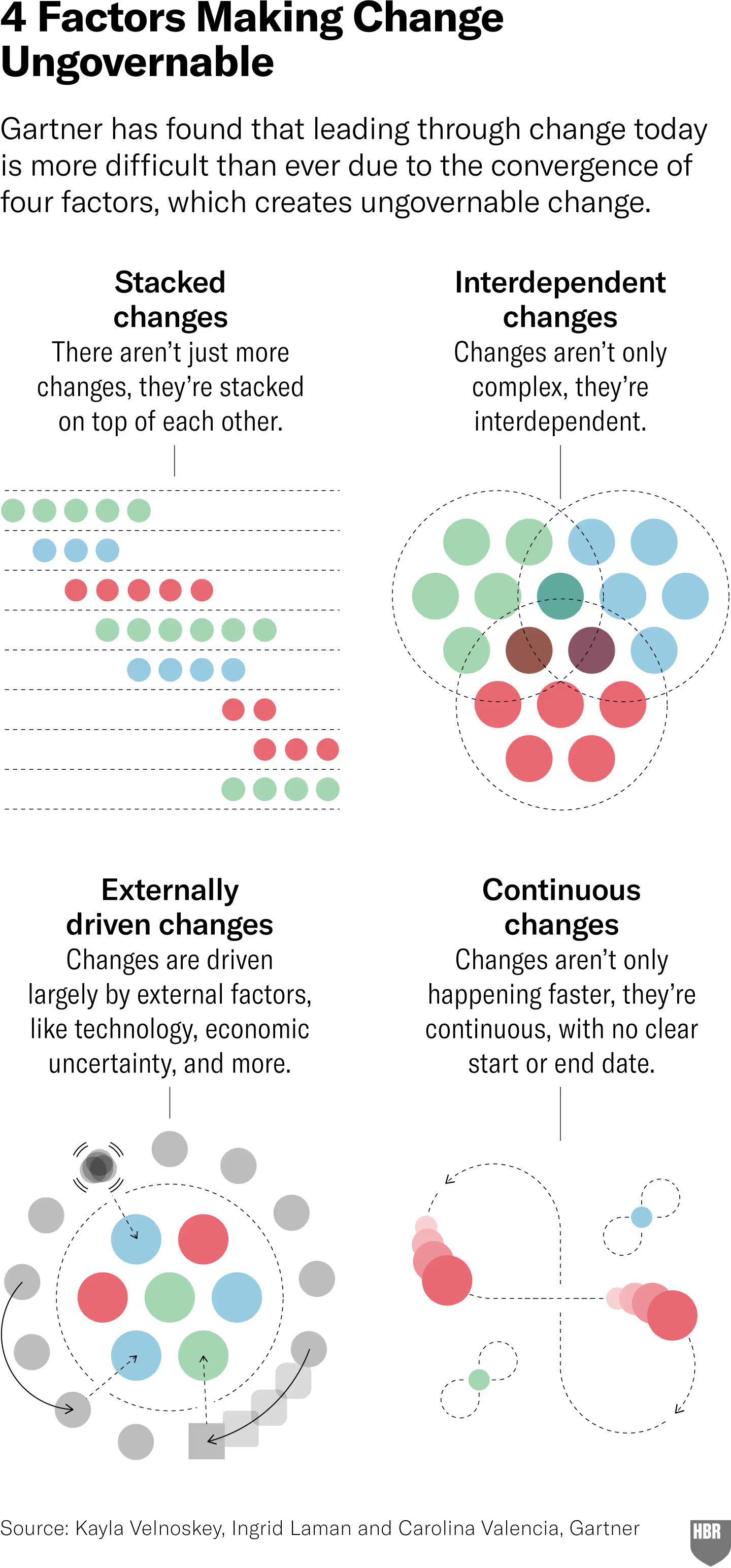
The answer in not to slow down, according to the authors, because the world is moving at ungovernable rates.
The companies that are most successful turn the situation inside out. Instead of slowing down, they inculcate routinizing change. They ‘routinizing change—treating it as an everyday business process’.
Note that in their own survey data, ‘79% of employees don’t trust their organization’s ability to change effectively’. This means ‘adopting three strategies’:
Communicate that change is a journey, not a destination.
Enable change-ready employees, not change enthusiasm.
Foresee multiple possible scenarios, not just the current change.
The examples they offer sound rational, but the paper reads more like a PowerPoint than something that can overturn the disruptions of ‘ungovernable change’. And the subtext, again, is Pieper’s ‘total work’ seeping into everything. Not only do you have to complete the work of the day, but have to become a willing confederate in blowing up any sense of stability, and embrace total change — in all dimensions — as the norm.
I’ve been writing and speaking about the future of work for over 30 years. Along the way, I’ve consulted with and written for Microsoft, IBM, Google, Dell, Cisco, and dozens more. In 2007, I coined the term ‘hashtag’ (yes, hashtag), and many other terms that have shaped the way we think about work, like ‘work management’, ‘social tools’, ‘work media’, and others. If you want to help me continue my work, consider a paid subscription.
