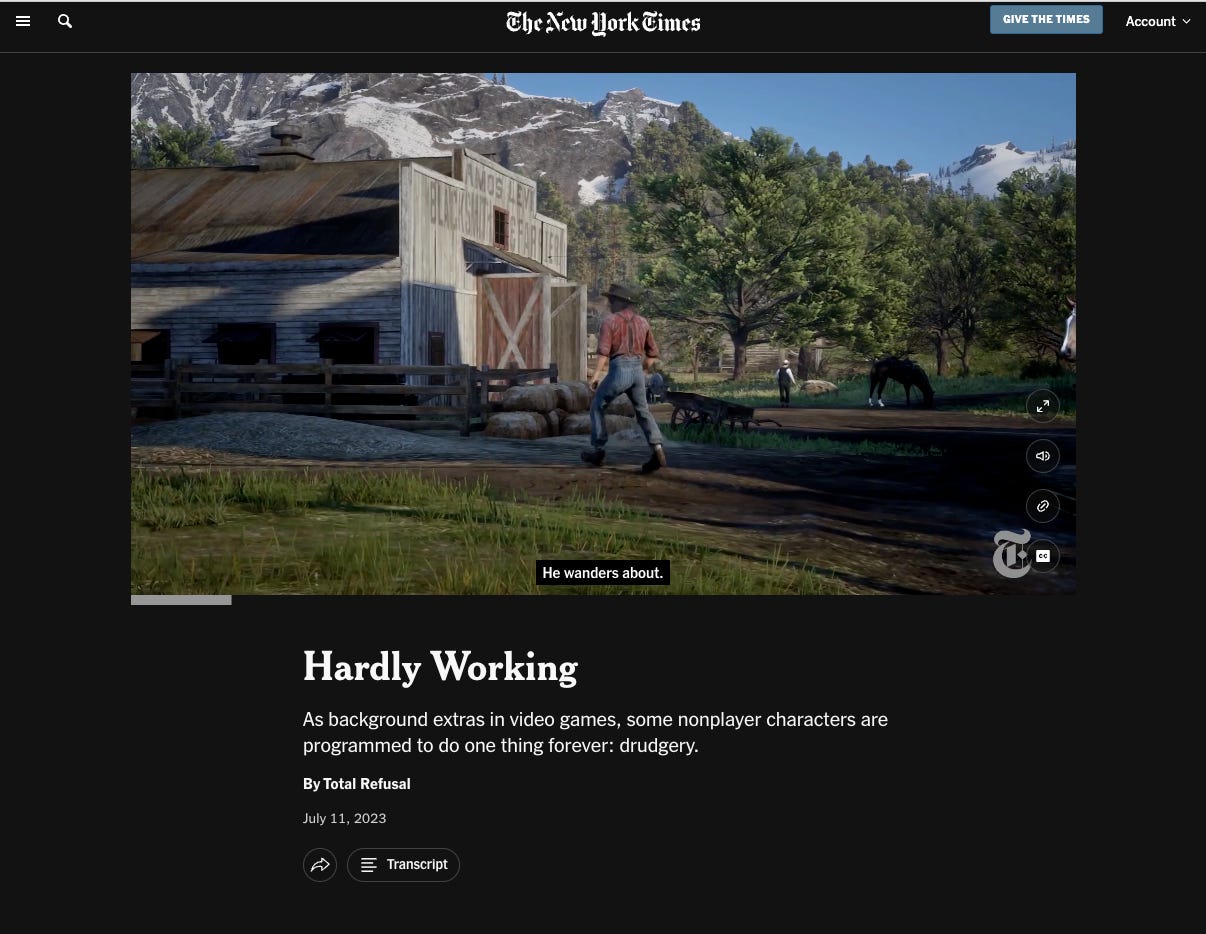
A great video by the artist collective Total Refusal.
I’d really like readers to sign up for a paid annual subscription, so for the rest of April, I have dropped the annual subscription to $30. Note that I’ve also raised the monthly subscription to $10 per month from $6 per month. Give annual a try. The biggest value is years of posts behind the paywall, and of course, seeing new posts in their entirety.
The Fall of Pax Americana
The numbers are clear: war is on the rise, globally, and not just this month.
From 1989 to 2014, battle-related deaths from cross-border conflicts averaged fewer than 15,000 a year. Beginning in 2014, the average has risen to over 100,000 a year. As states increasingly disregard limits on the lawful use of force, this may be just the beginning of a deadly new era of conflict.
According to the projections, an estimated 28,300 people will be killed in Ukraine in 2026, while 7,700 deaths are forecast in Israel and the Palestinian territories, and 4,300 in Sudan.
Ukraine, Sudan, Venezuela, Iran, Lebanon, Gaza, Myanmar, and whatever is coming next. The world contains at least 31 million refugees, and we are creating more all the time.
China has managed to stay out of military conflicts, while Russia and the US are up to their armpits in them. What has China been doing, instead?
Already, China’s economy is roughly 30 percent larger than the United States’ by purchasing power, its industrial base twice as large, its power generation twice as high, and its navy is on track to become 50 percent larger by the end of this decade. It leads in new technologies like electric vehicles and next-generation nuclear reactors while the United States increasingly depends on it [China] for everything from antibiotics to rare-earth minerals.
China announced on Wednesday the world’s largest trade surplus ever, even adjusting for inflation, as a tsunami of exports flooded markets around the world last year.
China’s surplus, the value of goods and services it sold abroad versus its imports, reached $1.19 trillion, an increase of 20 percent from 2024, according to data released by the country’s General Administration of Customs. The number had already exceeded $1 trillion through November.
The country’s surplus is still widening: For December alone, China’s surplus reached $114.14 billion, propelled by surging exports to the European Union, Africa, Latin America and Southeast Asia. It was the third-highest monthly surplus on record, trailing only January and June last year.
The enormous trade surplus for the full year came despite efforts by President Trump to use tariffs to contain China’s factories. The tariffs reduced China’s trade surplus with the United States by 22 percent last year. But Chinese factories increased sales to other regions, in many cases bypassing American tariffs by shipping goods to the United States through Southeast Asia and elsewhere.
Of course, it’s not all sunshine and flowers. China has persistent problems, like the massively overbuilt housing sector which had harmed individual investors, banks, and regional governments that financed the glut. Older workers find themselves pushed out jobs because of institutionalized agism. Young workers are growing disillusioned by a stagnating economy, as reported by Joy Dong, Max Kim:
In past decades, China’s rapid economic growth lifted 800 million people out of poverty and gave rise to a flourishing middle class. But, analysts say, growth and wages have since stagnated, and prospects for social mobility have dimmed. For many young people, the once-idealized life of striving now evokes drudgery, exhaustion and disappointment.
Those sentiments are reflected in the backlash to “996” culture — the expectation of working from 9 a.m. to 9 p.m., six days a week, promoted by prominent figures in the country’s tech sector. They can also be seen in online descriptions of modern life as “garbage time,” an American sports term for the final minutes of a game, when the outcome is already decided but players must still go through the motions.
This perspective explains the rise of an oddball meme, the Sad Toy Horse.
source: eBay
The plushie first appeared last year in a shop in eastern China. It has stumpy legs, a golden bell around its neck and lettering on its side that reads, “wishing you instant wealth.” It also bears a conspicuous manufacturing error: Its mouth is sewn upside down, turning what should have been a content smile into a picture of melancholy.
Known as the “crying horse,” the glum toy has become an online sensation in China ahead of the Lunar New Year, the country’s biggest holiday, which begins on Feb. 17. The “crying horse” hashtag has appeared more than 190 million times on Douyin, the Chinese version of TikTok, and inspired a winking joke: Take the crying version to work, leave the smiling one at home.
The toy’s sudden popularity has resonated beyond novelty. Many young Chinese workers have embraced it as a symbol of their exhaustion and disillusion.
“Its expression perfectly reflects the helplessness of an office worker,” Ms. Hao said. She bought four, two sad and two smiling.
China is no garden of Eden, but even with the sad toy horses — this is the year of the horse, there — and all the social ills of Chinese society, I have to confess that it’s apparent stability relative to what the US is up in geopolitics has its attractions. But I will have to add the caveat that China might use this time of invasions to occupy Taiwan, and that would figure given the strange calculus of 2026.
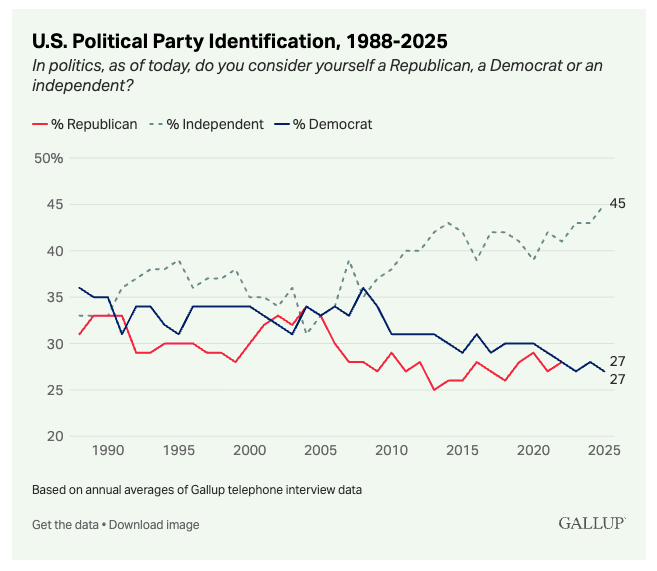
Gallup reports on a political realignment in the US: more independent voters.
A record-high 45% of U.S. adults identified as political independents in 2025, surpassing the 43% measured in 2014, 2023 and 2024. Meanwhile, equal shares of U.S. adults — 27% each — identified as either Democrats or Republicans. … In most years since Gallup began regularly conducting its polls by telephone in 1988, independents have been the largest political group. However, the independent percentage has increased markedly in the past 15 years, typically registering 40% or higher, a level not reached prior to 2011.
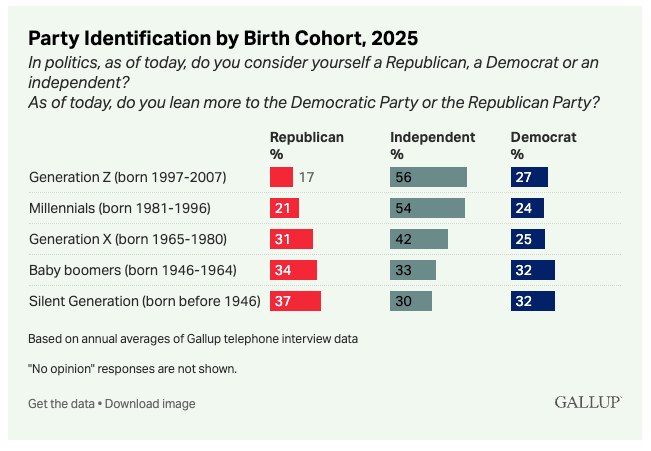
The higher rate of political independence also results from younger adults today being more likely than young adults in the past to identify as independents. The 56% of Gen Z adults identifying as independents today compares with 47% of millennials in 2012 and 40% of Gen X adults in 1992.1
Taking into account Americans’ party identification and political leanings, an average of 47% identified as Democrats or said they were independents who lean toward the Democratic Party, while 42% identified as Republicans or leaned Republican. This breaks a three-year stretch in which Republicans held an edge in party affiliation.
US voters are growing increasingly dissatisfied with both major political parties.
Continue reading this post for free, courtesy of Stowe Boyd.