
The pathology of decision-making in wars like this is that leaders often fall into sunk cost fallacies. Wars tend to go on well beyond the point when either side can attain a decisive advantage. At a certain point, leaders often want to believe that something will break their way simply if they persist, even though there’s no evidence of that happening.
| Michael Kofman, ‘Time Is Not on Russia’s Side’: A Q & A With Michael Kofman
…
Watching three wars at once — in Iran, Ukraine, and Lebanon — brings Kofman’s observation into high relief. His ‘wars like this’ was referring to Russia’s war in Ukraine, but Israel has been invading, occupying, and retreating in and out of Lebanon since 1978. And now, the US has gone to war with Iran. And the protagonists have fallen into the trap: desire is not a strategy.
These lessons are directly applicable to business, too. For example, look at the history of media mergers and acquisitions in the past few decades. Remember the $99 billion write off at AOL Time Warner? And the drunk-falling-down-the-stairs history of Time Warner since?
I’d really like readers to sign up for a paid annual subscription, so for the rest of April, I have dropped the annual subscription to $30. Note that I’ve also raised the monthly subscription to $10 per month from $6 per month. Give annual a try. The biggest value is years of posts behind the paywall, and of course, seeing new posts in their entirety.
Grift, Plain and Simple
Financial shenanigans — especially those that increase debt for nebulous economies — are overwhelmingly bad, strategically, and only line the pockets of financiers.
Perhaps the most remarkable fact about modern finance is that it fails on its own terms. Mergers and acquisitions tend to destroy value even as they sate the appetites of empire-building chief executives. In 2016, the Harvard Business Review highlighted “the rule confirmed by nearly all studies: M&A is a mug’s game, in which typically 70 percent to 90 percent of acquisitions are abysmal failures.”
| Oren Cass, The Finance Industry Is a Grift. Let’s Start Treating It That Way.
Tech Layoffs Go Viral
Oracle lays off 18% of its workforce, around 30,000 people. Block laid off 40%, Snap 16%, Meta plans another 10% cut in May. Brian Elliott writes in Contagion:
Oracle’s Larry Ellison, Block’s Jack Dorsey and Meta’s Mark Zuckerberg are among the notable tech founders now racing to see who can make the most of the AI opportunity to transform work. They may also be in a contest to see who can be the most badass when it comes to cutting people.
Predictably, the contagion is spreading. The WSJ reports this week that Block’s CFO is fielding calls asking for their playbook. I’ve heard the same from a number of people in San Francisco: the tech bros are out to see who can get aggressive the fastest in transforming their business, damn the side effects.
More cuts in tech are coming. The narrative is taking hold: AI is a human replacement technology.
So guess what? All those economists and senior leadership who countered claims about AI as a job-killing tsunami by saying it would augment, not replace workers, workers who would be freed from drudgery and allowed to develop new skills, new sorts of work… well, it’s turning out to be bullshit, at least in large tech companies.
Brian Elliott argues that these large companies may be using AI as a smokescreen to reduce bureaucratic bloat. But he also cites BCG research that shows serious levels of projected disruption:
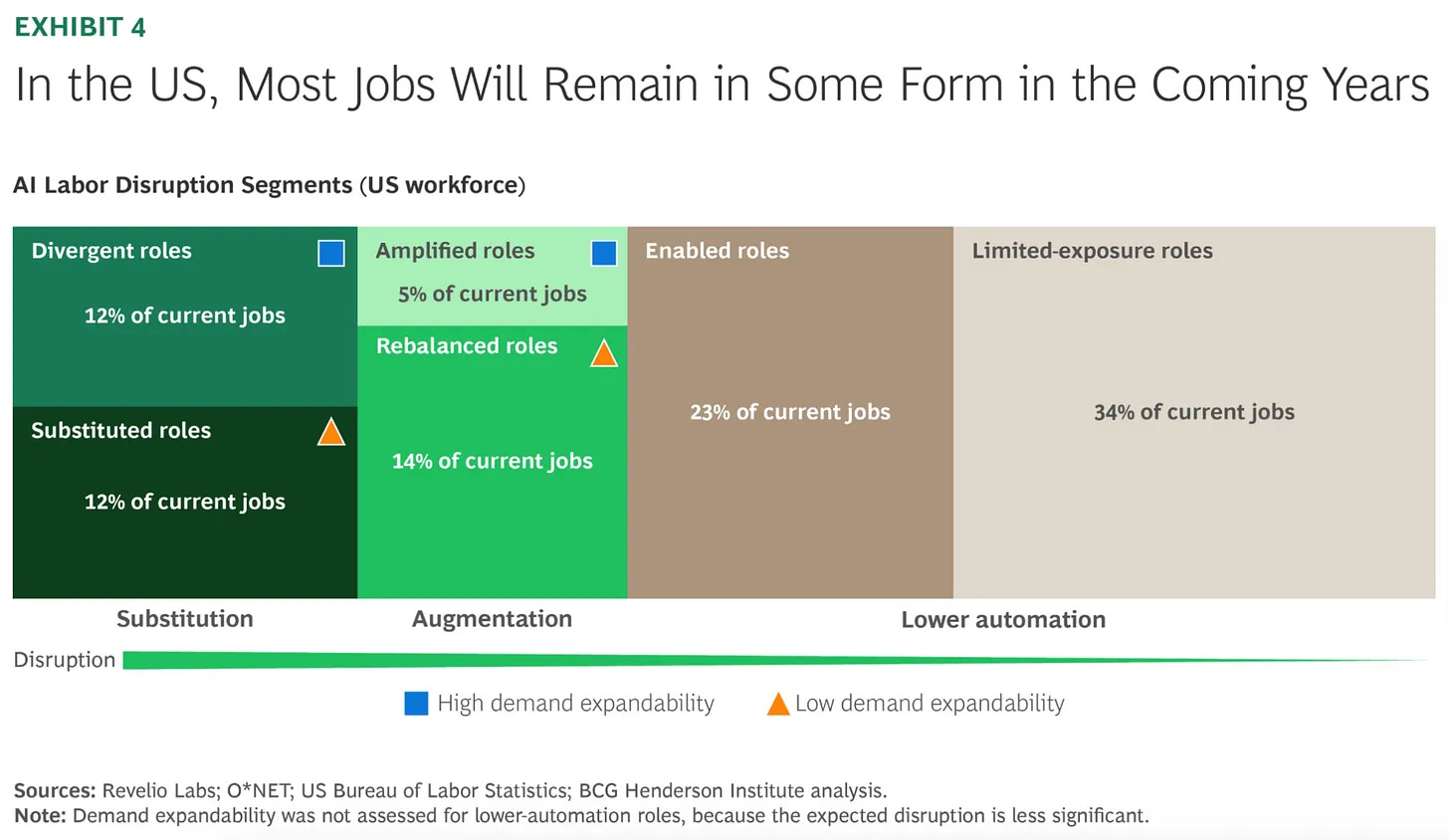
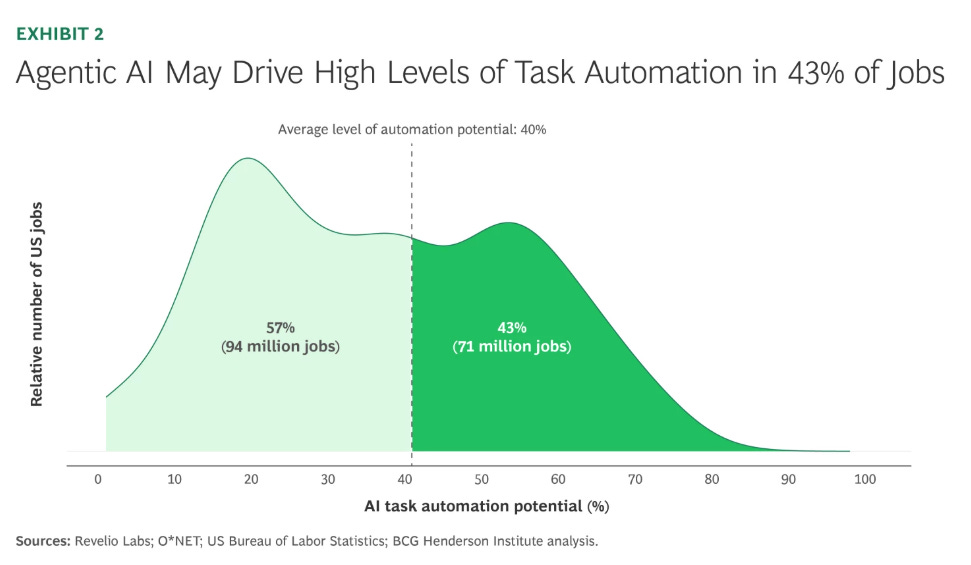
71 million jobs impacted by ‘high levels of task automation’: that’s half of the 150 million people working in the US, today.
And the BCG researchers attempt to square the circle saying that most jobs would be reshaped, not replaced, but that with this year’s AI tools. What about AI of 2027, or 2030?
…
As I have argued for over decades, just as soon as it is possible, businesses will cram AI into every nook and cranny, and displace workers without a second thought.
Unless we, the people — presumably through our elected representatives — stop them.
It is time for the Human Spring, when we collectively demand a moratorium on job displacement by AI, or else we may be standing in the ruins of a once-thriving (or at least muddling by) civilization.
Even though our governments seem to flubbing the fight against climate change, we must rise to the challenge of unfettered AI. And soon. Or else.
The Fall of HR
Ashly Goodall zooms in on how HR is seemingly out of the loop while this is going on [emphasis mine]:
Today, the HR profession finds itself at a crossroads. Its traditional focus has been the supply of talent. It has concerned itself with hiring, compensation, promotion, and learning, all in service of ensuring that an organization has the right people in the right roles for as much of the time as possible. Where it has moved beyond this remit, it has tended to retain the perspective of the C-suite. So its work on culture has typically focused more on describing what a culture should be than on figuring out how one is made, or changed. And its work on performance has typically focused more on how to judge it than on how to generate it.
But much of this work is being automated. For better or worse, AI is now screening applicants, recommending salaries, suggesting e-learning, and writing performance reviews—and even where humans remain in the loop, much of the traditional work of HR is being hollowed out.
Meanwhile, many organizations appear increasingly indifferent to the idea that they owe anything to their employees. Layoffs abound once again. My former employer, Deloitte, is cutting PTO and parental leave for some part of its workforce. Workers are being summoned back to the office in ever sterner terms.
So the technical elements of HR are being done more and more by the machines, even as the human elements are devalued. I heard recently about an HR leader who asked his CEO if he could invest in a leadership development program. The CEO told him his job was to keep HR issues off the CEO’s desk—and that if he succeeded at this, he could invest in whatever programs he wished.
HR was always more like a police force than faculty, but increasingly, they are being marginalized as even the incredibly precarious 21st-century work detente between management and managees is fraying.
