We learn to think of history as something that has already happened, to other people. Our own moment, filled as it is with minutiae destined to be forgotten, always looks smaller in comparison.
Gessen uses the lens of history to shrink our experience to inconsequence. But others have shared a different take on history making us feel small, like Gary Greenberg:
History’s wheel is indifferent, not unlike cancer or a cheating spouse, and can crush us willy-nilly. Which means, I hear myself saying to my own surprise and dismay, that it falls upon us to cultivate helplessness. That’s not to say we should cultivate inaction or nihilism. It’s to say that we really have no choice but to recognize just how tiny we are, and how much we therefore need one another, and in uncertain times even more. Our minds, as glorious as they are, cannot tell us the future, nor save us from it. The uncertainty we live in right now is only a reminder that this is our lot.
Realizing we are tiny can bring us together.
I’d really like readers to sign up for a paid annual subscription, so for the present time, I have dropped the annual subscription to $30. Note that I’ve also raised the monthly subscription to $10 from $6. Give annual a try. The biggest value is years of posts behind the paywall, and of course, seeing new posts in their entirety.
Excel and Accountants
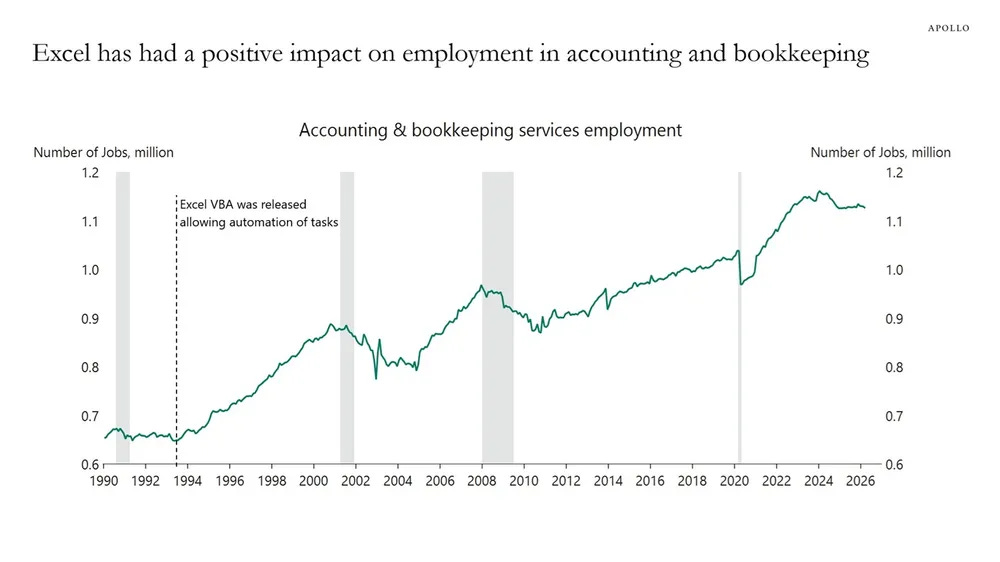
Courtesy of Mike Zaccardi, this chart tracks the increase in accountants following the release of Excel 5.0:
source: Torsten at Apollo
Zaccardi mentions this as an example of Jevons paradox — where efficiency gains paradoxically lead to an increase in resource use1 —, saying:
In 1993, Microsoft released Excel 5.0 for Windows, opening up near-unlimited possibilities for automating repetitive tasks, crunching numbers, and presenting data. The result has been more accountants, not fewer.
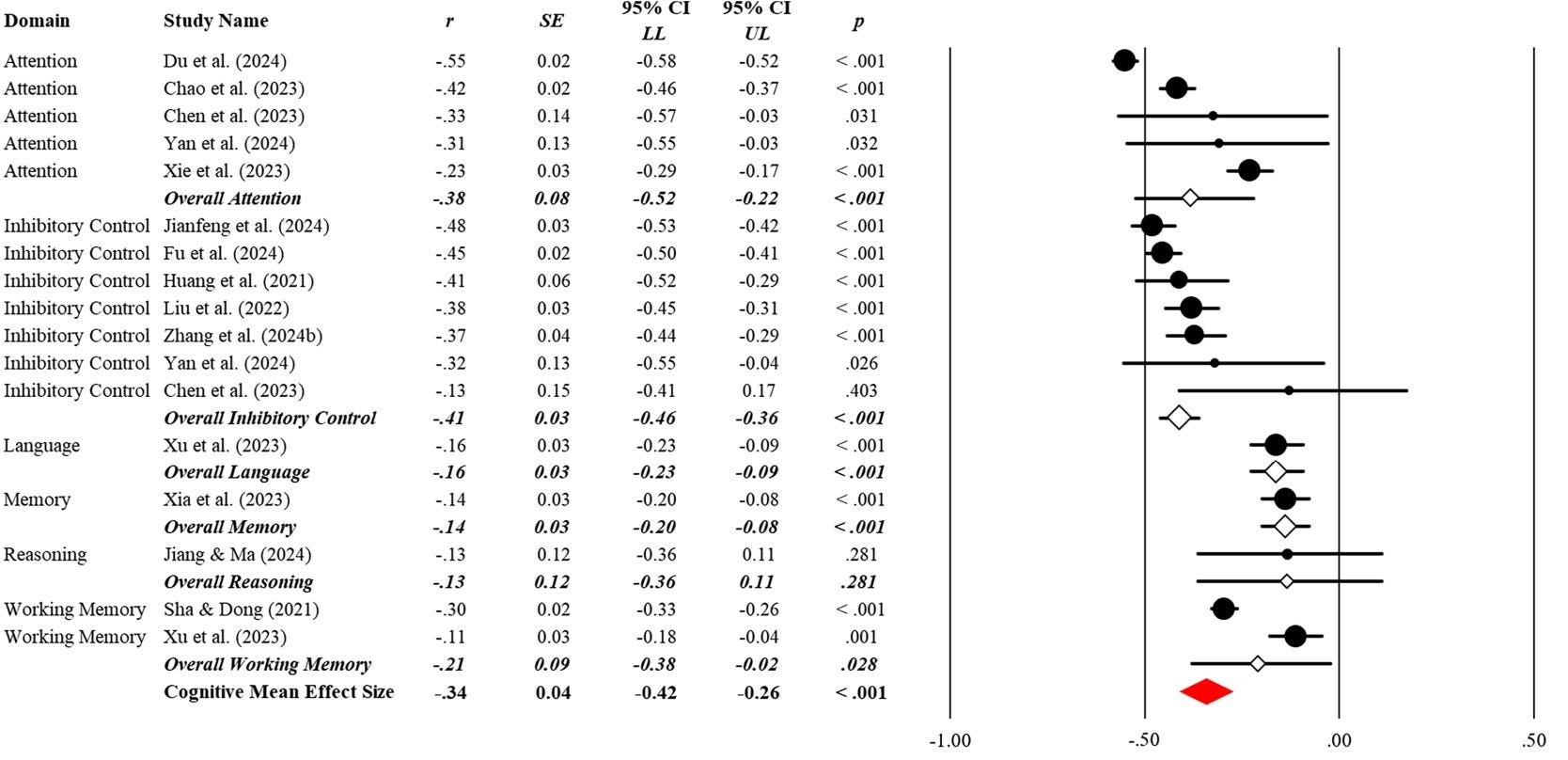
A systematic review of 71 studies with 98,000 participants published in 2025 reached an alarming finding. Across the dozens of studies, heavy short-form video users showed moderate deficits in attention, inhibitory control, and memory. In the chart below, you can see a consistently negative, if also heterogeneous, relationship between heavy short-form video use and problems with attention, memory, and control.
Several studies in the meta-analysis reported structural and functional differences in the prefrontal cortex and reward circuits among high-frequency users, while others found cognitive flexibility reductions and altered dopaminergic reward responses. None of this proves causation. But taken together, they suggest a plausible mechanism: a daily diet of hyper-rewarding, rapid-fire stimuli may gradually reshape attention and regulatory systems in ways that weaken our attentional control. It is, of course, possibly that people with weaker cognitive control are simply more drawn to slot-machine media in the first place.
Data Center Building Overtakes Office Construction
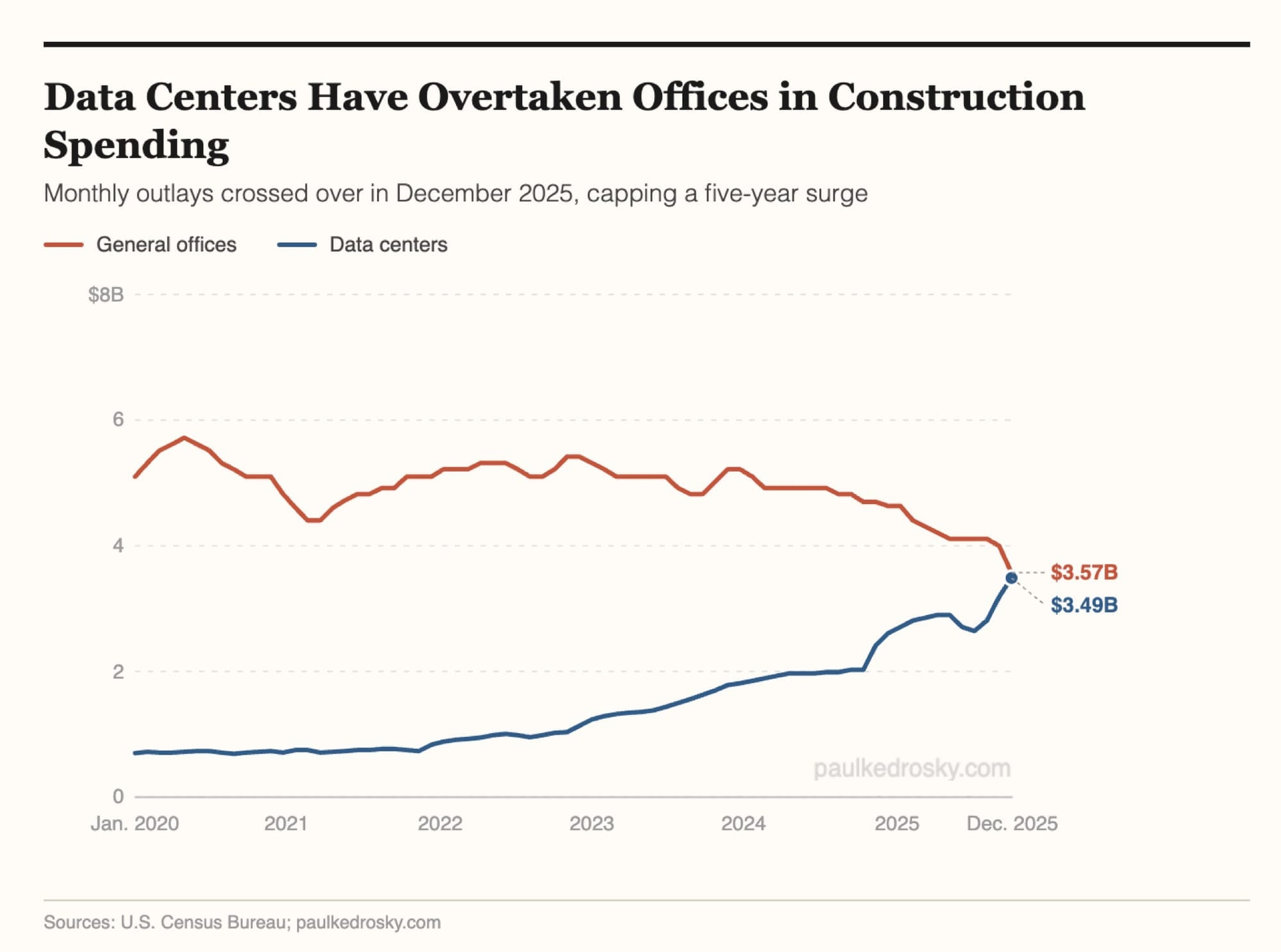
Via Paul Kedrosky [emphasis mine]:
Data center construction spending passed office spending for the first time in December 2025, crossing at roughly $3.5B monthly.
Office construction has fallen ~35% from its 2020 peak.
Data center spend is up 5x since 2020, with the curve steepening sharply in late 2024.
Data center spending in the U.S. just crossed over office construction spending. Granted, office construction spending has been declining for years — down roughly 35% from its 2020 peak — but data center construction is up 5x over the same period.
The Census data excludes racks and servers, so this is purely structural construction: concrete, steel, power infrastructure, cooling systems, etc. That makes the numbers more meaningful, not less. The physical footprint of AI compute is now larger than the physical footprint of white-collar office work, at least as measured by monthly construction spending.
The acceleration in the back half of 2024 and into 2025 is impressive. The curve isn’t linear: it steepened sharply as hyperscaler capex commitments made in 2023 and early 2024 translated into actual ground-breaking.
The office line, meanwhile, has no obvious bottom. Remote and hybrid work permanently destroyed a layer of demand that is not coming back. And AI is changing the shape and scope of future white-collar work. Capital is really and truly replacing labor, in multiple ways.