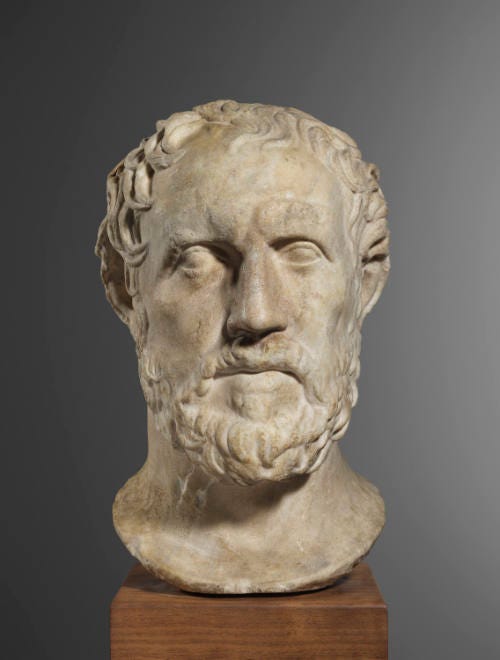
The strong do what they can, and the weak suffer what they must.
| Thucydides, History of the Peloponnesian War
…
Thucydides was writing at the end of the fifth century BC about the war between Athens and Sparta. In a perhaps apocryphal debate between representatives of Athens and the island of Melos. Unsuccessful in gaining Melian support for their cause, the Athenians simply invaded the island, killing the men, enslaving the women and children, and colonizing the island.
Twenty-five centuries later, his words echo in our politics, economics, and social systems, from battlefields to corporate boardrooms.
Management vibes.
In a recent survey of 5,000 employees by commercial real estate firm CBRE, 37% of office workers said they report to a manager who sits in a different office. Physical proximity, in other words, is no longer the default for nearly 40% of the office workforce.
But at many RTO organizations, management is trying to turn back the clock. [This might be related to the general shift in the C suite away from worker-friendly policies, and a hardening of authoritarian impulses, reflecting the political shift in the US.]
Again, Elliot:
What’s behind too many return-to-office drives isn’t data. It’s vibes. Employees see the lack of trust, and feel less engaged. “When people feel a mandate, their intrinsic motivation to do that activity goes down,” Professor [Anne-Laure] Fayard [of the Nova School of Business and Economics] explained.
Fayard’s viewpoint is supported by other evidence. A survey by Sponge Learning showed that workers are shellshocked when management makes changes like full-time return to the office. They call these shaken workers ‘generation numb’:
Change feels like noise.
When companies announce new rules, ways of working, or strategies, almost 50% of employees say they feel numb, indifferent, or ‘nothing’ at all, with a further 30% reporting feeling overwhelmed or anxious as a result. Rather than igniting motivation, change is reinforcing detachment.
Disconnection is pervasive.
Despite always being “connected” online, 63% of respondents said they sometimes, often, or always feel disconnected from colleagues. For many, this sense of isolation is translating into reduced productivity, creativity, and engagement. Of these, a quarter say it’s made them ‘disengaged’, and a further 1 in 5 self-reports becoming ‘more cynical’ as a result.
Cynicism is one of the precursors of burnout.
Meetings suck.
A November survey by Dropbox looked into the current state of meetings.
Meetings remain stubbornly inefficient. According to a recent Flex Index survey of global knowledge workers:
32% spend most of their week in meetings, yet fewer than half (48%) find them effective
Only 13% say most meetings are worth the time
45% report getting enough uninterrupted time for deep work
Just 20% automate notes for most meetings, while 37% rarely or never use automation tools
Attendance is often driven by obligation, not because participants add meaningful value
Meetings are a challenge internally at Dropbox:
Our own internal surveys echo this. While about 70% of meetings are considered effective (which is rather high compared to external benchmarks), Dropbox employees still report that recurring meetings, inconsistent agendas, and global time zone challenges continue to create friction.
The report goes on to make a lot of good recommendations, basically suggesting being much more intentional about meetings, minimizing them to the degree possible, being judicious about who should attend, structuring the agenda clearly, and so on.
However, the survey suggests that meetings need rethinking.
And, many companies want more people in the office five days a week so they can have more meetings.


