
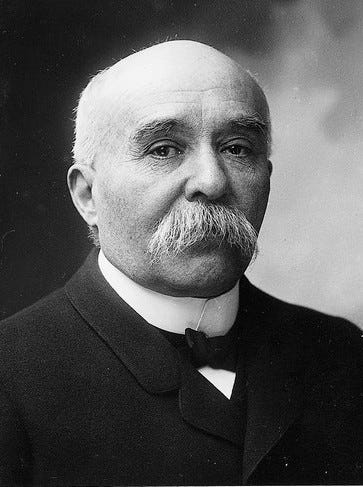
It is far easier to make war than peace.
| George Clemenceau
A Bias Toward Action
Clemenceau is also remembered for saying ‘War is a series of catastrophes that results in a victory’ and ‘War is too serious a matter to entrust to military men’, which suggests that his experience as Prime Minister of France during World War I led him to a deep understanding of the frailties of peace and traps of war.
The top-most quote can be generalized as ‘It is far easier to take action than to think’, a tendency that is increasingly in vogue in today’s AI-accelerated business climate. How many times have I recently read that the AI economy is moving so fast that slower, more deliberative modes of decision-making must be rejected? A lot.
Daniel Kahneman won the Nobel prize in economics for his breakthroughs in behavioral economics, although trained as a psychologist. He, Dan Lovallo, and Olivier Sibony wrote1 about the two systems we use for navigating the world before his masterpiece, Thinking, Fast and Slow, was even released [emphasis mine]:
According to cognitive scientists, there are two modes of thinking, intuitive and reflective. (In recent decades, a lot of psychological research has focused on distinctions between them. Richard Thaler and Cass Sunstein popularized it in their book, Nudge.) In intuitive, or System One, thinking, impressions, associations, feelings, intentions, and preparations for action flow effortlessly. System One produces a constant representation of the world around us and allows us to do things like walk, avoid obstacles, and contemplate something else all at the same time. We’re usually in this mode when we brush our teeth, banter with friends, or play tennis. We’re not consciously focusing on how to do those things; we just do them.
In contrast, reflective, or System Two, thinking is slow, effortful, and deliberate. This mode is at work when we complete a tax form or learn to drive. Both modes are continuously active, but System Two is typically just monitoring things. It’s mobilized when the stakes are high, when we detect an obvious error, or when rule-based reasoning is required. But most of the time, System One determines our thoughts.
Lovallo and Sibony, in an additional paper, focused specifically on the need to recognize uncertainty as a way to counter the bias toward action, and to think more slowly [emphasis mine]:
Most executives rightly feel a need to take action. However, the actions we take are often prompted by excessive optimism about the future and especially about our own ability to influence it. Ask yourself how many plans you have reviewed that turned out to be based on overly optimistic forecasts of market potential or underestimated competitive responses. When you or your people feel—especially under pressure—an urge to take action and an attractive plan presents itself, chances are good that some elements of overconfidence have tainted it.
To make matters worse, the culture of many organizations suppresses uncertainty and rewards behavior that ignores it. For instance, in most organizations, an executive who projects great confidence in a plan is more likely to get it approved than one who lays out all the risks and uncertainties surrounding it. Seldom do we see confidence as a warning sign—a hint that overconfidence, overoptimism, and other action-oriented biases may be at work.
Superior decision-making processes counteract action-oriented biases by promoting the recognition of uncertainty. For example, it often helps to make a clear and explicit distinction between decision meetings, where leaders should embrace uncertainty while encouraging dissent, and implementation meetings, where it’s time for executives to move forward together.
Looking at the war that the US finds itself in — by overconfidence and a hubristic bias toward action — we can be certain that those who decided to initiate the war on Iran forgot — or never read — Clemenceau’s thoughts on war and peace. And I would be surprised if President Trump or Secretary Hegseth read Thinking, Fast and Slow, or even considered that a bias toward action is dangerous, especially when the stakes are high, and uncertainty rules the day.
I’d really like readers to sign up for a paid annual subscription, so for the present time, I have dropped the annual subscription to $30. Note that I’ve also raised the monthly subscription to $10 from $6. Give annual a try. The biggest value is years of posts behind the paywall, and of course, seeing new posts in their entirety.
Week In Review
On a personal note.
I had a singularly unproductive week preceding Memorial Day.
Somehow — I’m not exactly sure how — I managed to injure my right thumb. I woke up one morning, Tuesday last, and the base of my thumb ached, as if it had been ‘stubbed’ (as I have sometimes done with my big toe).
After a bit of research, it appears I was suffering from ‘mommy’s thumb’ or DeQuervain's Tendonitis. One reason for that prognosis is that after icing it for a few hours and two days of no typing, the pain had completely stopped, meaning the swollen tendon in my thumb had worked free from the channel it had caught in. Whew. No surgery required.
The second factor in my lack of productivity was something more pernicious: overwhelm. I am an avid notetaker and daybook curator, relying on the Obsidian platform. To avoid a too-detailed explanation, I have been juggling a long list of works-in-process, source materials, and plans for the future. Last week, I reached the point where things became unworkable.
The solution turns out to be conceptually simple but complicated in practice. I had been managing tasks in several Kanban boards, for example, one for workfutures.io. However, I had over a hundred tasks on that one board alone; other boards were overflowing as well. I resolved to create a dozen or so smaller boards for materials, working notes, and plans related to narrower topics — such as ‘AI backlash’ and ‘girl bosses’ — rather than the entirety of everything workfutures.io.
As I said, easy conceptually. But in practice, it took me a few days to retool those hundreds of tasks, sprinkled all across my Obsidian folders, and create the dozen or so topic-centric Kanban boards.
As I was involved in that activity, I also unearthed dozens of old notes and articles related to the often newly identified topics. A sort of housecleaning, beating down the cobwebs, and also decreasing the background stress I’d been feeling for the past months, as the tasks had been mounting.
I feel I can breathe, again. But I didn’t post much last week. Apologies.
What’s coming next.
I am going to try to share some materials I’ve pulled into my notes prior to writing about them in detail.
I am working on a few front-burner topics:
The term ‘girl boss’ is getting some play, often as a kind of backlash against the Lean In era stereotype, and the excesses of self-help authors. See, for example: Plot Twist newsletter: This self-help book has hit the zeitgeist | The Economist; The Revolt Against the Girl Bosses Has Finally Come | Tressie McMillan Cottom; It’s Not a Mystery Why Fertility Rates Are Declining | Jessica Grose.
The backlash against AI is mounting. Even Pope Leo has things to say. Graduating seniors are booing tone deaf convocation speakers lauding AI. One survey found that three-quarters of Americans worry AI could pose a threat to humanity. What are the EU and China doing differently than the US? See, for example: China Wants A.I. to Flourish, but Not at the Expense of Jobs | Catie Edmondson; Empowering American Workers in the Age of AI | Bharat Ramamurti; Gov. Gavin Newsom to Sign Executive Order Aimed at A.I. Job Loss | Cecilia Kang; Resistance | Michelle Kim
Also tracking other themes: employer concentration, paid parental leave; meritocracy; and, of course, bad bosses.
