

When you’re young you think that time moves forward. At 80 you know that it doesn’t, it stands still. We’re the ones that move.
…
I’ve been distracted this past week, partly because of a menagerie of visitors passing through in homage to my mother-in-law, Erna Hoover, who celebrated her 100th birthday last Friday. With all the comings and goings, I was pulled away from my daily patterns, which can be both positive and negative simultaneously.
The pleasant distraction of the World Cup, and great conversations with family and friends led me back to Dylan’s observation that time is actually standing still while we are the ones moving, an echo of ‘time is a flat circle’ from True Detective. Everybody I spoke to — even 100-year-old Erna — spoke about where they are headed, new directions and new impulses.
And I discovered a new move that I will be making, in a series of discussions with one of my sons, Blake. You’ll be hearing more about that soon.
In the larger context of the Dylan quote about being 80, he also wrote about attaining freedom ‘from the lie that anything was ever under control. You don’t chase the parade anymore.’
Well, I realized that I am not 80 — or 100 — and I still have a parade or two left in me. More to follow.
I’d really like readers to sign up for a paid annual subscription, so for the present time, I have dropped the annual subscription to $30. Note that I’ve also raised the monthly subscription to $10 from $6. Give annual a try. The biggest value is years of posts behind the paywall, and of course, seeing new posts in their entirety.
AI Threatens The Back Office
Ben Casselman reports2 on a group that may be more vulnerable to displacement by AI than the often-discussed, higher-degreed knowledge workers like IT staff, lawyers, consultants, and radiologists: namely, back-office workers:
Many economists are more concerned about a different, larger group of white-collar workers: customer service representatives, bookkeepers, payroll clerks and human resources specialists who fly under the radar but collectively account for tens of millions of jobs.
These jobs typically offer a middle-class salary or a pathway to achieving one — much as manufacturing jobs did for men before decades of globalization and automation wiped many of them away.
“I worry that A.I. will be to high-school-educated women what deindustrialization was to high-school-educated men,” said Molly Kinder, a former researcher at the Brookings Institution who is starting an organization focused on A.I.’s impact on workers and the economy.
Like manufacturing in the early 2000s, when China was admitted to the World Trade Organization (leading to what is known as China Shock 1.0), Kinder is referring to the potential for outsourcing back-office jobs that provide a possible path to the middle class for many:
“If you think about the back office, that’s not the main function of the company, so they might think of it as a cost center,” said Jung Ho Choi, an accounting professor at Stanford.
Economists at Northwestern University recently recalculated measures of A.I. exposure based on the makeup of the total work force, not just the people using the technology. Administrative and frontline roles, such as customer service representatives, rose to the top of the list.
“The most affected jobs are secretaries, are routine clerks,” said Michelle Yin, one of the working paper’s authors. “They’re not computer scientists or data scientists at all.”
Widely cited measures of A.I. exposure, she added, “give the wrong impression” about who will be most affected — and, in particular, tend to understate the impact on people without college degrees, older workers and people of color.
[...]
“My worry is that the lesson from deindustrialization is that many of these women will be able to get another job, but it might be a much worse job,” Ms. Kinder said. “It might be more precarious.”
This is parallel to the IT revolution of the ‘80s and ‘90s, when typists, filing clerks, bookkeepers, and secretaries were displaced by office suites, email, and web services.
And even if AI comes on slowly enough for these millions of workers to make a transition to the new economy, so long as they get the chance to gain skills to take the next step on a new career ladder, like a receptionist moving into human resources.
If A.I. eliminates that middle step, it could be harder for workers to move up the career ladder, said Justin Heck, a coauthor on a recent article with Mr. Muro.
“What happens if we’re no longer building those skills on the job? Where is there available to move up?” Mr. Heck asked. “What are the ramifications three years from now, when workers remain stranded in low-wage work, and employers are struggling to fill high-wage roles because we’ve carved out the middle?”
What, indeed.
…
Meanwhile
Tech workers not using AI are three times more likely to be laid off, according to Gallup:
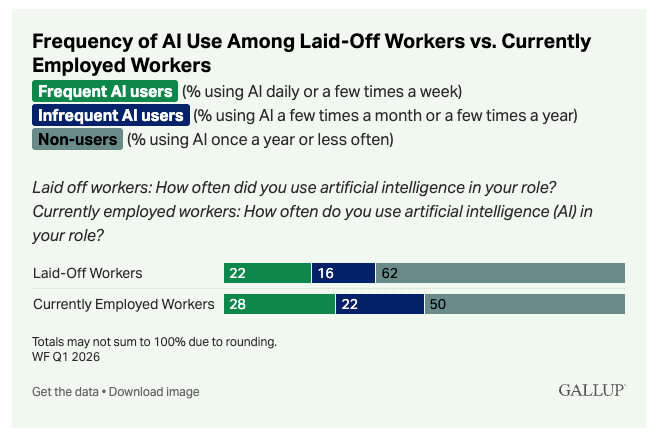
In the same survey, only 1% of laid-off workers claim AI was the reason. But consulting firm Challenger Gray & Christmas reported in March that AI had been cited in over 12,000 job cuts in the U.S.
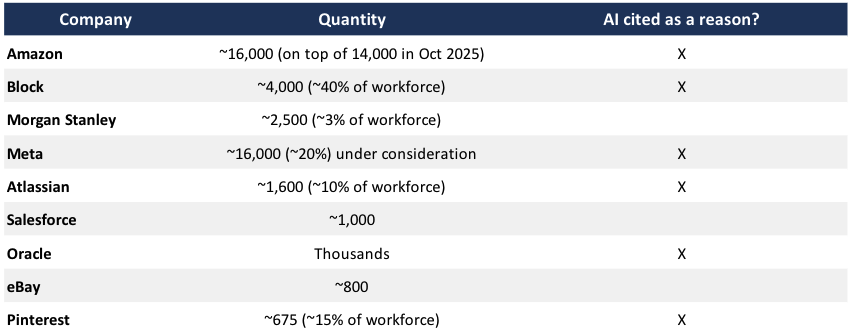
Maybe people were laid off without being told AI was the supposed reason?
Short Takes
The Luddites are back.
In Understanding the Luddites in the age of AI, Brian Merchant writes
The Luddites are back in fashion, but too many people still get them all wrong. This is what they really stood for, fought against, and why they matter now more than ever.
I haven’t read it all yet, but looks like a long and detailed treatment of what neo-Luddism is, or might become, not just a Wikipedia entry on loom smashing.
…
Nothing about us, without us.
I’ve downloaded this report from CircleForward.us, entitled Nothing About Us, Without Us: A Protocol for Decision-Making with Consent. May be more material for my series on Deciding How To Decide.
…
Something You Buried Might Still Be Breathing
Circling back to the teaser at the top of this issue — where I wrote that I ‘still have a parade or two in me’ — I am reading and rereading this post by Anna from Back to Senses, who describes herself as the human equivalent of a psychedelic, entitled Something You Buried Might Still Be Breathing.
She warns that ‘the word reinvention is a little misleading’, and when I read a few paragraphs down, I felt like I’d fallen into a deep well [emphasis hers]:
Here’s the thing: the thing you set down doesn’t leave. It goes quiet, but it doesn’t go away. It often shows up as a small persistent pull toward something you can’t quite justify. A faint ache when you see someone else doing the thing you used to do. A restlessness that doesn’t respond to any of the reasonable fixes. We’re very good at not noticing these signals, or noticing them and looking away, because they don’t add up on paper and we’ve built whole lives on the principle of only taking seriously the things that add up on paper. But the not-adding-up is sometimes the most honest information you’ve got. It’s the part of you that was overruled, still filing its objection.
There’s a catch in all this, which is that the part you’re listening for doesn’t speak the language you’re listening in. We usually go looking for it the way we look for everything — by thinking more. We sit down and try to reason our way to it, make a list, weigh the options, wait for it to present a coherent case. But it doesn’t deal in thoughts. It deals in energy, in flow, in the particular and slightly embarrassing joy of doing something for no reason. It shows up as experience, not as argument. Which means you can’t usually find it by sitting still and reflecting harder. You find it by doing things and watching what happens to you while you do them.
So the better instrument isn’t analysis, but paying attention.
Again, more to follow.
Takeaway:
The part you’re listening for doesn’t speak the language you’re listening in.
