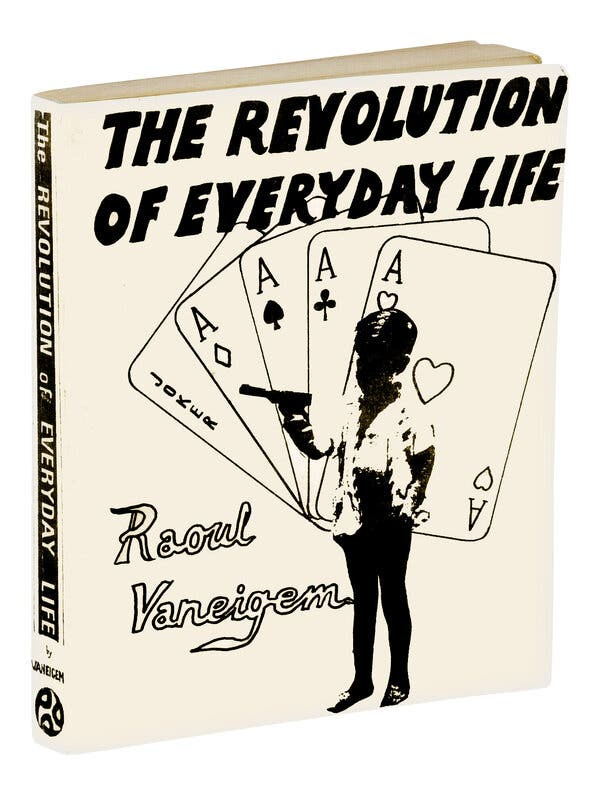
What spark of humanity, of possible creativity, can remain alive in a being dragged out of sleep at 6 every morning, jolted about in suburban trains, deafened by the racket of machinery, bleached and steamed by meaningless sounds and gestures?
| Raoul Vaneigem, The Revolution of Everyday Life
…
Raoul Vaneigem
I confess that until this week, I was unaware of Raoul Vaneigem and his highly influential writings, like The Revolution of Everyday Life. Adam Nossiter’s obit makes clear his lasting impact on French and global discourse [emphasis mine]:
Mr. Vaneigem’s prescience in diagnosing French discontent with post-World War II prosperity, reiterated in dozens of subsequent books that tapped into a rich vein of national unease, made him an intellectual reference point in France over the next 50 years. When French citizens took to the streets, as they so often do, journalists frequently came calling to get Mr. Vaneigem’s take.
[…]
The world of mindless work, of materialism, of authority; the state’s instruments of control and repression — these were the targets of Mr. Vaneigem’s poetic prose, honed into easily remembered phrases that were well-suited for a street demonstration or a university wall.
“Who wants a world in which the guarantee that we shall not die of starvation entails the risk of dying of boredom?” he wrote at the outset of “Revolution.” The question perfectly captured the anomie of the generation that would take to the streets less than a year later. Material well-being was as unsatisfactory as a safe 9-to-5 job, in his view.
Mr. Vaneigem hit communism as hard as capitalism. “The great collective illusions, anemic from shedding the blood of so many, have since given way to the thousands of prepacked ideologies sold by consumer society like so many portable brain-scrambling machines,” he wrote.
Vaneigem’s anti-work — and anti-Maxist and anti-establishment — positions may be ripe for reassessment in the 21st Century. Are we returning to the ‘ecstasy of revolution’1 that peaked in 1968 Paris?
Vaneigem was an early member of the avant-garde Situationist group, along with Guy Debord and others, decrying the dark negatives of capitalism. But his way diverged, focusing more on the tensions of everyday life, leaving grander political theory to Debord, whose The Society of the Spectacle stands as a takedown of both mainstream and Marxist dogma. As Robert Zaretsky wrote in 2017 during Trump 1.0,
With the presidency of Donald Trump, the Debordian analysis of modern life resonates more deeply and darkly than perhaps even its creator thought possible, anticipating, in so many ways, the frantic and fantastical, nihilistic and numbing nature of our newly installed government. In Debord’s notions of “unanswerable lies,” when “truth has almost everywhere ceased to exist or, at best, has been reduced to pure hypothesis,” and the “outlawing of history,” when knowledge of the past has been submerged under “the ceaseless circulation of information, always returning to the same list of trivialities,” we find keys to the rise of trutherism as well as Trumpism.
In his later work, “Comments on the Society of the Spectacle,” published almost 20 years after the original, Debord seemed to foresee the spectacular process that commenced on Jan. 20 [Trump’s first inauguration]. “The spectacle proves its arguments,” he wrote, “simply by going round in circles: by coming back to the start, by repetition, by constant reaffirmation in the only space left where anything can be publicly affirmed …. Spectacular power can similarly deny whatever it likes, once or three times over, and change the subject, knowing full well there is no danger of any riposte.” After Trump’s inauguration, the actual size of the audience quickly ceased to matter. The battle over images of the crowd, snapped from above or at ground level, simply fueled our collective case of delirium tremens.
Debord and Vaneigem turn their smudged mirror to reflect today’s world, just as much as that of the Twentieth Century. And in Vaneigem’s quote, at the top of this issue, is a perfect echo of today’s disaffection in work, and its place in our lives: ‘bleached and steamed by meaningless sounds and gestures’.
Short Takes
More AI Slop
And here is a company that sent a job application rejection email to a candidate that read, “Write a warm but generic rejection email that sounds polite yet firm. Do not mention specific reasons for rejection. Make the candidate feel like they were strongly considered even if they weren’t. Remember to use candidate name and company name variables.”
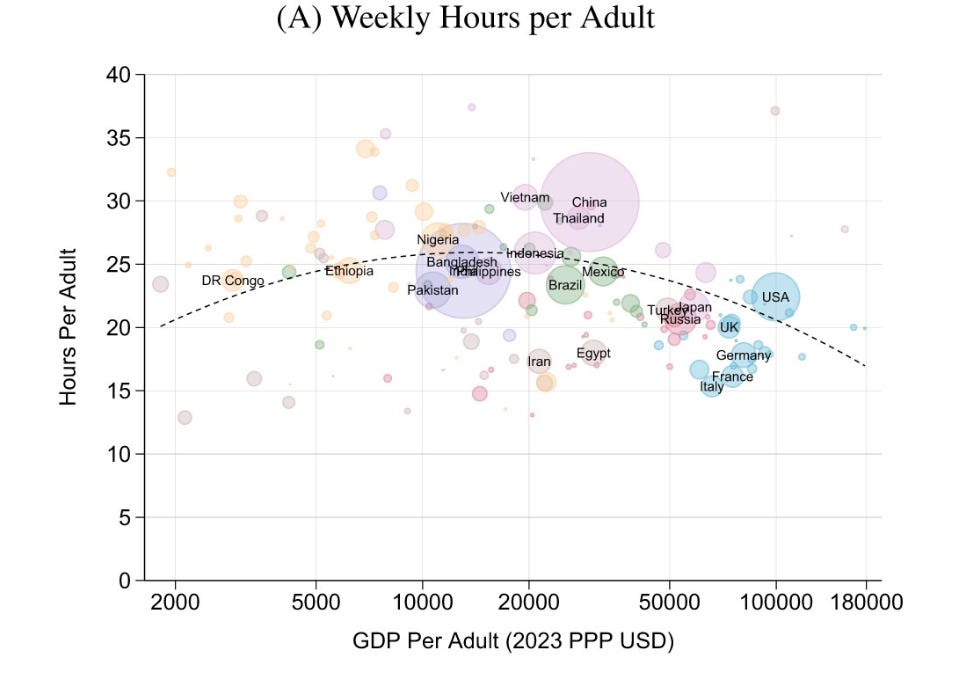
This article uses labor force surveys from 160 countries to build a new microdatabase on hours worked covering 97% of the world population in cross section. We also construct time series spanning over 20 years in 86 countries. Hours worked per adult slightly decline with GDP per capita but are weakly correlated with development overall. Hours worked by the young (aged 15–19) and elderly (aged 60+) fall with development, driven entirely by growing school attendance and public pension coverage. Hours worked among prime-age adults (aged 20–59) are stable with development but undergo a great gender reshuffling: falling hours per male worker have been exactly offset by increases in female labor force participation in many countries. Labor income taxes are strongly negatively related to hours worked across countries. This correlation is attenuated when controlling for social spending and disappears when further controlling for working hours regulations. Both social spending and working hours regulations are associated with lower hours worked.
She says AI doesn’t seem to be helping employers find the candidates they (say they) need, or shortening the time involved. Meanwhile, applicants interact with AI systems and often receive no feedback on their applications.
As employers continue to use A.I. to rationalize the process of identifying strong applicants, applicants have begun to use similar tools to game the systems evaluating them. The vicious cycle thus begins: Employers buy or build new tools, which job seekers cotton on to, and on and on. It becomes a futile “Spy vs. Spy” showdown instead of a useful way to meet the ostensible goal of giving qualified people jobs.
This is a problem that seems as if it could be solved only through a return to some analog processes and better regulation at the federal level that forces employers to make their current methods of evaluation more transparent and fair.
Or just make the process legible for the applicants.
And what sort of regulation could be employed?
The most important remedy for job applicants is likely fixing the laws around automated hiring at the federal level so that there is much more transparency about the use of A.I. and your personal data.
New York City’s laws could be a model for such legislation, my newsroom colleague Steve Lohr pointed out in 2023. “The city’s law requires companies using A.I. software in hiring to notify candidates that an automated system is being used. It also requires companies to have independent auditors check the technology annually for bias,” he wrote.
[Emory University law professor, Ifeoma]Ajunwa also thinks that the Fair Credit Reporting Act should apply to all A.I. companies that collect data on applicants and then give them a score. Applicants should be able to access that score and “check it for inaccuracies, and also demand a correction from whoever holds that file,” she said. This is the argument behind a class-action lawsuit filed in January against Eightfold AI, a company that uses a data set that includes the profiles of more than 1 billion people. The plaintiffs want transparency into how they were scored and what information was used to assess them.