

Power concedes nothing without a demand. It never did and it never will.
| Frederick Douglass
Quit versus Grit
Lindsay Crouse writes1 a well-researched and well-reasoned essay that adds a new dimension to the ‘men are from Mars, women are from Venus’ trope. Apparently, women are much more likely to grind away when confronted by impossible or difficult situations, while men will simply walk away.
Some excerpts [emphasis mine]:
Under stress, women downshift but make it through. Men under stress go to extremes. They take more risks and walk away with nothing or all. It tracks with what the masculinity scholar Richard Reeves argues about how we’re raised: Boys are like orchids. They are fragile and protected. Girls, he says, are like dandelions — surprisingly tough.
Now I think those men were onto something I missed. Too much grit can work against us. I thought my willingness to push, no matter what, was bold (and virtuous). But what is the point of overcoming every obstacle if the effort leaves you exhausted and stuck? In a marathon, there’s a finish line. In life, we can grind forever.
Women like me are eager (and able) disciples of the “Never give up” dogma. We might benefit from opting out, but we dismiss that option before we ever consider it. Then we pay the costs. We start out as resilient dandelions, but what good is that if it sets us up to be trampled on?
Research starts with kids:
When researchers examined children’s responses to ineffective teaching methods, they found that boys tended to abandon approaches that led nowhere and seek better options. Girls were more likely to continue following directions, even when those directions led them to fail. Girls learn to work. Boys learn to win.
And what about in business?
Researchers tracked nearly 30,000 management-bound employees and found that when women were passed over for promotion, they were more likely to stick with their companies than men in similar situations. The men were more likely to walk away. And they were rewarded for it. They got retention benefits where they were, or they left.
Jumping for advancement is a winning game.
The final takeaway:
Giving up on things that don’t work is the only way to find things that work better or to go farther than before.
Sidetracked
I read a deeply researched report this week, Sidetracked: The Hidden Crisis in Mid-Career Professional Economic Mobility2. The NYU School of Professional Studies analyzed 1.3 million career histories and learned that
nearly one in four mid-career professionals in the United States is stalled: steadily employed, but experiencing years of flat wages, no promotions, and no clear path to advancement. Unlike unemployment, this crisis is invisible in official statistics. Its consequences are not: underutilized talent for employers, and significant cumulative lost earnings for workers. For the average stalled software developer, the financial penalty exceeds $43,000 over 15 years.
The data is sliced and diced in dozens of ways: by industry, occupation, region, and demographic group.
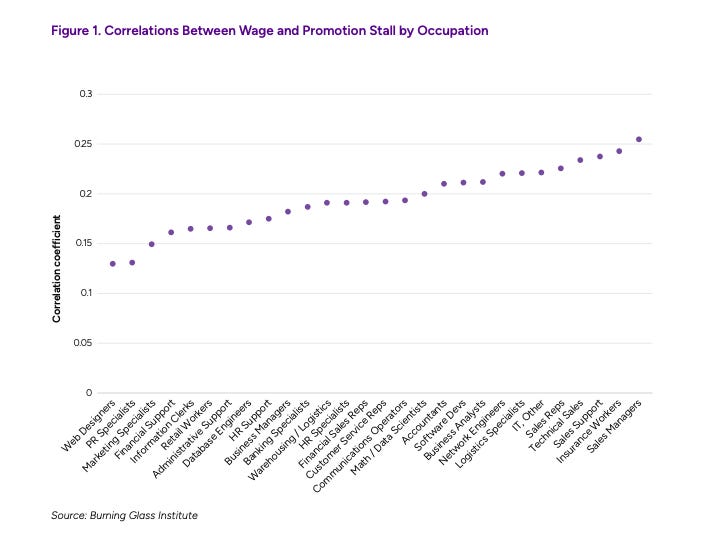
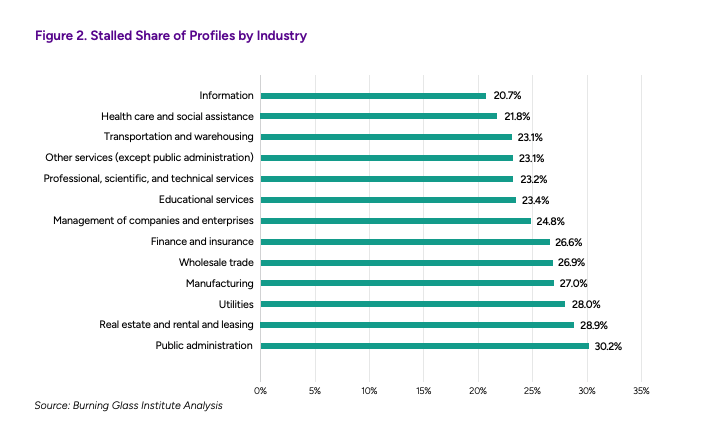
The researchers diagnose three forces — occupational structure, credential quality and alignment, and early-career trajectory — that play against the individual:
The report also maps real pathways to recovery. Strategic reskilling into adjacent, higher-mobility roles can reduce stall risk by as much as 86%; the gains come not from starting over, but from pivoting into positions where existing expertise unlocks a steeper trajectory. Mid-career stall is a structural problem, not an individual failure. Detected early and addressed with targeted intervention by employers, educators, and policymakers, career momentum can be rebuilt.
Absent is any deep discussion of the failings of employers in this dynamic. Although they offer this;
The infrastructure of upward mobility—internal promotion ladders, job-to-job transitions, scope-expanding roles—has weakened in ways that constrain these outcomes.
Note that this is expressed in the passive voice, although management makes these policy choices deliberately. After all, when employees stall, the company saves money.
But, as usual, the individual is pretty much on their own in the late capitalist economy. But, if you think you are stuck at mid-career, you might take a long look at what you might do to shake loose.
The biggest takeaway:
Three core insights anchor this discussion. First, mid-career stagnation is not simply an outcome—it is a time-sensitive condition that becomes harder to reverse the longer it persists. Second, its foundations are often laid in early career, meaning that early detection and prevention matter as much as remediation. Third, it does not have to be a permanent sentence; targeted strategies involving skill development, credentialing, and occupational pivots can help workers facing, or already in the grip of, career stall overcome the economic obstacles in their path. Together, these findings shift the focus from treating stall as an isolated event to understanding it as a compounding risk that emerges early, can be detected before it hardens, and may be preventable through timely intervention.
Prevention is more powerful than remediation: by the time stagnation is visible in mid-career data, compounding mechanisms are already deeply at work.
And, as Lindsay Crouse laid out: it’s better to jump than to grind.
I’d really like readers to sign up for a paid annual subscription, so for 2026, I have dropped the annual subscription to $30, the lowest Substack allows. Note that I’ve also lowered the monthly subscription to $5, so I am making next to nothing on that tier. Give annual a try, please.
The hidden value is years of posts behind the paywall, and of course, seeing new posts in their entirety. I rely on your support, so thanks.
