
Short Takes #4: To Be Somebody Else
Sylvia Plath | Giving Up | A Second Job | Growing More Pessimistic
It’s a hell of a responsibility to be yourself, It’s much easier to be somebody else or nobody at all.
| Sylvia Plath
Giving Up
In The Surprising Benefits of Giving Up, Molly Glick reviews recent research by Hugh Riddell and a long list of colleagues that comes down to the perhaps unintuitive conclusion: adjusting goals downward is ‘often a more appropriate and beneficial response’, [emphasis mine]:
The authors of the sweeping meta-analysis examined 235 studies spanning various fields, including psychology, health, and social sciences, that detailed how people shift their goals after encountering obstacles to success. The researchers wanted to consolidate this “fragmented” information and observe how adjusting goals relates not only to psychological well-being but also physical health, social functioning, and future ambitions. This allowed them to chart a goal “roadmap.”
“Sticking with impossible goals can take a real toll, with previous research suggesting it can lead to higher stress, poorer well-being, and even physical health costs such as illness,” said study author Hugh Riddell, a professor at the School of Population Health at Curtin University in Australia, in a statement. “But letting go and—crucially—reengaging with new goals, was found to restore purpose and well-being.”
The team employed statistical analysis to illuminate what causes people to ditch, adjust, or re-engage with goals. Disengagement from goals, for example, was most strongly linked to negative feedback on these ideas and an “action crisis” stemming from one’s failure to overcome related obstacles. Our personalities might also play a major role in these types of decisions: Optimism tended to be strongly linked to one’s openness to revise a goal to better fit their skills and resources. “These findings indicate that goal-striving flexibility is more likely to emerge when individuals feel secure, exhibit stable regulation, and possess emotional resilience,” the paper notes.
The scientists also analyzed the impacts of these decisions. Giving up on goals was significantly linked to reduced stress, anxiety, and depression, for instance. And adopting new ones was strongly associated with high social and physical functioning. Finding new goals also came with moderate to large benefits to psychological functioning, feeling a sense of purpose in life, satisfaction, and personal growth.
In my own recent efforts — for example, considering new ways to grow readership for this newsletter — I confess I have embarked on various plans that, as I researched and analyzed the trade-offs in time, in several cases I have shelved those goals. And, yes, I’ve halted several efforts where I felt that not pushing ahead, at all costs, has led to a renewed interest in the underlying goal of wanting to understand what is going on in the world of work rather than spreading myself too thin with podcasts, or building a magazine with multiple contributors.
I haven’t shelved all avenues, however. And I get up every morning with a sense of renewed purpose.
workfutures.io is a reader-supported publication. To receive new posts and support my work, consider becoming a free or paid subscriber.
40% off for 2026!
A Second Job
Andy Spence reports:
In research from LinkedIn,
51% of professionals say that learning AI feels like a second job
41% say the pace of change is affecting their well-being.
People are making themselves unwell, to keep up with the hype.
Growing More Pessimistic
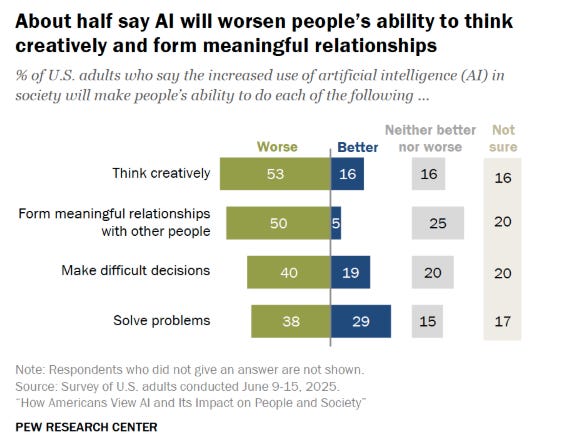
Pew Research Center reports on people perceptions of AI on creativity and connection:
Americans are far more pessimistic than optimistic about the effect AI will have on human creativity and connection. About half (53%) say AI will worsen people’s ability to think creatively, while 16% say it will improve this. And 50% say it will worsen people’s ability to form meaningful relationships with others, while only 5% say it will make this better.
As generative AI technology continues to improve, most Americans (76%) say it’s extremely or very important for them to be able to distinguish between content made by AI and by people. But 53% are not too or not at all confident that they can personally tell the difference; just 12% are highly confident.
Not a ringing endorsement.