
Short Takes #6: If We Change
Georg C Lichtenberg | Outcomes, Not Tasks and Skills | The Quarter-Zip Generation | Flexicurity

I cannot say whether things will get better if we change; what I can say is they must change if they are to get better.
| Georg C Lichtenberg
workfutures.io is a reader-supported publication. To receive new posts and support my work, consider becoming a free or paid subscriber.
Outcomes, Not Tasks and Skills
Deloitte is running a series on workforce planning, called From jobs to skills to outcomes: Rethinking how work gets done, examining how companies are moving away from organizing around jobs.
Task- and skills-based approaches to workforce planning can grant organizations an additional level of detail to refine their approach and home in on their critical needs. More organizations are recognizing the value of this approach. Deloitte research reveals that 93% of survey respondents believe that moving away from the job construct is important or very important to their organizations’ success.
One approach is to break work out of jobs and into tasks, and then line tasks up with workers whose skills match the tasks. One small problem:
According to the Institute for Corporate Productivity, only 22% of organizations are effective at breaking down jobs into tasks.1
Maybe technology to match tasks to skills will help. We’ll see.
I favor the alternative spelled out in the report by Sue Cantrell. Instead of atomizing work into tiny little bits, how about organizing around problems and outcomes?
Broaden people’s roles so they are structured based on achieving outcomes, solving problems, or creating new sources of value. (figure 4). Doing so can essentially provide guardrails for workers in terms of the broad “what” of work—but give them the freedom and autonomy to choose the “how.”
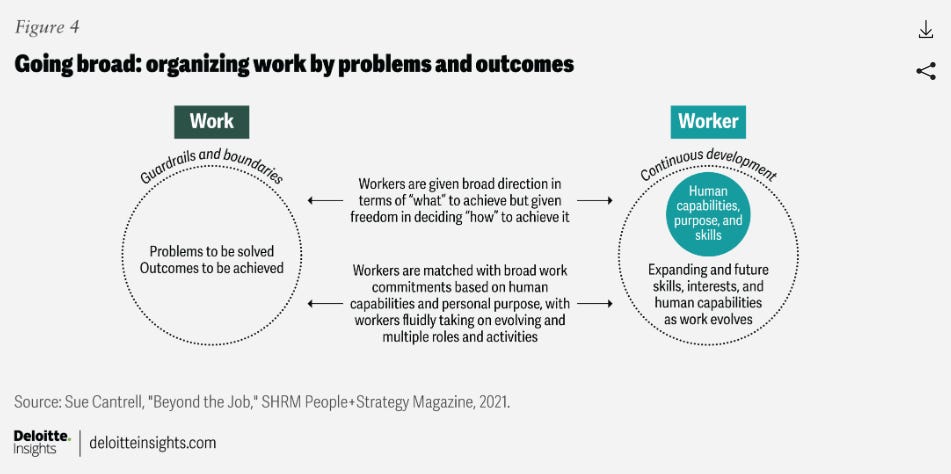
I am a strong advocate for greater autonomy and outcomes-based work. This is a linchpin of the emergent organization, which I have written about a great deal.
I will likely write a longer workfutures.io piece on this, and related efforts to deconstruct the organization away from jobs, departments, and so on, replacing that with a project-based organization.
The Quarter-Zip Generation
Sandra E. Garcia reports on how the Z in Gen Z is now standing for the adoption of the quarter-zip vest, at least for men:
For generations, teenagers have looked for ways to signal to society that they had grown up. The longhaired, bell-bottom-wearing, fringe-trimmed teens of the 1960s and ’70s eventually morphed into the power suit-wearing yuppies of the ’80s. Now, it seems, the time has come for Gen Z to lean into business casual, and the often ribbed, always square quarter-zip sweater seems to be their garment of choice. The shift from the Nike Tech fleece sweatsuit — an athletic-looking ensemble made of a polyester-cotton blend and favored by many Gen Z men — to the classic quarter zip signifies an aesthetic pivot toward the expectations of the professional world.
Better than power suits, at least.
Flexicurity
An NPR story in late November 2025 profiled Denmark’s ‘flexicurity’ policies [emphasis mine]:
Darian Woods [of NPR’s Planet Money]: And here’s where flexicurity comes in. Employers can fire easily, but there’s also security - generous unemployment benefits, training and help for anyone looking for a new job. Rakul [Skardenni, a Danish woman working in day care and taking advantage of the policy] did have obligations, though. She had to show that she was applying to jobs and regularly meet with a jobs counselor.
Rakul Skardenni: They were, like, telling me that I had that - an opportunity to get in school. And they were like, but listen to me. You are - you have so much positive vibes in your body that we mean that you will be great to this job. And I was like, OK, what is this job?
Stephan Bisaha [of Planet Money]: The job - train to become a nursing assistant.
Rakul Skardenni: And I was like, but what about money? I’m a single mom. I cannot have - afford to pay school. And he was like, but now - yeah, but you are getting 100% payments, yeah, during the school.
Stephan Bisaha: The Danish government would pay 110% of the unemployment benefit to people studying in industries where there was a shortage of labor.
Rakul Skardenni: So I was like, wow, I want to try to do that.
Darian Woods: Rakul enrolled and studied for the next 5 1/2 years. And she didn’t need to take on an extra part-time job.
Rakul Skardenni: You’re living a normal life and you can give your children food in their mouth without thinking about, oh, we need to save 10 krones for this and 15 for that.
Darian Woods: This is flexicurity in action.
Stephan Bisaha: But for a less motivated person, we wanted to know if there was a risk this safety net might become a hammock.
Morten Grazing: So you want to know about the flexicurity?
Darian Woods: Yes. So we’ll talk about...
Stephan Bisaha: Morten Grazing is a deputy director general at the Danish Agency for Labor Market and Recruitment.
Morten Grazing: Basically, there’s a unwritten contract that, OK, you receive these social benefits. They’re quite generous. But then you have to participate in activities and be active in seeking jobs and document that you are active pursuing to get a job.
Stephan Bisaha: Unemployment benefits are sanctioned if the person doesn’t meet these responsibilities.
Darian Woods: Morten says this muscular approach balancing rights and responsibilities has worked.
Morten Grazing: In many years, we’ve had a high employment. And also our unemployment is very low, actually. So well, basically, the results are quite good.
This would work in the U.S., too, if our policies aligned with human-centered values. Democrats might want to take notes.
I4CP, Talent & learning leaders: Organizations are merely guessing in the war for talent, September 24, 2021.