

On some great and glorious day the plain folks of the land will reach their heart’s desire at last, and the White House will be adorned by a downright moron.
| H.L. Mencken (1920)
…
One hundred years later, Mencken’s prophecy has been borne out.
While we have to concede that Trump has a ‘feral genius’1 for turning grievance into a political movement (like other authoritarian populists), and thereby getting himself elected, he’s clearly out of his depth when trying to actually steer the nation in a positive direction, to put it mildly. Less mildly, he’s a ‘downright moron’, which he has demonstrated over and over again: the tariffs, ICE, gerrymandering, antagonizing our allies and trading partners, and most notably, an absolutely unnecessary war with Iran that will cost us $100 billion at the minimum, with absolutely none of the supposed war aims met.
And, to top it off, the ludicrous UFC fights staged on the White House lawn, yesterday. I couldn’t even bring myself to hate-watch it.
Everyone Hates Data Centers, But Isn’t AI the Real Culprit?
It seems that every day, I encounter another story about growing opposition to data centers, ranging from citizens shouting at their elected local officials at town halls, to states barring their construction after dozens or hundreds have already been built.
To me, though, that’s akin to blaming sewing machines for the fast fashion trend. Yes, sewing machines are employed to make all those cheap, and unsustainable clothes, but the root cause are the businesses that have souped up supply chains to smother the world in a glut of throwaway clothing.
Shouldn’t our anger and opposition be directed to the tech companies contracting for all this computing power, instead of the buildings housing the bazillion server racks that AI requires?
Tressie McMillan Cottom wrote about data center hatred2, recently [emphasis mine]:
Americans hate data centers. They really, really hate them.
A Gallup poll from May found that 71 percent of Americans would oppose a data center being built in their area. In rural communities in Utah and North Carolina, regular people are organizing to stop data center construction, speaking out at public hearings and pressuring politicians for bans. They are passionate enough to attend political education sessions about water rights, land use and thermodynamics. Cities like Tulsa, Okla.; Birmingham, Ala.; and New Orleans have recently passed temporary moratoriums on data center construction. Last week, lawmakers in New York passed a statewide pause on large-scale data centers; other states, including Maryland and Michigan, could be next.
According to polling by Heatmap News, more than half of all Americans support a national ban on data centers. The public seems to agree that data centers are giant, ugly, noisy, smelly altars to industrial-scale hostile architecture. In our virulently partisan country, this constitutes a rare show of consensus.
She goes on to make an impassioned case for the Democrats mobilizing this anger as a central aspect of their platform. She cites some Democrats efforts versus data centers:
Senator Elizabeth Warren has made a proposal that focuses on taxation of A.I. firms and mandating transparency about how the A.I. boom is shaping companies’ financial risks. All of these are good-faith attempts to respond to voters’ anger, but Warren’s message is too wonky to match the moment.
Senator Bernie Sanders has gone further, floating a big idea that’s consistent with his brand of democratic socialism. He called for a national data center moratorium and labor protections for workers displaced by A.I., and he is proposing the “American A.I. Sovereign Wealth Fund Act” to give the American public shared ownership, and therefore control, over A.I.’s expansion and its profits. But, Alex Hanna, director of the Distributed A.I. Research Institute, told me that a wealth fund act would enshrine the tech sector’s as-yet-unproven claims of its importance. This is the risk of treating A.I. as something that is as important as humans discovering fire and inventing the wheel. That’s zealotry. It has no place at a tent revival.
Representatives Alexandria Ocasio-Cortez of New York and Ro Khanna of California are going after data centers with an organizer’s flair for spectacle and an anti-oligarchy message. Khanna has called data centers extractive and uses them as justification for his proposed wealth tax.
This all feels like a rear-guard action to me. Apparently, the Democrats have ceded the high-ground of AI’s inevitability to the Tech Overlords. She spells that out, to some degree:
Data center infrastructure is a marriage of the technology and energy sectors. Separately, the two industries are economic powerhouses; united, they are a behemoth. A.I. interests are well on their way to spending hundreds of millions of dollars on state and federal elections in this midterm cycle, when there are far too few competitive races to influence. The A.I. industry’s deep pockets are making candidates on the left and the right cagey.
Important, too, is the seductive cultural narrative that flows from the pro-data center camp. A powerful bench of celebrity C.E.O.s, exuberant financiers, developers and futurists consistently present artificial intelligence as an inevitable technology Americans must adopt, lest they be left behind. If you accept the inevitability thesis, you are likely to believe that data centers are necessary and public dissent is naïve or, worse, un-American.
To which I say fuck them, and fuck that shit. Instead of bracing for lifelong membership in Jasmine Sun’s ‘permanent underclass’, or tinkering around the edges with anti-data center protests, we should demand AI regulation so that jobs are not lost in order to make billionaires richer.
China — of all places — is leading in this fight, as reported3 by Catie Edmondson:
When a Chinese court ruled late last month that a tech company had illegally laid off a worker after replacing him with artificial intelligence software, it delivered an implicit warning to other employers.==
“The development of artificial intelligence technology should be applied to liberating labor, promoting employment and improving people’s livelihood,” the Hangzhou Intermediate People’s Court wrote. “Labor law allows employers to undertake technological changes and upgrade their operations, but it should also take into account the protection of workers’ legitimate rights and interests.4
The case — the third time the Chinese government has highlighted a ruling siding with workers displaced by A.I. — underscores how Beijing is contending with the need to balance its ambitions for the widespread use of A.I. with the unemployment that might accompany it.
China has invested billions to become an artificial intelligence superpower and raced to integrate the technology across a broad range of industries. But those aspirations have run headlong into a growing political problem: anxiety over the workers who could be displaced by the realization of Beijing’s technological drive.
This issue is singularly acute for China, where more than 200 million workers are stuck in gig economy work, with a weaker safety net than in the US. Youth unemployment is 17% there, and growing. Instead of considering universal basic income — as is being discussed in South Korea, Japan, and the UK — China’s courts are taking a hard line on employers: you can deploy AI, but don’t use it to cut jobs.
Again, Edmondson:
The three court rulings have offered an early glimpse of what that response might look like. In each case, the court said employers remained responsible for keeping workers on the payroll, even if A.I. had rendered their jobs redundant. Judges have repeatedly ruled that replacing workers with A.I. is voluntary cost-cutting that does not justify mass layoffs.
Chinese policymakers appear eager for both workers and employers to get the message. The Hangzhou ruling in favor of the tech worker replaced by A.I. was given a special designation signaling that it should serve as a model for future cases.
In that case, an employee identified in filings only by the pseudonym Zhou had worked as a quality assurance supervisor at an A.I. company until the technology replaced him. When the company offered him a new role that would cut his salary to 15,000 renminbi per month from 25,000, he refused and was fired. The court ruled his employer had failed to properly accommodate him.
We should emulate China, as soon as is possible.
In earlier eras, US unions fought for similar resolution of job-killing technological advance. For example, the International Typographical Union (ITU) was part of the Columbia Typographical Union (CTU) which at its peak had over 120,000 members.
In 1974, the [Washington] Post had about 1,000 printers on the payroll, working some 700 “situations.” But another revolution in printing was taking place and the Linotype machines and the jobs involving hands-on contact with pieces of type begin to disappear.
With some sections already converted from “hot metal,” Post CTU members in 1974 signed their first contract to include a “lifetime job guarantee” that recognized the inevitable disappearance of their craft.
Decades later, only a few hundred ‘printers’ remained, having made the transition from Linotype to cut-and-paste compositing and photography, and then to computer layout software.
But that approach allowed a social transition without dumping 100,000s of ‘printers’ onto the streets. Somewhere between that union-led generational retreat, and Chinese judicial policy to hold onto all jobs threatened by AI, is a human-first answer to the looming AI jobs apocalypse.
If we leave it to the Tech Bros and the corporate finance corps, millions might be laid off over the next decade. We need more time — more breathing room — and a better response than is being offered by even the most left-wing progressives.
Short Takes
Brace yourself for bad news.
In The Kobeissi Letter (@KobeissiLetter on X) June 14, 2026 we learn some bad news:
Americans can’t find jobs.
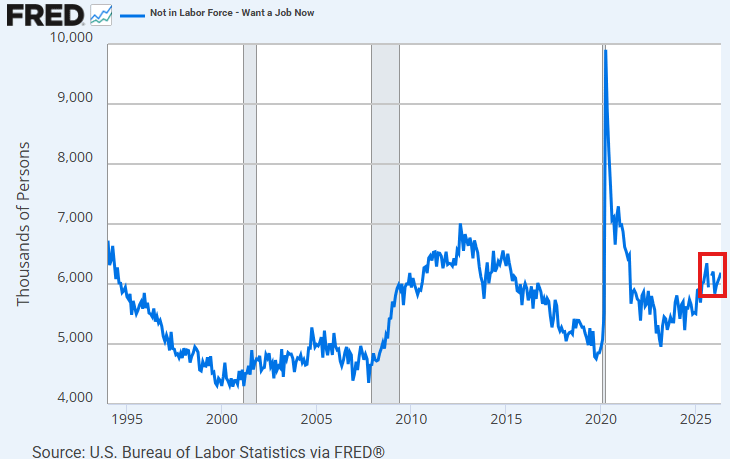
The number of Americans not in the labor force who currently want a job rose +76,000 in May, to 6.2 million, the 3rd-highest since July 2021.
These are people who are not officially part of the labor force, meaning they are not actively looking for work, but say they want a job.
This marks the 4th consecutive monthly increase, totaling +349,000.
Since March 2023, this figure has surged by +1.2 million people and is now above 2008 Financial Crisis levels.
As a % of total employment, this metric is up to 3.8%, the 2nd-highest since October 2021.
By comparison, the 2001 recession and the 2008 peaks were 3.6% and 4.3%.
Labor market conditions are deteriorating beneath the surface.
Meanwhile, our federal government is firing workers, closing agencies, and cancelling Joe Biden’s efforts toward industrial policy.
We are on a sharply downward trend.
…
What about bringing back manufacturing jobs?
Back in January, David Uberti looked at factory jobs in the US:
The manufacturing boom President Trump promised would usher in a golden age for America is going in reverse. After years of economic interventions by the Trump and Biden administrations, fewer Americans work in manufacturing than any point since the pandemic ended.
Manufacturers shed workers in each of the eight months after Trump unveiled “Liberation Day” tariffs, according to federal figures, extending a contraction that has seen more than 200,000 roles disappear since 2023.
An index of factory activity tracked by the Institute for Supply Management shrunk in 26 straight months through December, but showed a January uptick in new orders and production that surprised analysts. The Census Bureau estimates that manufacturing construction spending, which surged with Biden-era funding for chips and renewable energy, fell in each of Trump’s first nine months in office.
This is one part of a larger trend: a decline in blue-collar jobs:
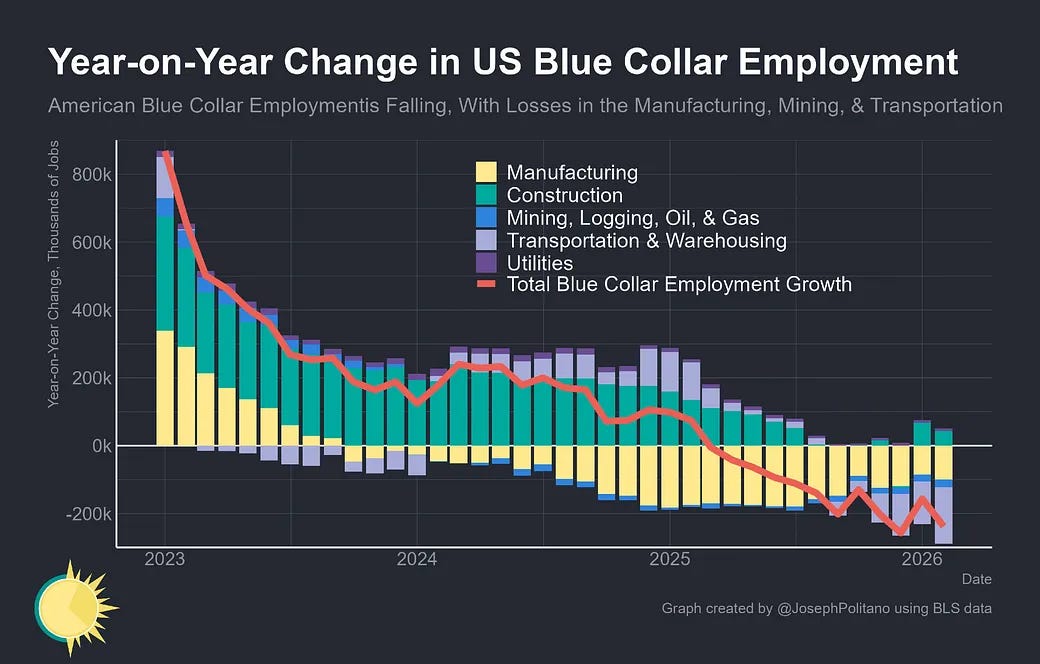
It’s not a pretty picture.
…
Young people can’t get started.
Molly Jong-Fast was writing about commencement speakers being booed5 when they waxed lyrical about the wondrous future of AI, but she dropped some stats, too:
Young people are facing what M.I.T. Technology Review calls a “ looming crisis in entry-level work,” and college, once assumed to be a prerequisite for a secure job, no longer feels worth it. The general gestalt coming from a certain sliver of affluent Americans is that college graduates are more liberal trouble than they’re worth and perhaps could be replaced by bots. Marc Andreessen, the venture capitalist and G.O.P. megadonor, mused to Joe Rogan that a bot “never gets drunk, never gets sick, never gets high” and “never files H.R. complaints.” (It never boos a smug commencement speaker, either.)
According to a recent working paper from researchers at Harvard, hiring for entry-level roles at companies that have adopted generative A.I. has dropped each quarter since 2023. What is not clear is whether A.I. is taking people’s jobs or if companies are using A.I. as an excuse for not hiring. Either way, A.I. is not exactly popular with people entering the work force for the first time.
Time to smash the looms?
