

Culture has increasingly ceded authority to systems that mistake information for understanding and speed for judgment.
| Yonatan Touval, The Iran War Is a Failure of Imagination
I’d really like readers to sign up for a paid annual subscription, so for the rest of April, I have dropped the annual subscription to $30. Note that I’ve also raised the monthly subscription to $10 per month from $6 per month. Give annual a try. The biggest value is years of posts behind the paywall, and of course, seeing new posts in their entirety.
Pace Layering
It has become commonplace to characterize the world as moving faster, as if the planet were spinning more energetically around its axis. This is really just a metaphor, but one that is now firmly embedded in our daily psychology.
Stewart Brand (with Brian Eno) created the Pace Layers model to help understand how the various elements of our civilization interact.1
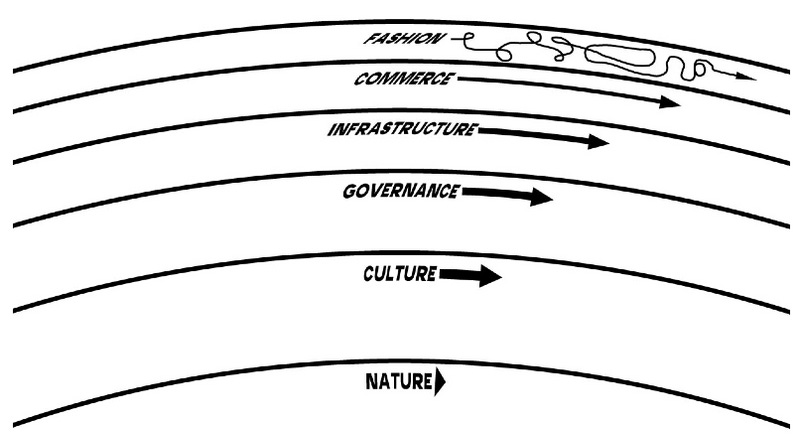
As Brands explains,
I propose six significant levels of pace and size in the working structure of a robust and adaptable civilization. From fast to slow the levels are:
Fashion/art
Commerce
Infrastructure
Governance
Culture
Nature
In a durable society, each level is allowed to operate at its own pace, safely sustained by the slower levels below and kept invigorated by the livelier levels above. “Every form of civilization is a wise equilibrium between firm substructure and soaring liberty,” wrote the historian Eugen Rosenstock-Huessy. Each layer must respect the different pace of the others. If commerce, for example, is allowed by governance and culture to push nature at a commercial pace, then all-supporting natural forests, fisheries, and aquifers will be lost. If governance is changed suddenly instead of gradually, you get the catastrophic French and Russian revolutions.
It is the friction between layers that allows them to influence each other. Fashion trends — like a transition from skinny to baggy jeans — drive changes in commerce, and innovations in commerce — like faster supply chains — drive quicker transitions in fashion.
But Brand points out in the original caption for the diagram above,
The order of a healthy civilization. The fast layers innovate; the slow layers stabilize. The whole combines learning with continuity.
Touval’s opening quote ends with a layer farther down, culture, where we are rejecting time for judgment in favor of speed. In fact, the sense many of us share — that the world is spinning faster — may boil down to our cultural acquiescence to speed over judgment and a confusion between information and understanding.
Living at Log Level
One reaction to the vertigo imparted by a seemingly sped-up world was recently summarized by Gordon Brander in Dropping to log-level, reminding us that we may be in a situation too complex to effectively model:
A model is a map of the parts of a system that aren’t changing.
But when all parts of our world system are changing, we can’t find any stable parameters. So we have to bail on modeling. What’s left for us to make sense of the world?
Really, when things are moving this quickly, we don’t want a model, we want a log. It’s the simplest narrative structure that could possibly work.2 Just lines of timestamped comments, one after the other: “this happened, then this happened, then this happened”. No higher-level analysis. In software, we log everything that happens during program execution, because logs are invaluable when things spin out of control. We can comb through the log to find patterns, and begin to form higher-level hypotheses about what is happening.
I think this is the right level of sense-making for the moment. It’s time to drop to log-level. You’ll see me shifting away from essays, toward work in progress, technical posts, fragmentary ideas, and raw logging.
I found a great resonance with these insights, which remind me of the motivations behind writing more Short Takes, and fewer longer essays that might be outdated in a few weeks.
Brander constrasts what’s in or out when we drop to log level:
In/out:
Out: essays.
In: logging what I learn, as I learn it.Out: theory.
In: practice.Out: good writing.
In: good ideas.Out: “having an audience”.
In: hoarding things I know how to do.
So, I feel my task — or calling — has shifted. More surfacing of good ideas and insights, fewer authoritative screeds (since I’m deeply uncertain about so much). Less emphasis on ‘audience’ and theory, more focus on sharing what I find, and how I found it.
Flow and Unflow
Flow
One danger lurking in the sense of a sped-up world is a decrease in the happiness that emerges from entering a ‘flow’ state, as researched by Mihaly Csikszentmihalyi. In his work, he interviewed thousands of people to understand when they were most happy. Derek Thompson characterizes his insight this way:
He heard in these diverse testimonies a kind of singular melody—a description of how, in the best parts of life, a feeling of self, time, and anxiety melt away in the face of deep immersion in an activity. He named this phenomenon “flow.”
Thompson then cites a quotation from Csikszentmihalyi’s book, Flow:
The optimal state of inner experience is one in which there is order in consciousness. This happens when psychic energy—or attention—is invested in realistic goals, and when skills match the opportunities for action. The pursuit of a goal brings order in awareness because a person must concentrate attention on the task at hand and momentarily forget everything else. These periods of struggling to overcome challenges are what people find to be the most enjoyable times of their lives
Thompson adds:
Flow suggests a waterway—something liquidly effortless, an unimpeded stream. But the wisdom of Csikszentmihalyi was to recognize that well-being is no lazy river. It is neither ease nor effortlessness that leads to the highest happiness. It is something close to their opposite. It is immersion in an activity that is hard, but just hard enough; it is the discovery of comfort at the outer realm of difficulty. Life feels best, not when it is smoothed with frictionlessness, but when it is filled with achievable challenges.
As with Stewart Brand’s Pace Layers, friction between the layers transmits value in both directions. ‘The fast layers innovate; the slow layers stabilize. The whole combines learning with continuity.’ The friction is essential.
But what if technology could decrease the friction?
Unflow
In our sped-up world, there are opposites to the inherent learning/activity cycle at the heart of flow.
Shishi Wu writes of ‘passive flow’ as a mechanism to understand why people absorb more streaming media than they intend to [emphasis mine]:
Passive flow is a state of low-effort immersion caused by external design features. It includes three main feelings: unclear goals, loss of self-consciousness, and time transformation. It is different from classical flow, which usually involves focus, skill, and challenge. Passive flow appears in low-effort environments where users receive a continuous stream of content. They do not need to make choices. Features such as autoplay, endless scrolling, and personalized feeds help hold their attention. As a result, users stay longer than they intended. Many say they lost track of time. Passive flow does not directly define unplanned use. But it helps explain why unplanned use happens more easily.
Thompson makes the connection between passive flow and the ‘trancelike state’ that gamblers can enter when playing the slots. And the so-called ‘shitty flow’ (from psychologist Paul Bloom) sounds like a synonym of passive flow.
I will collapse those frictionless states into ‘unflow’: a negative psychological state with some superficial similarities to flow — losing track of time, a sense of calm — but lacking the challenges inherent in flow.
But that sense of calm is phony, more like being drugged, or acting like a mindless zombie, as Thompson styles it. Removing the friction of flow leaves a state emptied of challenge, of engagement, and ultimately, of purpose.
We need to make choices if we are to gain from the spinning of the world, and one of those choices has to be to avoid unflow in its many forms, to slow down, and to experience our surroundings.
Remaining grounded in a sped-up world requires throttling passivity, placing judgment over speed, and perhaps living and working at log level, if only to remain functioning and sane.
We should take to heart this thought by Simone Weil:
The authentic and pure values — truth, beauty and goodness — in the activity of a human being are the result of one and the same act, a certain application of the full attention to the object.
