
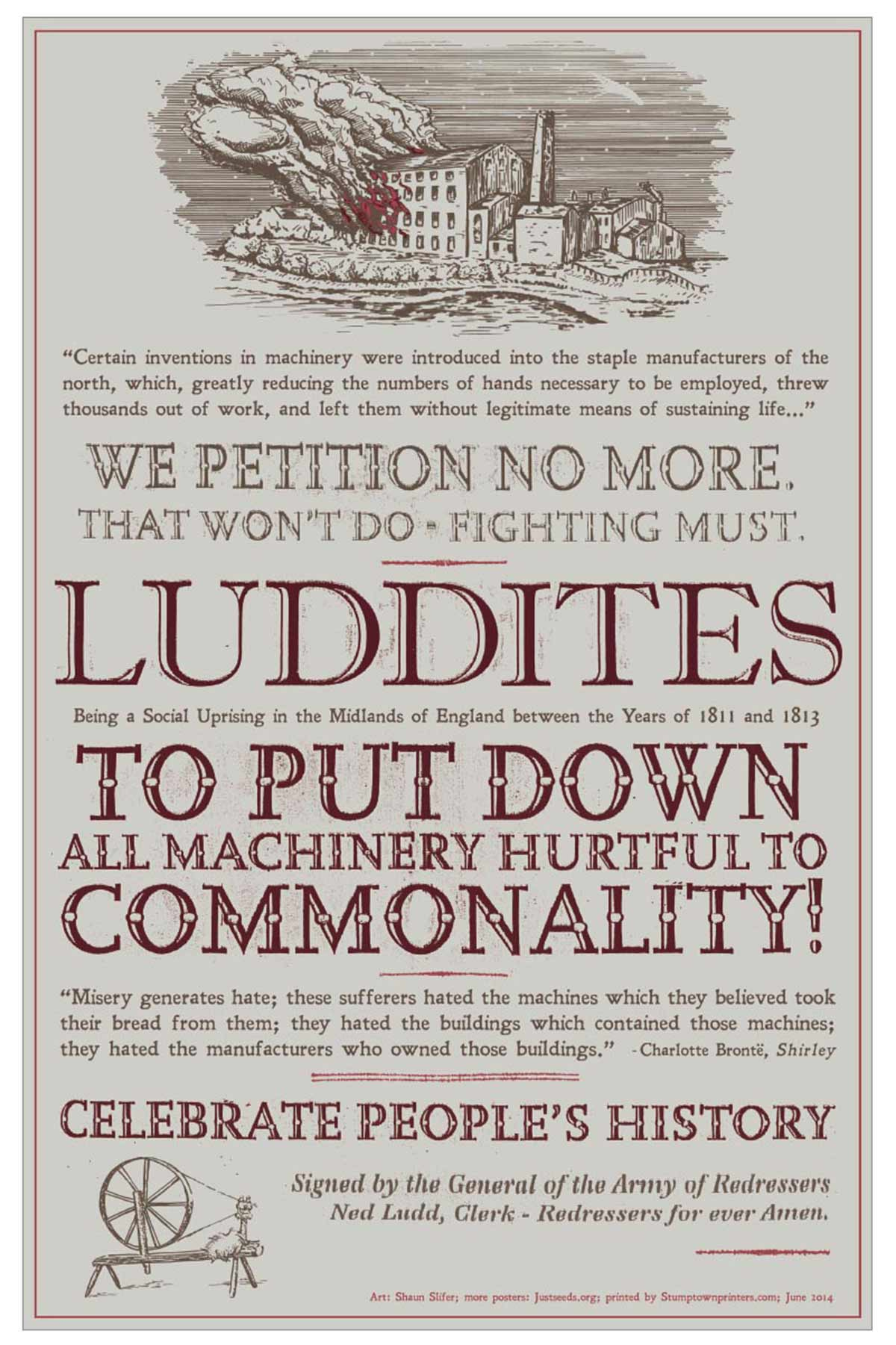
Misery generates hate; these sufferers hated the machines which they believed took their bread from them; they hated the buildings which contained those machines; they hated the manufacturers who owned those buildings.
| Charlotte Brontë, Shirley
…
I offer the following close and adversarial reading of Michael Steinberger’s recent Your Job May Already Be in Jeopardy,1 where he embodies the ambivalence and shifting point-of-view that animates so much of the public discussion about AI (meaning Large Language Model-based chat tools). Steinberger is a good writer, but, in my view, fails to take a side in this controversial battleground. And he fails to call out those creating the coming catastrophe as bad actors, unconcerned with the devastation that their golems may cause.
What Steinberger says.
Michael Steinberger opens his wide-ranging OpEd on the looming AI apocalypse with an anecdote about a young college grad who can’t find work despite his degree in accounting, and instead joins the family tree service company. The classic humanizing a macro trend, a la Gladwell. Then the macroeconomic smokescreen we’re hearing: maybe companies overhired in and after the pandemic? But when the Citrini Research ‘thought experiment’ hit the streets Wall Street freaked:
Many companies went on hiring sprees coming out of the pandemic, and the slowdown is perhaps just the inevitable adjustment. But it is happening against the backdrop of the generative A.I. revolution and fears that vast numbers of knowledge workers will soon be evicted from their cubicles and replaced by machines — fears being amplified by an army of online Cassandras. In a sequence of events that called to mind the 1938 Orson Welles radio adaptation of “The War of the Worlds,” famous for convincing panicked listeners that aliens had really invaded, a recent Substack post imagining the economic hellscape that could result from an A.I.-induced white-collar blood bath helped send the Dow Jones industrial average tumbling 800 points. Anxious times.
The AIpocalypse.
Then, after wondering why the people building all this AI are warning us of its potential for job destruction, the possible political fallout:
While new ones will hopefully emerge, the transition won’t be painless, and if the cracks we are seeing in the labor market become sinkholes, the effect not just on our economy but also our politics could be profound. If millions of college-educated voters have their lives upended by A.I., they will surely make their fury known. That prospect should be causing alarm in Washington and spurring efforts to try to cushion Americans from the blow that may soon befall them — by giving serious consideration, for instance, to something like universal basic income. But it is an election year, Congress is barely functioning, and on this issue, as with so many others, inertia will very likely prevail.
Historians have written a great deal about past circumstances where suddenly disadvantaged elites turn to revolution.
Government by organized money is as dangerous as government by organized crime. | FDR
An economy that created only 181,000 jobs in 2025?
According to Lawrence Katz, a professor of economics at Harvard University, what we are experiencing now — a sustained period of “slow job growth and gradually rising unemployment without a real recession” — is virtually unprecedented.
And of course, it’s white-collar jobs being axed, not the usual blue-collar schlubs.
Steinberg quotes another economist, Gad Levanon, who points out that ‘hiring has come to a virtual standstill in finance, insurance, accounting, consulting and tech, which are pillars of the “knowledge” economy’. He posits that these companies must have found some solution to improve productivity without additional heads, which is LLMs. Supporting that are the claims of CEOs like Jack Dorsey of Block, who Steinberger quotes, ‘“the intelligence tools we’re creating and using, paired with smaller and flatter teams, are enabling a new way of working which fundamentally changes what it means to build and run a company.”’ But former employees (who Steinberger cites without a name or link), ‘contend that poor management left Block with a bloated payroll and that A.I. is just a convenient excuse for the pink slips.’ And another factor is that Wall Street loves this attrition: ‘Whatever the truth, investors responded with delight to the news: Block’s stock soared over 20 percent, which is perhaps indicative of where Wall Street comes down on the job augmentation vs. job elimination question.’
Some white-collar workers might give up, if laid off and searching for jobs for a long time. And while people may be able to learn a trade and join the electricians building data centers for AI, I hear an echo of Judge Smails from Caddy Shack, stating ‘the world needs ditch diggers, too’.
But Steinberger points out that if millions have their white-collar jobs disappear, not all of them are likely to find work for anything like comparable pay: ‘Even now, college-educated workers command an enormous wage premium — more than 70 percent, by most calculations — over those with only high school diplomas’. Of course, these dispossessed workers will still be degreed, but those degrees will simply be less valuable, no matter how much they still owe for college loans.
While people may be able to learn a trade and join the electricians building data centers for AI, I hear an echo of Judge Smails from Caddy Shack, stating ‘the world needs ditch diggers, too’.
He returns to the theme of how Americans feel about the seemingly inexorable march of AI: incipient rage at being dispossessed from the neoliberal compact, the Fordist pact: the mass machinery -- institutions, corporations, politicians -- will do what they do, so long as ordinary people can live their lives, save for retirement, and set their kids up for success. He quotes Martin Wolf, the chief economics correspondent of the Financial Times (not a bastion of leftist revolutionary thought):
‘if lots of “skilled, trained thinking activities” are displaced by machines, it could provoke a furious backlash. “We could have a social and political crisis that makes deindustrialization look trivial,” [Wolf] said. “Deindustrialization, though one of the biggest forces shaping our world, shook the working class, particularly the male working class, from top to bottom. Shaking the prospects of the educated middle class is socially far more dangerous and explosive because it affects them and their parents, who are the people who run our societies in almost every possible way.”’
Steinberger mentions a few on Capitol Hill are worrying about the possible rending of the economy by AI, but fairly ineffectively, at least so far.
What Steinberger doesn’t say.
First of all, Steinberger doesn’t say what the enraged former white-collar dispossessed will do. Vote the bums out? Storm the ramparts? Blow up the data centers? Stop spending?
Second, while reading this, I was reminded of an interview with Alan Supiot, the French political historian and theorist, where he quotes FDR:
The freedom of a democracy is not assured if the people tolerate private power growing to such an extent that it becomes stronger than the democratic state itself. From recent history, [FDR] drew the lesson that “economic despotism“ gave rise to fascism and that “government by organized money is as dangerous as government by organized crime.”
The rise of AI and the complacency of our elected officials in the coming dispossession of white-collar workers are outgrowths of private power and moneyed interests coöpting democracy. The elite, those who run institutions theoretically empowered to benefit us all, have abdicated that charge, as Christopher Lasch expounded in The Revolt of the Elites and the Betrayal of Democracy. Rod Dreher decoded Lasch’s arguments in 2021, and they still hold [emphasis mine]:
Lasch wrote the essays in Revolt near the beginning of the modern era of globalization, which can be dated to the end of the Cold War in 1989, the invention of the World Wide Web in 1991, and China’s growing presence as a global economic behemoth. The Clinton Administration, coming to power in 1992, made the Democratic Party’s peace with Reagan-era trade and economic liberalization. At the time, growing economic inequality troubled Lasch, who wrote, “People in the upper 20 percent of the income structure now control half the country’s wealth.”
Those were the days! According to a 2017 analysis by the Washington Post, the top 20 percent of Americans now control 90 percent of the country’s wealth.2 Both the decline of the working class thanks to post-1980s deindustrialization and the hollowing out of the middle class have been well documented.
So has the widening economic and moral chasm between what Charles Murray called the “New Upper Class” and the “New Lower Class.” The divide is not merely economic, but cultural. Lasch saw elites segregating themselves and their progeny into networks and institutions separate from the broader public. Unlike elites in past eras of US history, today’s elites feel less obligation to provide for the commonweal. Rather, they have seceded—socially, intellectually, and often into coastal liberal enclaves—from a country they do not understand and do not wish to understand, regarding it as a land of backward people “at once absurd and vaguely menacing.” Says Lasch, of these elites, “It is a question whether they think of themselves as Americans at all.” This has become so pronounced in the past quarter-century that it’s hard to feel the same sense of urgency Lasch brought to his discussion.
I have to note that Dreher and I differ on who the ‘elite’ are. He thinks of them as coastal liberal professionals, but my definition of elites is limited to the executive class, billionaires, and the elected officials who take their money to serve darks ends.
In the final analysis, Lasch points out what Steinberger is missing: we have become inured to the disassociation of the elite from the world -- and lives -- of ordinary people. The uncomfortable fact that a massive adoption of labor-saving AI tools might -- must? -- lead to millions of workers to not only lose jobs, but to lose their hopes of middle-class life, and, this is being orchestrated so that the elite can collect all -- or at least most -- of the money to be made, thereby. Steinberger simply fails to name names: those who stand to benefit from the catastrophe they are engineering.
As Rebecca Solnit tells us, in Call Them By Their True Names, ‘Naming is the first step in the process of liberation’. Those elites who seek to divorce themselves from our shared fate will fail, but only if we stop them before the point of no return.
