
When the future loses its promise, the past becomes a refuge.
| Yi-Ling Liu, The U.S. and China Are Hurtling Toward a Shared A.I. Future1
…
The topic Yi-Ling Liu discussed in the paragraph I pulled this quote from wasn’t specifically AI, but rather the growing allure of tarot, Chinese astrology (bazi), and the occult in China. As she asked a friend about it, the friend remarked, ‘No one turns to tarot when times are good’.
According to Theresa Reed (The Tarot Lady) the tarot card of the year 2026 is The Wheel Of Fortune:

She explains:
2026 promises to be a game-changer. It’s governed by the Wheel of Fortune, a card associated with opportunities and luck. Keep in mind that doesn’t mean everyone is about to win the lottery. The Wheel is unpredictable – some folks might experience a twist of fate that turns everything on its head, while others might have “dumb luck,” the ability to be in the right place at the right time. No matter what happens, good or bad, the Wheel keeps turning. You have to roll with the punches and be ready to leap when the doors of opportunity open.
Or leap to one side when events come crashing down. As Svetlana Boym wrote in The Future of Nostalgia:
Nostalgia speaks in riddles and puzzles, so one must face them in order not to become its next victim — or its next victimizer.
Liu’s observations reminded me of something Christopher Brown wrote in a review of Boym’s The Future of Nostalgia:
Nostalgia has accompanied modernization in each new stage, and with the advent of greater and greater technology, which has made the time and space of the world smaller and smaller, contemporary nostalgia is not so much about past as about a vanishing present.
As modernization has sped up, what seems to be vanishing is the solidity of the present, not only an imagined future.
I’d really like readers to sign up for a paid annual subscription, so for the present time, I have dropped the annual subscription to $30. Note that I’ve also raised the monthly subscription to $10 per month from $6 per month. Give annual a try. The biggest value is years of posts behind the paywall, and of course, seeing new posts in their entirety.
Employer Concentration
One of the reasons American workers might be turning to tarot, or feeling nostalgic — in the case of younger members of the workforce, perhaps a nostalgia for a time they never lived in — is the hard fact that many Americans’ pay is being compressed: despite contemporary productivity and corporate profits, compensation has not been rising as fast as it did in the post-WWII boom years.
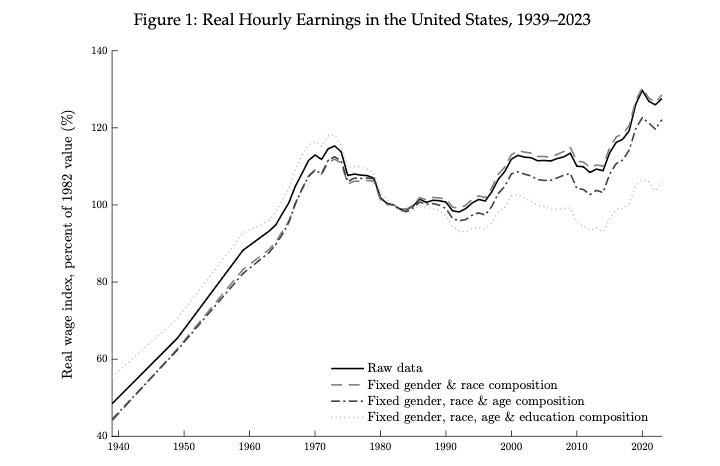
This chart is the centerpiece of research by Niklas Engbom, Aniket Baksy, Daniele Caratelli in The Long-Term Decline of the U.S. Job Ladder:
We quantify how structural changes in the U.S. labor market have contributed to wage stagnation over the past four decades by weakening the job ladder.
[…]
We estimate that employed workers today are about half as likely to receive a better-paying outside offer as they were in the 1980s.
[…]
Cross-state variation suggests that rising employer concentration and the growing use of noncompete agreements have curtailed opportunities for job shopping.
I was turned onto this research by Jessica Grose, in There’s Another Reason Gen Z Can’t Find Work:
Indeed, the job market for the Class of 2026 has been described elsewhere in this paper as the grimmest in years, but it isn’t solely because of A.I.’s impact on hiring for office jobs, and it isn’t just because of the state of the economy. For those who think trade jobs are a cure-all, the employment numbers for non-college graduates are not looking so cheery either — some of them have stopped looking for work entirely. It is true that we are in a period in which not many people are getting hired or fired, which leads to a kind of logjam for new entrants to the work force. But this stasis is just the rancid icing on the spoiled cake of much longer trends.
Grose cites Sydney Ember’s College Graduates Are Facing the Grimmest Job Market in Years, which includes this chart, showing rising unemployment:
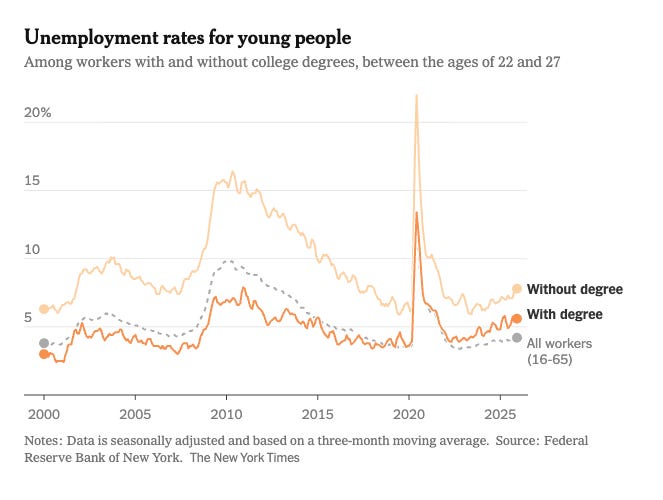
So it looks like the job ladder is being particularly weakened at the bottom rungs, hitting youngest workers the most.
The research by Engbom and colleagues identified two primary factors in the deladdering of the US work market: in a discussion with Grose, Engbom said employed workers are ‘increasingly stuck in low-paying jobs’ and ‘they’ve seen a complete collapse of the job ladder’. And people in that situation in a down employment market stay put.
The two major reasons? Employer concentration, and noncompete agreements. Today: employer concentration; at a later date: noncompetes.
As, for example, supermarket chains merge or simply grow dominant, they exert strong anti-growth pressure on compensation. Consider the so-called Walmart Effect, where Walmart harms the communities it ‘serves’ despite low prices. Rogé Karma wrote:
Two new research papers challenge that view. Using creative new methods, they find that the costs Walmart imposes in the form of not only lower earnings but also higher unemployment in the wider community outweigh the savings it provides for shoppers. On net, they conclude, Walmart makes the places it operates in poorer than they would be if it had never shown up at all. Sometimes consumer prices are an incomplete, even misleading, signal of economic well-being.
The bottom line:
In the 10 years after a Walmart Supercenter opened in a given community, the average household in that community experienced a 6 percent decline in yearly income—equivalent to about $5,000 a year in 2024 dollars—compared with households that didn’t have a Walmart open near them. Low-income, young, and less-educated workers suffered the largest losses.
The Walmart effect costs households $5,000 per year, despite lower prices on food and other goods.
Walmart hires so many people when it opens a store in a new community that its wage structure bleeds over, partly because other stores fail and workers take jobs with Walmart. And then, the employer concentration effects spread like a disease:
Workers in counties where a Walmart opened experienced a greater decline in earnings than they made up for with cost savings, leaving them worse off overall. Even more interesting, he [researcher Justin Wiltshire] finds that the losses weren’t limited to workers in the retail industry; they affected basically every sector from manufacturing to agriculture.
Factoids
The crumbling job ladder, continued.
Junior-level postings on the job site Indeed fell 7 percent in 2025 from the previous year, according to a report the company released last week.
| Sydney Ember, Graduates Reset Ambitions in Pursuit of First Jobs
…
Virginia is the first southern state to adopt paid family leave legislation.
I’m not so sure that Virginia can be considered a southern state, anymore. Politics make it more like southern New Jersey. But still:
When the new law takes effect in 2028, eligible workers will be able to take up to 12 weeks off per year to welcome a new child, care for a sick family member, or receive medical treatment themselves and receive 80% of their typical pay.
While the US lacks national paid family leave benefits, one-third of private-sector workers nationwide now have access to paid leave through state-level programs.
…
