

Don’t count out the possibility that people want and need work.
| Nick Bunker
…
The labor market is not just a bunch of numbers. It’s like Soylent Green: ‘It’s people! It’s made of people!’ And people come with strings attached.
I’d really like readers to sign up for a paid annual subscription, so for the present time, I have dropped the annual subscription to $30. Note that I’ve also raised the monthly subscription to $10 from $6. Give annual a try. The biggest value is years of posts behind the paywall, and of course, seeing new posts in their entirety.
Who To Believe About The (Coming?) Jobs Apocalypse?
The Economist has run an issue focused on the impact of AI on finance, politics, and society. One of the pieces is The jobs apocalypse: a (very) short history. Here, the unknown author sets context:
At no time in polling history have Americans been less optimistic about their long-term employment prospects. The average person believes they have a 22% chance of losing their job in the next five years, according to one survey, a higher share than even during the global financial crisis of 2007-09. The cause of this gloom is artificial intelligence. Nearly one in five American workers recently told another pollster that AI or automation is “very” or “somewhat” likely to replace them.
It isn’t just average people who are alarmed. So are the leaders of the very AI companies causing the anxiety. Dario Amodei of Anthropic has warned that AI could push unemployment to 10-20%. Bill Gates, co-founder of Microsoft, said that in an AI world people will not be needed for “most things”. Sam Altman, boss of Open AI, has clocked that talking up the technology’s disruptive power is provoking a backlash, and now speaks of “tools to augment and elevate people, not entities to replace them”. But even he could not resist mentioning “disruption/significant transition as we switch to new jobs”.
The author proceeds to pooh-pooh the notion that AI will be massively disruptive, arguing that no other major technological breakthrough has been. He specifically lodges an argument about Friedrich Engels’ tale of disruption in England at the start of the Industrial Revolution:
One instance of technological change has become notorious: the Industrial Revolution in 19th-century Britain. According to some accounts, it was horribly disruptive to workers. James Watt’s inventions in the 1760-1780s made steam engines efficient enough to power factories. This led to a period of blistering economic growth that appeared to coincide with stagnation in inflation-adjusted wages. Between 1790 and 1840 these barely budged, even as capitalists earned vast profits.
Today’s “thought leaders” in Silicon Valley often invoke this pause. It is associated with Friedrich Engels, a capitalist-heir-turned-communist who described it in “The Condition of the Working Class in England”, his account of Manchester’s slums in the 1840s. Recent scholarship, though, casts doubt on whether “Engels’ pause” is a useful blueprint for what AI may have in store for workers.
But recall, the Luddites who rose up to smash the mechanical looms and burned the mills were not looking ahead to what the result of the industrial revolution would be a hundred years and more in the future. As Neil Postman pointed out in Technopoly:
The term ‘Luddite’ has come to mean an almost childish and certainly naive opposition to technology. But the historical Luddites were neither childish nor naive. They were people trying desperately to preserve whatever rights, privileges, laws and customs had given them justice in the older world-view.
The Economist author never uses the words ‘rights’ or ‘justice’ in his analysis, note.
The author does take time to hedge his economic optimism with a strawman counter-scenario to his ‘no, there isn’t going to be a jobs apocalypse’ theme:
That does not mean it can never happen at all. The first signs would be sharply rising productivity combined with weak real-wage growth in America, the world’s frontier economy. This would show up as an increase in GDP per person, above Mr Gordon’s ceiling of 2.5%, and a simultaneous jump in corporate profits, reflecting the gains from higher output flowing to capital, not labour. Another signal would be big job losses in lots of industries.
But aren’t those numbers what we are seeing? US GDP is way up, according to another Economist article:
Over the past five years or so American productivity has been growing at the fastest rate in around two decades. Whether you look at output per worker or per hour, it has risen by a lively 2% a year, from a moribund 1% for most of the 2010s (see chart 3). This has led the Federal Reserve to raise its median forecast for America’s long-run GDP growth from 1.8% to 2%. Jerome Powell, the outgoing chair, bore witness at a recent press conference. “I never thought I’d see this many years of really high productivity,” he marvelled in response to a question from The Economist.
Corporate profits are up and rising, says this Economist piece:
Estimates from FactSet, which blends actual quarterly results from companies that have already reported these with analysts’ forecasts for firms yet to report, suggest that aggregate earnings for the S&P 500 rose by 19% in the first quarter, year on year. And the forecasters expect the ink to get blacker still. Their predictions of earnings in the next 12 months are 24% higher than a year ago.
And jobs losses seem to be growing, too:
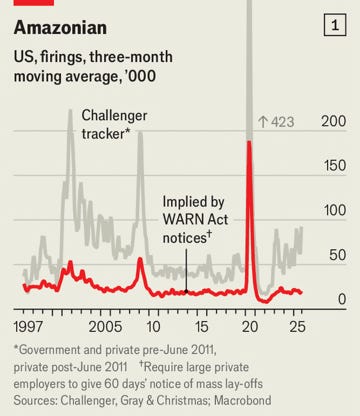
Whatever the official figures suggest, companies seem to be shedding workers. Amazon, a mighty online retailer, and Verizon, a telecoms firm, have both announced plans to lay off tens of thousands of people. An influential tracker of firing plans maintained by Challenger, Gray & Christmas, an employment consultancy, showed private-sector firings spiking in October [2025] to their highest in over a decade, excluding those during the pandemic. A broader measure, based on official notices that bigger companies must file ahead of big job cuts, also rose a little (see chart 1), as did mentions of lay-offs in earnings calls.
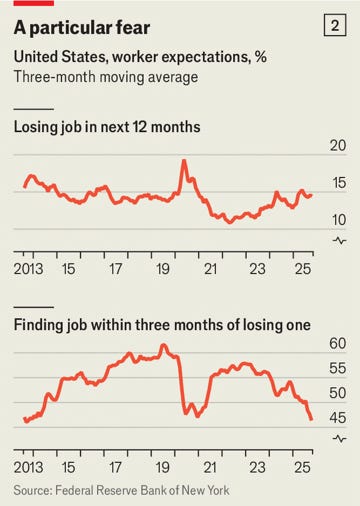
The final reason for concern is glum survey data. Consumer confidence has been dire ever since the post-pandemic inflation surge. It is now near a record low. Over the past few months Americans have also started to worry about what will happen if they lose their job. Respondents to a survey by the New York Fed put their odds of finding a new one in the next three months at under half, worse even than in the midst of the pandemic (see chart 2).
The author’s final hedge, an appeal to Schumpeter’s creative destruction:
History holds a final lesson. If disruption is coming, it will show up in a recession. Downturns cleanse the economy of unproductive jobs. Companies must make radical changes to survive; weak firms go under; capital and labour moves to more productive ones. Almost all of America’s once-routine jobs have vanished during past downturns. Which ones vanish next time will offer a big hint. Until then everyone—including Messrs Amodei, Gates and Altman—will remain none the wiser about the shape of the AI world to come.
And one may be coming, if the Hormuz mess keeps on. We have to keep an eye on the Sahm Rule, a short, steep rise in the unemployment rate compared to its low point over the past year. That often foretells a recession. In April it was 0.13, and 0.5 would (theoretically) signal a recession on the horizon. Fingers crossed.
Other Things
Purpose is Pointless
Margaret Heffernan was in rare form in Purpose is Pointless, writing about No More Tears: the dark secrets of Johnson & Johnson by Gardiner Harris, a chilling tale [emphasis mine]:
What I can’t do is is read No More Tears believing that Purpose or any other fancy face-saving formulation of business buzzwords can have impact on a business culture sufficient to withstand the temptations of profit. But profit alone cannot be the sole culprit here. Widescale abuses of power in organizations whose only business is (or should be) the improvement of human life—charities such as Oxfam, Save the Children, institutions such as the Catholic Church and Church of England—cannot but make any serious student of leadership and management stop and ask: after a century of research, authorship, debate and (apparent) reform, have we learned nothing? What, seriously, can we offer now that defies the cynical conclusion that these businesses and institutions are all the same? And what credible hope can we offer younger generations that working inside organizations will not infect them with wilful blindness? If J&J is one of the most admired corporations in the world, what must the rest be doing?
At the very least, we need to stop reaching too quickly for a consoling bundle of magic words. Purpose has become a smokescreen, a disguise. Pretending to, or encouraging a belief in, a higher value system beyond profit is a feint. Deceptive and mind-numbing at worst, decorative and distracting at best, it is a displacement activity which looks like conscience but cannot induce it. We will get nowhere until business can forswear abstract nouns and learn to use language that is practical and tangible. We also have to call out the suspects that keep making repeat appearances at every crime scene: Scale, Competition, Speed and, yes, Purpose: the over-zealous belief in an organization so devout that it blinds followers.
A must-read.
…
Boos
In Graduation Speaker Shocked When She’s Loudly Booed by Students for Saying AI Is the Future, Maggie Harrison Dupré reports on a Florida executive’s commencement address:
