
Tech is, to put it bluntly, full of people lying to themselves. As countless cult leaders, multilevel marketing recruits, and CrossFit coaches know, one powerful way to convince people that following you will change their life is to first convince yourself.
| Christopher Mims, What I Got Wrong in a Decade of Predicting the Future of Tech
I’d really like readers to sign up for a paid annual subscription, so for the present time, I have dropped the annual subscription to $30. Note that I’ve also raised the monthly subscription to $10 from $6. Give annual a try. The biggest value is years of posts behind the paywall, and of course, seeing new posts in their entirety.
Or you can just buy me a coffee.
A Parade of Pundits
Mims wrote the above in the Wall Street Journal in May 2024, as a mea culpa, reflecting on ‘a decade of embarrassing myself in public—and having the privilege of getting an earful about it from readers’.1
His point no. 1 was: ‘disruption is overrated. The most-worshiped idol in all of tech—the notion that any sufficiently nimble upstart can defeat bigger, slower, sclerotic competitors—has proved to be a false one.’
He goes on to credit Jill Lepore for her magisterial debunking of Clay Christensen’s ‘disruption theory’, in which — along with many other observations — she shows why Christensen’s model fails:
Disruptive innovation as a theory of change is meant to serve both as a chronicle of the past (this has happened) and as a model for the future (it will keep happening). The strength of a prediction made from a model depends on the quality of the historical evidence and on the reliability of the methods used to gather and interpret it. Historical analysis proceeds from certain conditions regarding proof. None of these conditions have been met.2
A pragmatic insight is that, in 2007, Christensen and his model predicted the iPhone's failure, which went on to generate 150 billion dollars in revenue in just the next five years and has now generated trillions.
…
But Christensen and disruption theory are not the sole cultish pundits and myths out there, as Jerry Neumann recently laid out in Startup Punditry’s 25 Years of Failure3. Neumann uses an analytic framework similar to Lepore’s in a broadly sweeping condemnation of start-up punditry. However, his argument lies on a stark point of fact: if these pundits — ranging from Michael Porter, Steve Blank, Eric Ries, and others — were offering advice that actually helped start-ups thrive, it should show up in the numbers. But it doesn’t:
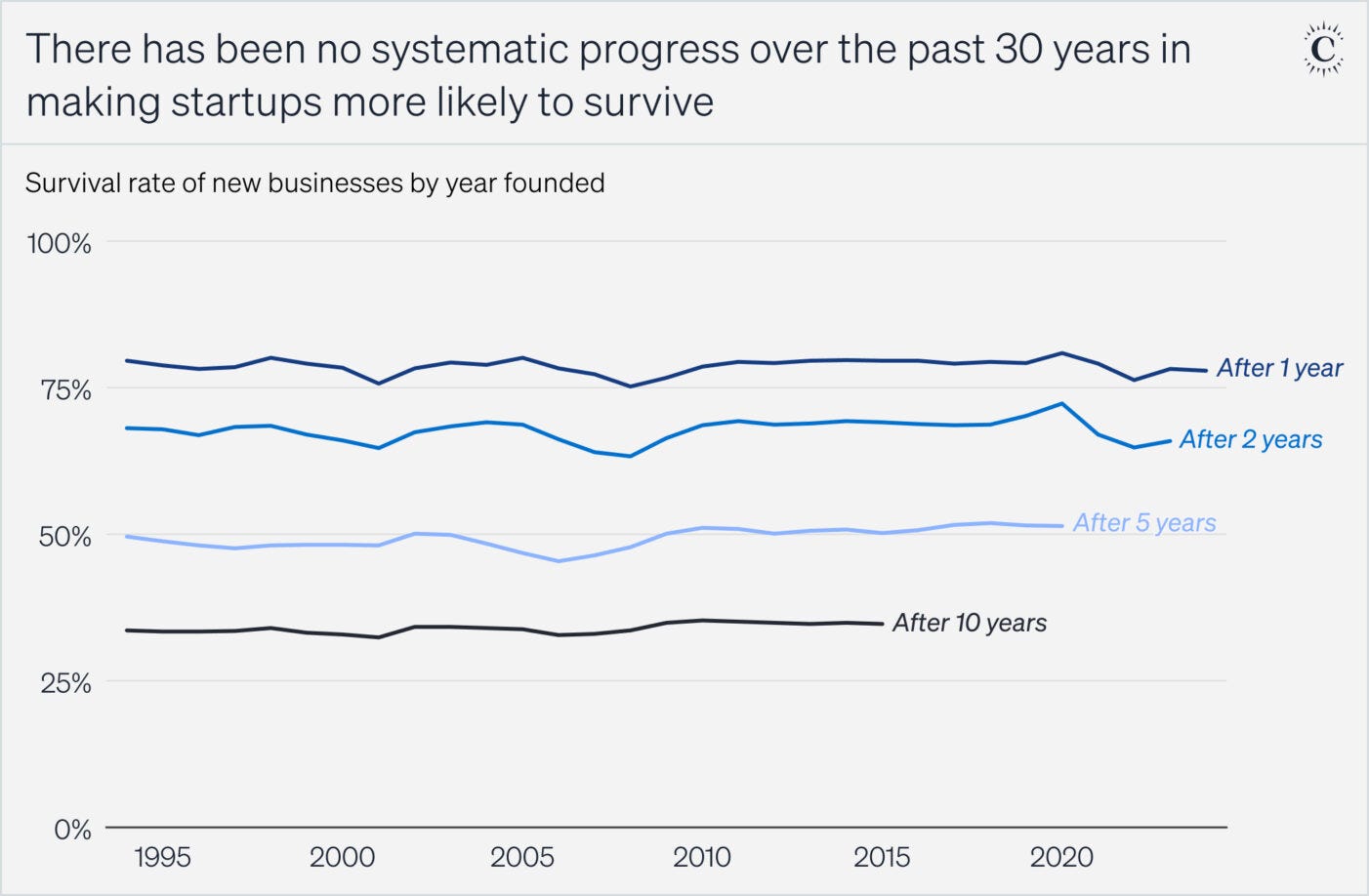
Neumann levels his critique against the claims of ‘startup science’:
The New Punditry’s advice was, instead, intuitively rational, apparently well-argued, and offered founders a step-by-step process for building a business amid real uncertainty. Steve Blank’s customer development method in The Four Steps to the Epiphany (2005), for example, taught founders to treat their business idea as a set of falsifiable hypotheses: get out of the building, interview potential customers, and validate or kill your assumptions before writing any code. Eric Ries’ The Lean Startup (2011) built on this with the Build-Measure-Learn loop: Launch a minimum viable product, measure real user behavior, and iterate rapidly rather than waste time perfecting a product no one wants. Osterwalder’s Business Model Canvas (2008) gave founders a tool to map the nine key components of a business model and pivot when something isn’t working. Design thinking, popularized by IDEO and Stanford’s d.school, emphasized empathy with end users and rapid prototyping to surface problems early. Saras Sarasvathy’s Effectuation Theory prescribed starting with a founder’s own skills and network rather than reverse-engineering a plan to meet a distant goal.
These pundits were consciously trying to build a science of entrepreneurial success. By 2012, Blank said that the National Science Foundation was calling his customer development framework “the scientific method for entrepreneurship,” and claimed that “we now know how to make startups fail less.” The official Lean Startup website claims that “The Lean Startup provides a scientific approach to creating and managing startups,” and the back cover of his book quotes Tim Brown, CEO of IDEO, saying Ries “proposes a scientific process that can be learnt and replicated.” Meanwhile, Osterwalder claimed in his PhD thesis that his Business Model Canvas is rooted in design science (the precursor to design thinking).
His basic conclusion is ‘if there’s one thing we know about startup punditry, it’s that it hasn’t worked’. The science preached by the pundits seems an illusion, and he wonders why [emphasis his]:
Behind these ideas, it seems inconceivable that they have not made a difference. And yet the data suggests that we have learned precisely nothing.
If we are ever to build a true science of entrepreneurship, we need to understand why. There are three possibilities. First, maybe the theories are simply wrong. Second, maybe the theories are so obvious that formalizing them was pointless. Or third, once everybody uses the same theories, maybe they stop conferring an advantage. Strategy is about doing something different from your competitors, after all.
Neumann sets about bursting all three of those bubbles. Most critically, perhaps, he argues that (a la Karl Popper) ‘a theory is scientific only if it can, in principle, be proven wrong’. Neumann points out that very few have applied this test to entrepreneurial innovation. But pundits aren’t motivated to test if their theories are right: ‘they make money and gain influence by selling books’.
The whole enterprise has the structure of what the physicist Richard Feynman called a “cargo cult science edifice that mimics the form of science without its substance, deriving rules from anecdotes without establishing underlying causality. Just because a handful of successful startups conducted customer interviews does not mean your startup will succeed if you do too.
Once again, this echoes Jill Lepore’s takedown of Christensen:
The handpicked case study, which is Christensen’s method, is a notoriously weak foundation on which to build a theory.
Strangely, Neumann’s essay never mentions Christensen’s disruptive innovation or Jill Lepore’s assertive rejection of its widespread adoption in business.
Lepore more or less sums up with this:
Disruptive innovation is a theory about why businesses fail. It’s not more than that. It doesn’t explain change. It’s not a law of nature. It’s an artifact of history, an idea, forged in time; it’s the manufacture of a moment of upsetting and edgy uncertainty. Transfixed by change, it’s blind to continuity. It makes a very poor prophet.
Pundits are not, then, prophets, and their theories go untested because they have no motivation to actually test them.
Emergent Discovery
I’ve written about Flagship Pioneering and their approach to innovation in biosciences several times. Noubar Afeyan and Gary P. Pisano published What Evolution Can Teach Us About Innovation4 in 2021. I continue to be surprised how little effect their approach has had outside of Flagship.
You might want to look at these two workfutures.io pieces: Emergent Discovery, or Applying Evolution To Innovation and Innovation: How Management Must Change in an Emergent Discovery Culture offer a good summary, starting with this from the first piece:
Noubar Afeyan and Gary P. Pisano have done us all a great service in describing in detail the techniques and philosophy behind the breakthroughs that Flagship Pioneering — the ‘venture-creation’ firm behind Moderna and 100 other life-sciences businesses — has created in applying Darwinian selection and variation to innovation. This technique is Emergent Discovery.
Unlike the charlatan pundits that Neumann and Lepore deride, emergent discovery is based on natural law: evolution. As the authors spell out:
Many people believe that the process for achieving breakthrough innovations is chaotic, random, and unmanageable. But that view is flawed, the authors argue. Breakthroughs can be systematically generated using a process modeled on the principles that drive evolution in nature: variance generation, which creates a variety of life-forms; and selection pressure to select those that can best survive in a given environment.
Maybe I should become an innovation pundit and write a book on how an emergent discovery approach could revolutionize other industries, not just biosciences?
