

If everyone is thinking alike, then no one is thinking.
| Benjamin Franklin
Out of the blue today I came across a Substack post by Maurizio Cuna (MC) with a somewhat misleading, clickbaity title: The exact 51 questions you can ask in any meeting when you are “not getting it”.
I clicked, and after scrolling past the title, I found something useful.
MC defines his idea — Precision Inquiry — this way:
Successful operators know that asking for clarification is an important tool of high-level execution: when you ask the question everyone else is too afraid to ask, you are both helping yourself and leading the entire conversation.
[…]
To help you navigate these moments with total confidence, I have curated 51 powerful questions categorized into 7 strategic frameworks.
He offers the questions in a tabular cheatsheet:
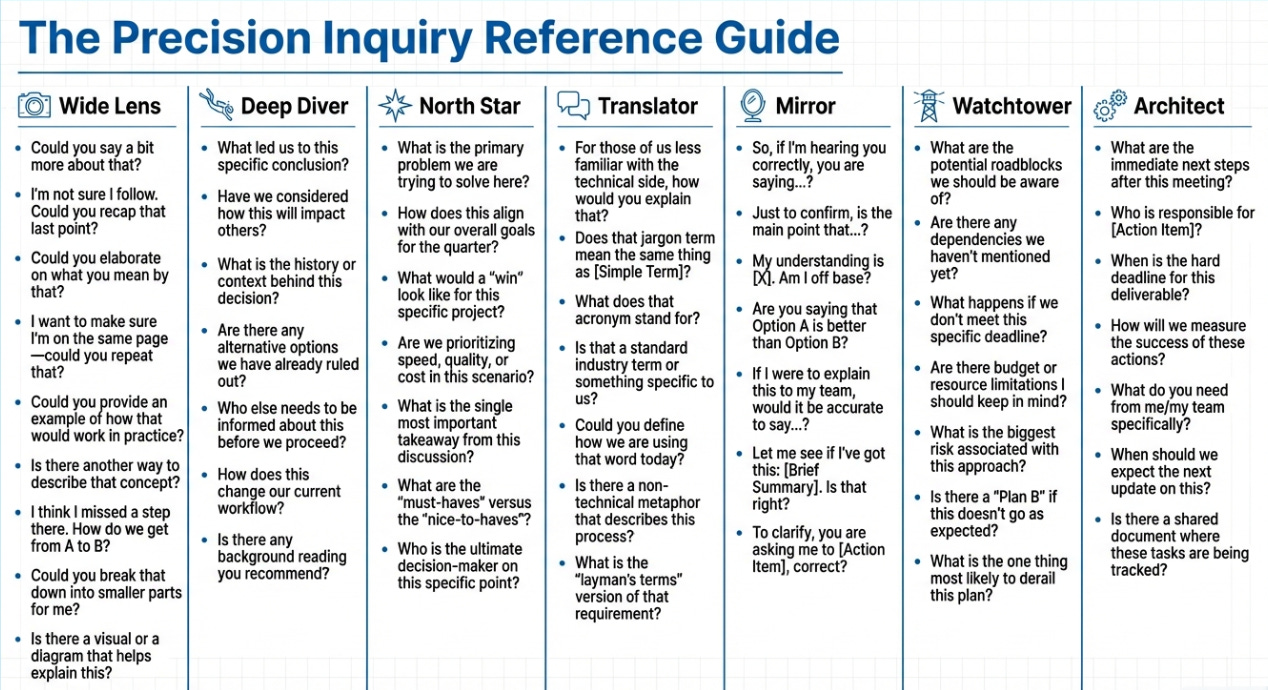
The cheatsheet drops out information that is quite helpful. Here’s his subtitle for the ‘Wide Lens’ category, parenthetically synonymed as ‘(General Clarification)’: ‘Pick one of these questions when the overall concept feels fuzzy and you need a high-level reset’.
My Recasting
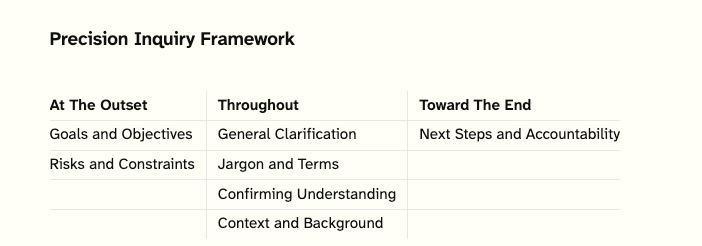
Rather than ‘the exact 51 questions’, it might be better to use these seven categories of questions as a framework with 51 examples. Also, it might be ‘one less thing’ to drop the ‘archetypes of inquiry’ — like ‘The Architect’ or The Translator’ — and just use the parenthetical categories. Also, I have sequenced a conceptual meeting1 into three phases: At The Outset, Throughout, Toward The End.
I find Cuna’s parenthetical categories more useful than the archetypes, and the subtitles (slightly revised) more useful than the categories. Also, in practice, consider the meeting timeline to discuss the status of a project plan or a company initiative.
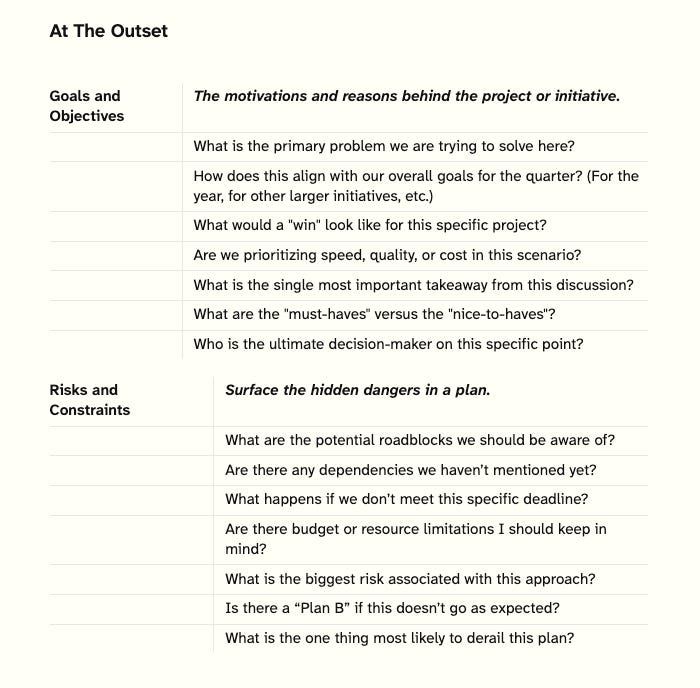
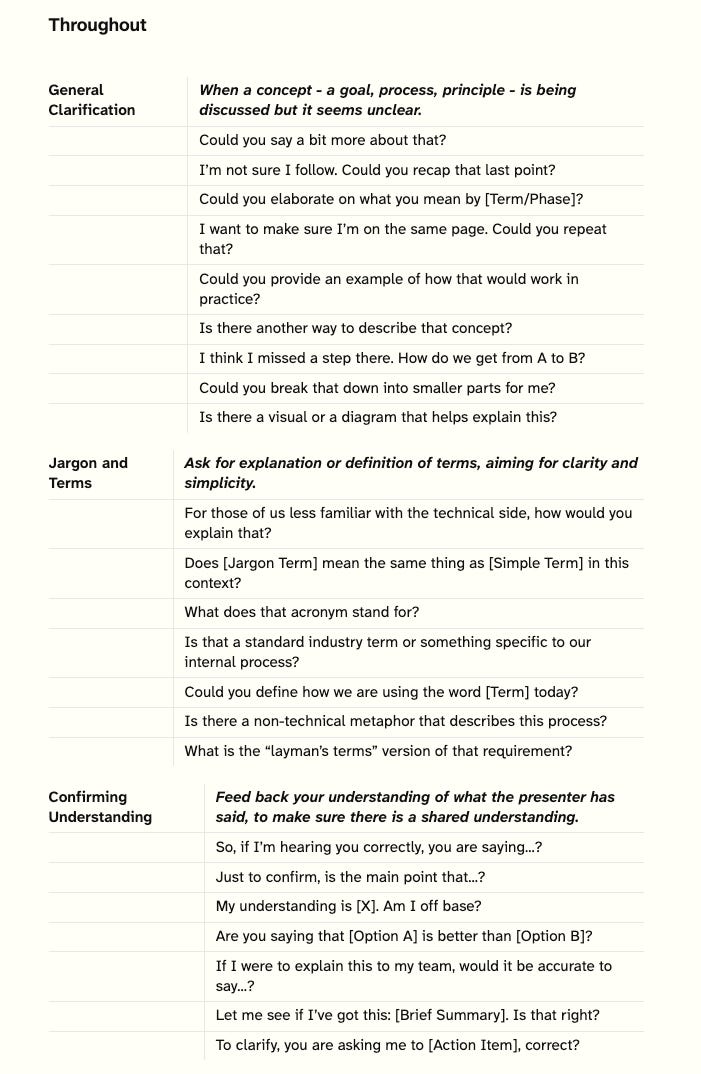
At the start, a presenter -- such as the person leading the project or initiative -- will likely lay out the purpose of the project, at which time questions about ‘goals and objectives’ are most salient. As the meeting progresses, other categories become relevant depending on the topic under discussion. When unclear jargon is used, ask questions to clarify the meaning of the jargon, for example, or if the presenter has not provided enough detail, or too much detail, feeding back your understanding could advance shared agreement on what is being said. As the meeting draws toward an end, next steps and accountability are called for before closing the meeting
So, here’s a different organization of the 7 categories, following that thinking:
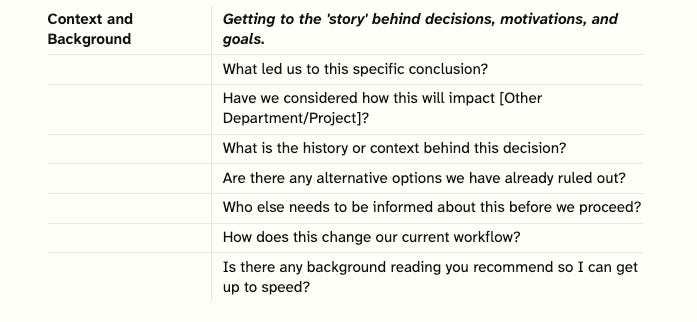
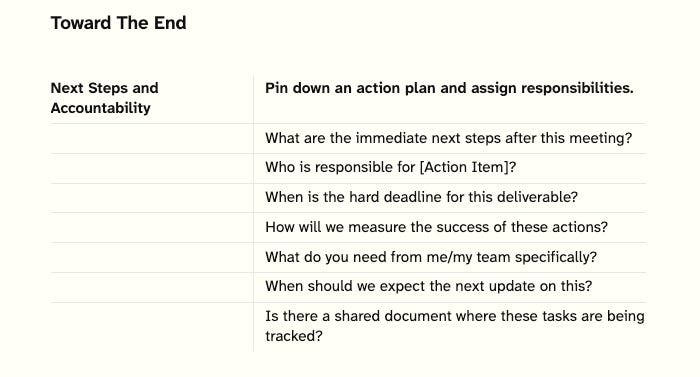
Feel Free
In practice, the three-phase model is just guidance. It may be appropriate to ask questions about goals at any phase, not just at the outset, but those questions may be more salient then. Likewise, the end of a meeting is not the only time to ask about responsibilities and next steps.
We owe a debt to Maurizio Cuna for his work, even though I stole it and redrafted it for my own purposes2. Artists steal, after all. Feel free to steal my version, too.
