

Every age, every culture, every custom and tradition has its own character, its own weakness and its own strength, its beauties and ugliness; accepts certain sufferings as matters of course, puts up patiently with certain evils. Human life is reduced to real suffering, to hell, only when two ages, two cultures and religions overlap. A man of the Classical Age who had to live in medieval times would suffocate miserably just as a savage does in the midst of our civilisation. Now there are times when a whole generation is caught in this way between two ages, two modes of life, with the consequence that it loses all power to understand itself and has no standard, no security, no simple acquiescence.
| Hermann Hesse
…
This such a time. And all living generations are caught in it, without security, without guide posts, without a standard. How to make sense of it?
I believe that in times of great insecurity, we each — as individuals, organizations, and societies — need to recommit to principles, to not just map a way out of the labyrinth, or simply hide amid the fog of confusion.
Principles for Times of Great Insecurity
Simone Stolzoff appeals1 to leaders (as is usual in Harvard Business Review: it’s always about leaders, not ordinary people) to develop ‘uncertainty tolerance’ as a ‘core skill’. He cites Airbnb CEO Brian Chesky responding to the uncertainties of the pandemic clarifying principles for the company’s way forward when travel came to an abrupt halt, and Airbnb lost 80% of its revenue:
Chesky knew this would be a period of unprecedented uncertainty for the company. So, one of the first things he did was create a list of four guiding principles for himself: Act fast, preserve cash, act with all stakeholders in mind, and play to win the next travel season.
In a crisis, “you make principle decisions, not business decisions,” he said, reflecting on what he learned. A business decision is “a decision predicting the best possible outcome. A principle decision is irrespective of the outcome.” These became Chesky’s anchors as he steered the company through 2020 to position it for success when the travel industry recovered. In December 2020, Airbnb went public, with a market capitalization of $86.5 billion after the first day of trading.
I especially like Chesky’s framing of principle decisions2, which is a term I have not heard before.
PS How uncertain are these times?
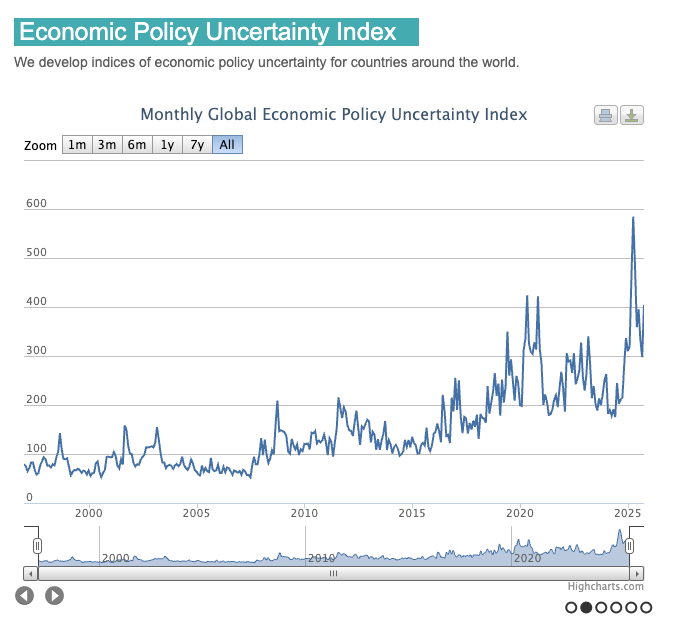
Uncertain Federal Science Funding
How deep have Trump’s cuts been?
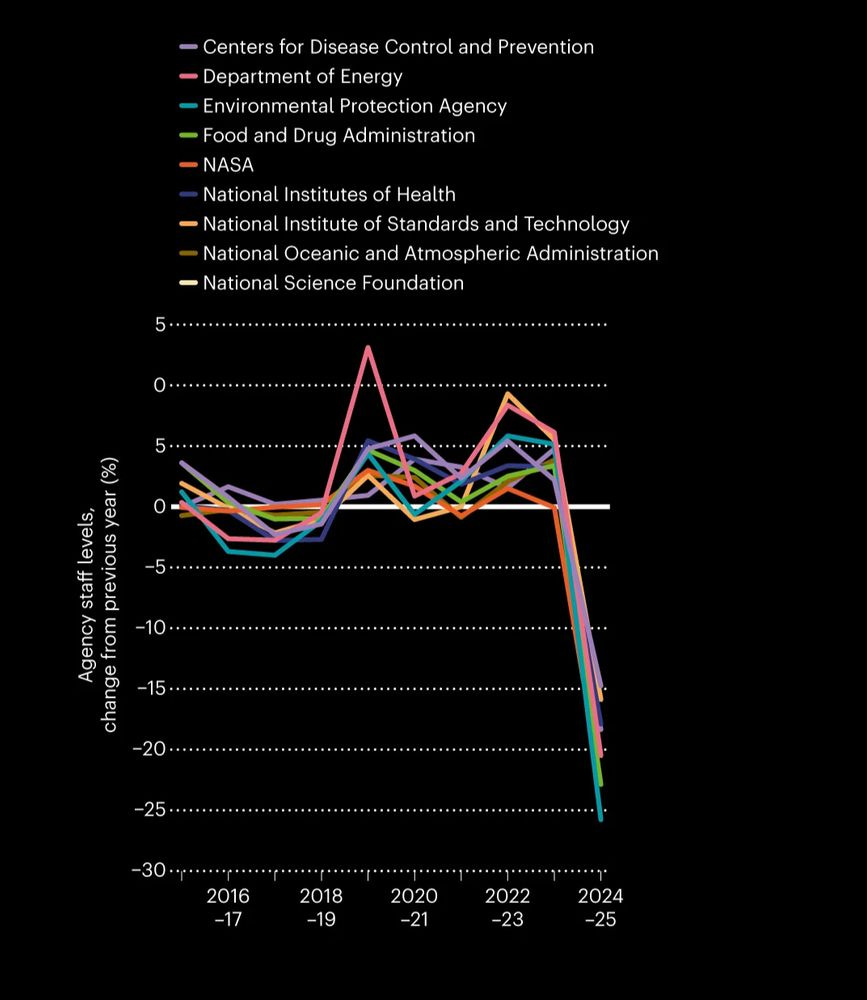
In total, federal science agencies lost about 20% of their staff in 2025 relative to the previous year, after modest increases over the past few years.
| Nature
Could take a generation to recover, if ever.
Uncertain of Their Future, New Zealanders Are Out-Migrating
Yan Zhuang and Tatsiana Chypsanava report on New Zelanders’ moving to Australia:
More than 71,000 New Zealand citizens left the country over the 12 months ending in October, far more than the roughly 26,000 who returned, according to official estimates. The outbound number — equivalent to more than 1 percent of the population of 5.1 million — is now the highest it has been since the aftermath of the 2008 global financial crisis.
More than half of New Zealanders who leave end up in neighboring Australia, a shortish flight away, where they can live and work indefinitely under a reciprocal visa arrangement.
By one HSBC estimate, New Zealand’s economy had the largest contraction in gross domestic product of any developed country in 2024.
The current unemployment rate of 5.3 percent is the highest in nearly a decade. Even those who have work are contending with reduced hours, wages that are growing more slowly than inflation and soaring costs of staples like bread and milk. Consumer confidence has not returned to prepandemic levels.
That’s more than 1% of the 5.1 million population moving away, mostly to Australia, who inherit well-educated workers, at basically no cost.
Meanwhile, many non-New Zealanders are moving to New Zealand — nearly 110,000 in the 12 months through October 2025 — more than the number of citizens leaving.
PS Bulgarians are doing the same thing, only more so:
Since it joined the EU in 2007, Bulgaria has suffered one of the biggest drops in population in the world, losing about 16% of its people as more than 1 million departed.
Bloomberg (via Adam Tooze)
National Manufacturing Uncertainty Made Local
Wonder why Marie Gluesenkamp Perez3, a Congresswoman from Washington state flipped Washington’s 3rd District in 2022 after a decade of Republican rule?
Washington State has lost roughly 19,000 manufacturing jobs between 2019 and 2023, the steepest drop in the country. Glusenkamp Perez’s politics are a quiet but forceful repudiation of the policies inflicted on districts like hers: factories offshored, wages flattened, families shoved into a gig economy that worships scale over craft. It is not the kind of “moderate” politics one finds in prosperous suburbs.
Co-owner of an auto repair shop (with her husband), she’s one to watch.
The Number: 27 Million
27 Million Fewer Car Trips: Life After a Year of Congestion Pricing | Emily Badger, Stefanos Chen, Winnie Hu, Asmaa Elkeurti, Larry Buchanan
Since congestion pricing began one year ago, about 11 percent of the vehicles that once entered Manhattan’s central business district daily have disappeared.
Fewer cars, faster traffic, higher speeds, more transit riders, better quality of life for residents.
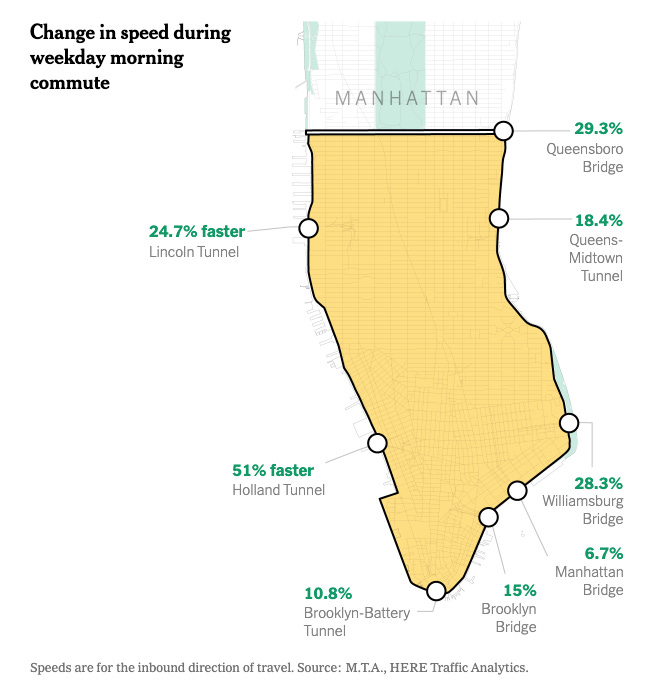
And many people were uncertain there’d be any benefits.
