

There are tranquil ages, which seem to contain that which will last forever. And there are ages of change, which see upheavals that, in extreme instances, appear to go to the roots of humanity itself.
| Karl Jaspers
Let’s see… what sort of age are we in, I wonder? And what did we think was looming over the horizon, twenty years ago?
…
For a variety of reasons — some of which I hinted at in previous posts — I have been pushed off my normal routines. Forgive my absence.
I’d really like readers to sign up for a paid annual subscription, so for the present time, I have dropped the annual subscription to $30. Note that I’ve also raised the monthly subscription to $10 from $6. Give annual a try. The biggest value is years of posts behind the paywall, and of course, seeing new posts in their entirety. I rely on your support, so thanks.
Short Takes
‘Dating’ at work?
Juno Kelly reports:
More than 90 percent of people who have had sex with a colleague didn’t regret it.
Higher than I would have expected.
…
But, meanwhile, no hugging.
Just 29% of Gen Z workers say casual hugs are acceptable in the workplace, while 28% say colleagues should stick to handshakes only, and 4% say there should be no touching at work, according to a survey from EduBirdie, an online writing service.
Well, no ‘casual’ hugs.
…
Americans can’t find jobs.
Americans can’t find jobs.
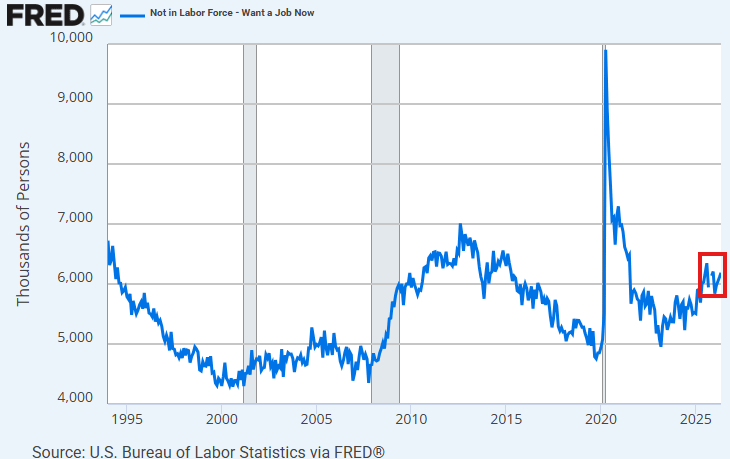
The number of Americans not in the labor force who currently want a job rose +76,000 in May, to 6.2 million, the 3rd-highest since July 2021.
These are people who are not officially part of the labor force, meaning they are not actively looking for work, but say they want a job.
This marks the 4th consecutive monthly increase, totaling +349,000.
Since March 2023, this figure has surged by +1.2 million people and is now above 2008 Financial Crisis levels.
As a % of total employment, this metric is up to 3.8%, the 2nd-highest since October 2021.
By comparison, the 2001 recession and the 2008 peaks were 3.6% and 4.3%.
Labor market conditions are deteriorating beneath the surface.
…
A China wind is blowing.
Keith Bradsher, Qilai Shen report on China’s dominance in wind power:
Last year, China installed three times as much wind power capacity as the rest of the world combined, even as its turbine exports jumped. The global industry’s center of gravity has shifted decisively: All of the world’s six largest wind turbine manufacturers are Chinese, displacing once-dominant European firms and companies like General Electric.
Elsewhen
Because of changes in my work process, I have been uncovering and re-exploring old materials. I thought I’d share some things from the archive that were predictions or pronouncements about the future of work, and which largely haven’t panned out.
…
How Anti?
Reading Even With a Dream Job, You Can Be Antiwork1, by Farhad Manjoo, is a dizzying experience, since it was written in 2021, when employers were hiring like mad, and workers felt like the balance of power had shifted:
The world’s long-suffering workers have finally gained some measure of leverage over their bosses, and their new power is a glorious thing to behold.
In South Korea this week, tens of thousands of union members staged a one-day strike to demand better benefits and protections for temporary and contract workers. In Britain, where Brexit has contributed to severe shortages of goods and labor, Boris Johnson, the prime minister, has been taking dubious credit for what he calls a new era of higher pay.
And in the United States, a record nearly 4.3 million people quit their jobs in August, according to the Labor Department, and more than 10 million positions were vacant — slightly down from July, when about 11 million jobs needed filling. The shortage of workers has led to a growth in wages that has surpassed many economists’ expectations, and seems to have discombobulated bosses who are used to employees leaping at their every demand.
How things have changed, in this brave new world.
Manjoo borrowed ‘antiwork’ from kathi weeks, the originator of the term, who shared this with him:
“The pandemic gave us a kind of forced separation from work and a rare critical distance from the daily grind,” Kathi Weeks, a professor of gender, sexuality and feminist studies at Duke University, told me. “I think what you’re seeing with people refusing to go back is a kind of yearning for freedom.”
And remember the surge in Reddit’s /antiwork?
You can get a peek of a post-job world at /antiwork, a Reddit forum “for those who want to end work” that has gone viral in recent months, with hundreds of thousands following its subversive cause. /antiwork teems with posts from workers who are mad as hell and are not going to take it anymore — including many screenshots from folks saying they are telling off their managers, quitting in a rage after years of abuse.
That rage has died down, a few years later (which seems like a lifetime, nowadays), now that we are in the ‘hire slow, fire slow’ era, and people are hunkered down, hoping to weather the storm of the 2020s economy.
Manjoo lands on a relatively mild and uninsightful truism:
Even a dream job is still a job, and in America’s relentless hustle culture, we have turned our jobs into prisons for our minds and souls. It’s time to break free.
Break free of what? Like most of those living inside the prison of work, he still wants to make it a personal quest, like people thinking they have to become more resilient instead of smashing the machinery that’s driving them like chattel.
…
The edge of chaos.
In 1999, Richard Pascale wrote Surfing on the Edge of Chaos2, making the argument that we were — then — entering a new era of ‘management science’.
I started out dubious, since he refers to the era immediately preceding — Michael Porter’s Five Factors and Competitive Advantage, and other now discredited models — as the ‘strategic era’. (At least he left out Clay Christensen’s Disruptive Innovation baloney.)
He states, [emphasis mine],
During the 1980s and 1990s, performance improvement (e.g., total quality management, kaizen, just-in-time, reengineering) succeeded the strategic era. It, too, has followed the S-curve trajectory. Now, as it trails off, an uneasiness is stirring, a feeling that “something more” is required. In particular, disquiet has arisen over the rapidly rising fatality rates of major companies. Organizations cannot win by cost reduction alone and cannot invent appropriate strategic responses fast enough to stay abreast of nimble rivals. Many are exhausted by the pace of change, and their harried attempts to execute new initiatives fall short of expectations.
The next point of inflection is about to unfold. To succeed, the next big idea must address the biggest challenge facing corporations today — namely, to dramatically improve the hit rate of strategic initiatives and attain the level of renewal necessary for successful execution. As in the previous eras, we can expect that the next big idea will at first seem strange and inaccessible.
So, did the unnamed ‘It’ succeed?
He names it: complex adaptive systems.
“Unlike the earlier advances in hard science,” writes economist Alex Trosiglio, “complexity deals with a world that is far from equilibrium, and is creative and evolving in ways that we cannot hope to predict. It points to fundamental limits to our ability to understand, control, and manage the world, and the need for us to accept unpredictability and change.
He spends a great many paragraphs outlining the interconnected notions of complexity, complex adaptive systems, and emergence. And while I confess that I was one of many who likewise looked to that body of science for insight and understanding for the world of work, my judgment in 2026 is that it has not meaningfully percolated into the average Fortune 1000 company, nor has it notably formed a new ‘era’ for management strategy that had moved into wide use. There may be a large cadre of consultants, academics, and even within-the-walls-of-the-corporation practitioners, but it is hard to see foundational change in management thinking across the board, alas.
His characterization of ‘old’ management approaches sound a lot like today’s management approaches:
As executives move up in organizations, they become removed from the work that goes on in the fields. Directives from the top become increasingly abstract as executives tend to rely on mechanical cause-and-effect linkages to drive the business: strategic guidelines, head-count controls, operational expense targets, pay-for-performance incentives, and so forth. These are the tie rods and pistons of “social engineering” — the old model of change.
